The war in Ukraine has now entered its fifth year. Russian commanders are relearning, at catastrophic cost, lessons that were written in blood between 1939 and 1945. Ukrainian drone operators are improvising kill chains that would have impressed Heinz Guderian, a major architect of German armored warfare. NATO logistics planners are revisiting problems that would have been familiar to SHAEF planners in 1944. And in the Taiwan Strait, military wargames continue to produce scenarios that raise many of the same questions about logistics, airpower, maritime operations, and coalition warfare that confronted planners in the Pacific theater. Recent disruption around the Strait of Hormuz and attacks affecting shipping through the Red Sea have also shown how vulnerable modern economies and military operations remain to the security of major maritime routes. The lessons WWII encoded into modern conflict are not archival curiosities. They are operational realities appearing in battlefield adaptation, procurement decisions, and alliance planning. The technologies have changed, but many of the strategic problems remain recognizably similar to those faced during World War II.

The Normandy coast at Pointe du Hoc, where Allied forces scaled 100-foot cliffs on June 6, 1944 — a reminder that strategic planning ultimately meets human terrain.
1. The Danger of Fighting the Last War
France spent the interwar years building the wrong fortress. The Maginot Line, roughly 280 miles of reinforced concrete, retractable gun turrets, and underground railways, was an engineering marvel designed around lessons drawn from the First World War. French military doctrine in 1940 emphasized static defense, firepower superiority, and the expectation that a major German attack would come through Belgium. The Ardennes, meanwhile, was treated as difficult terrain and given less defensive weight. German forces broke through at Sedan in May 1940 and drove rapidly into the Allied rear. Erich von Manstein and the Wehrmacht drove through it in three days.
The Fall of France in May and June 1940 was not a failure of courage. French and British forces actually fielded more tanks than Germany, but much of the Allied armor was dispersed among infantry formations, while the Germans concentrated their panzer divisions at critical points and employed them as part of combined-arms formations. French command and control was also slower and less flexible, while German units made extensive use of radio communications. The result was a rapid operational collapse that left more than 300,000 Allied troops trapped around Dunkirk and forced into evacuation.
The lesson is not complicated, but it is rarely applied: armies that optimize for the last conflict lose the first battle of the next one.
This failure repeats itself with extraordinary reliability. American planners entering Iraq in 2003 were heavily prepared for a conventional campaign, but the conflict quickly became an insurgency that required major doctrinal adaptation. The U.S. Army began revising its counterinsurgency guidance in 2004, and the joint FM 3-24 manual followed in 2006. Today, the risk is structural again. Several major militaries continue to operate expensive legacy platforms such as main battle tanks, fixed-wing aircraft, and large surface combatants while adversaries increasingly field cheap, networked drone systems in large numbers. Ukraine’s battlefield has demonstrated that relatively inexpensive FPV drones can threaten armored vehicles costing vastly more. RUSI estimates that an FPV fitted with an anti-tank grenade can cost roughly $800 to $1,800, although effectiveness depends heavily on electronic warfare, reliability, operator skill, and target conditions. The ratio is not a tactical curiosity. It is a procurement question that military planners can no longer ignore.
2. Logistics Wins Wars — Napoleon Knew It, Hitler Forgot It
Operation Barbarossa launched on June 22, 1941, with more than 3.5 million Axis troops crossing the Soviet frontier in the largest military operation in history. By December of that year, the Wehrmacht had advanced hundreds of miles, suffered enormous casualties, and was already facing serious logistical limitations. The German railway system used standard European gauge, while Soviet railways used a broader gauge, forcing the Germans to convert captured lines before they could be fully used. Trucks designed for European roads struggled on Russian mud tracks. And the fuel arithmetic for the advance to Moscow simply did not add up, a problem that German planners had identified before the campaign but failed to resolve.
At Stalingrad in the winter of 1942–43, the forces trapped in the pocket required at least 300 tonnes of supplies per day, with roughly 600 tonnes considered desirable to sustain operations. The Luftwaffe’s air bridge, despite Hermann Göring’s assurances, delivered an average of only about 94 tonnes daily. Around 330,000 Axis personnel were trapped when the Soviet encirclement closed in November 1942. By the surrender in February 1943, roughly 91,000 Germans were taken prisoner. The rest had been killed, wounded, or died from starvation, disease, and the extreme cold. Napoleon had faced the same fundamental problem on this geography 130 years earlier. Hitler’s generals understood the logistical dilemma in 1941 as well. The political leadership chose not to act on it.
Omar Bradley, the U.S. First Army commander, stated plainly after the war: “Amateurs talk strategy. Professionals talk logistics.”
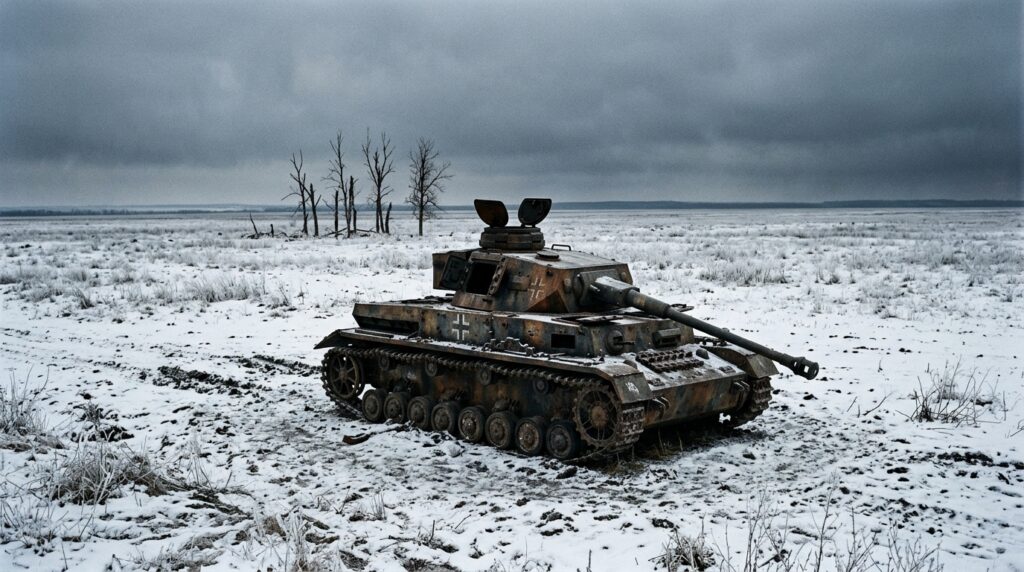
A knocked-out German Panzer lies abandoned on the Eastern Front — testament to a supply chain that could not keep pace with strategic ambition.
The parallels for contemporary military planners are not abstract. China’s anti-access/area-denial strategy in the Western Pacific is designed to complicate American power projection at distance, using long-range systems such as the DF-21D and DF-26 to threaten naval forces and other targets. NATO’s eastern flank presents a different but equally serious problem. A conflict involving the Baltic states would require sustaining and reinforcing heavy forces across the Suwalki Gap, the narrow land connection between Poland and Lithuania. NATO and allied studies have repeatedly identified logistics, infrastructure, and supply-chain resilience as major challenges on the eastern flank. Ukraine has exposed the same problem from another direction. The war’s enormous consumption of ammunition has strained Western stockpiles and forced NATO members to expand production and replenish their own reserves. Drone warfare has added another logistical variable, with large numbers of relatively inexpensive systems and high ammunition consumption placing additional demands on supply chains.
3. Air Superiority Is Not Optional
On September 15, 1940, the Royal Air Force Fighter Command faced one of the Luftwaffe’s largest assaults of the Battle of Britain. By the end of the day, the German attack had failed to break Fighter Command, and the date became known as Battle of Britain Day. Air Chief Marshal Hugh Dowding’s decision to preserve Fighter Command’s strength, combined with Keith Park’s tactical management of 11 Group and the wider Dowding System, helped Britain withstand the Luftwaffe’s offensive. Churchill’s tribute to the aircrew, “Never in the field of human conflict was so much owed by so many to so few,” is quoted so often that its strategic significance can be overlooked. Without air superiority over the Channel and southern England, the Wehrmacht would have crossed. Britain would have fallen. The United States would have had no Atlantic base from which to project force into Europe.
The Luftwaffe’s failure was not primarily a technical one. German aircraft and pilots were, in several respects, superior to their RAF counterparts in the summer of 1940. The German Me 109E fighter had a higher operational ceiling and a faster rate of climb than the Hawker Hurricane, giving German pilots an important performance advantage in combat. The failure was doctrinal and strategic. Hermann Göring’s decision in late August 1940 to shift the main effort from RAF airfields and radar infrastructure to London was one of the most consequential decisions of the campaign. The attacks on Fighter Command’s airfields had placed 11 Group under severe pressure, but Britain’s integrated air defense system was still functioning. The shift to London gave Fighter Command valuable breathing space at precisely the moment German pressure was becoming most dangerous. Albert Kesselring could target cities, but the Luftwaffe could not maintain the same pressure on Fighter Command’s ability to regenerate while doing so.
The lesson has become part of modern joint doctrine, but it is under new stress. Modern contested airspace, shaped by long-range surface-to-air missile systems such as the Russian S-400 and Chinese HQ-9, means that traditional air superiority operations now face layered and overlapping air-defense networks. The F-35 program, whatever its cost and schedule difficulties, reflects the growing importance of stealth, sensor fusion, and information advantage in penetrating and surviving these environments. In Ukraine, neither Russia nor Ukraine has established sustained air superiority over the battlefield. Both sides have retained substantial air-defense capabilities, while electronic warfare and long-range weapons have further complicated air operations. The result is a prolonged state of contested airspace that limits the ability of either side to use airpower freely. That constraint affects ground maneuver, logistics, and fire support, making control of the air a central consideration in future force planning.
4. Intelligence Decides Battles Before They Begin
By the spring of 1944, Allied intelligence had been reading German military communications for nearly four years. The Bletchley Park operation, code-named Ultra, had cracked the Lorenz cipher and multiple versions of the Enigma machine, delivering to Eisenhower a level of battlefield awareness that no commander in history had previously possessed. Ultra intercepts confirmed that German High Command had accepted the Allied deception plan, Operation Bodyguard, and genuinely believed the main D-Day landing would come at Pas-de-Calais rather than Normandy. Hitler held the 1st SS Panzer Corps in reserve for six critical weeks after June 6, 1944, waiting for a second landing that never came. That decision cost Germany any realistic chance of throwing the Allies back into the Channel.
The Pacific theater offers a parallel that is, in some ways, even more striking. In the days before the Battle of Midway in June 1942, Pacific Fleet intelligence officer Joseph Rochefort and his team at Station HYPO had broken enough of the Japanese JN-25 cipher to identify the target of Admiral Isoroku Yamamoto’s offensive as “AF,” believed to be Midway. To confirm this, Lieutenant Jasper Holmes proposed that Midway transmit a false radio message reporting a freshwater plant failure. Within forty-eight hours, Japanese naval signals reported that “AF” was short of fresh water. Chester Nimitz now knew where and approximately when the Japanese carrier force would appear. He positioned his three carriers, Enterprise, Hornet, and Yorktown, accordingly. The Japanese lost four fleet carriers during the battle, making Midway a decisive turning point in the Pacific War. The balance of power in the Pacific shifted permanently in one afternoon.

The Bletchley Park codebreaking facility in Buckinghamshire, England — the intelligence operation that arguably shortened World War II by two years.
The architecture of modern intelligence has changed beyond recognition since 1944, but the underlying logic has not. The NSA’s SIGINT apparatus, imagery analysis from NRO satellites, and AI-driven pattern recognition systems give American and allied commanders an intelligence advantage that Ultra’s architects would have found almost incomprehensible in scale. But Bletchley Park also teaches the limit of that advantage: intelligence is only decisive when commanders trust it and act on it. At Arnhem in September 1944, British intelligence identified evidence of German armored forces in the Arnhem area. Field Marshal Bernard Montgomery’s intelligence staff received warnings, and British intelligence officer Brian Urquhart raised the alarm. He was placed on medical leave, but Operation Market Garden proceeded, failed, and cost more than 17,000 Allied casualties. The intelligence was right. The institutional response was wrong. In 2025, cyber intelligence, SIGINT intercepts, and AI-generated battlefield assessments face the same structural problem: the human decision loop has to be willing to hear what the data says. Ukrainian forces have leveraged commercial satellite imagery and open-source intelligence, or OSINT, with a sophistication that professional intelligence agencies initially underestimated. The lesson from Rochefort and Bletchley Park is not that intelligence wins wars. It is that intelligence, correctly trusted and rapidly acted upon, makes strategic options available that were otherwise impossible. This is one of the war lessons WW2 encodes most clearly: institutional culture can neutralise the best intelligence in the world.
5. Coalition Warfare Requires Political Mastery
The alliance that defeated the Axis powers was held together by shared necessity and almost nothing else. Winston Churchill, Franklin Roosevelt, and Joseph Stalin met in person only twice during the war at Tehran in November 1943 and at Yalta in February 1945. Between those meetings, the three leaders managed a coalition that contained, among other fundamental tensions, Churchill’s visceral anticommunism, Stalin’s paranoid conviction that the Western Allies were deliberately delaying the second front to bleed the Soviet Union dry, and Roosevelt’s patrician belief that personal charm could substitute for binding commitments. The coalition survived because all three men understood that the alternative was losing. That clarity of purpose substituted for trust.
The near-fracture points were multiple and serious. After the fall of Singapore in February 1942, Churchill faced a Parliament that was questioning his continued leadership. Stalin’s demands for a second front in France reached a pitch by 1942 that amounted to a diplomatic ultimatum. The British decision, supported by Roosevelt over the objections of Generals Dwight Eisenhower and George Marshall, to pursue the North African and Mediterranean campaigns before Overlord — a strategy the Americans privately called “peripheral strategy” — came within a narrow margin of rupturing American confidence in British commitment. It is a historical footnote worth sitting with: the alliance that won the Second World War came within shouting distance of strategic paralysis at several points between 1941 and 1944.
NATO faces no such existential pressure in 2026, which is precisely what makes its coalition management harder, not easier. The Article 5 guarantee commits all members to assist an Ally that suffers an armed attack, but each Ally determines what action it deems necessary, making consultation and political coordination essential. Hungary’s repeated opposition to some Ukraine-related measures inside EU channels is a structural echo of wartime coalition friction, absent the shared mortal stakes that eventually compelled cooperation. The burden-sharing debate is also continuing, although the benchmark has changed substantially: at the 2025 Hague Summit, NATO allies committed to reach 5% of GDP in defence and defence-related spending by 2035, rather than the earlier 2% benchmark. Eisenhower’s gift, which the historical record underplays, was not simply battlefield brilliance but political management: the ability to keep Montgomery, Patton, de Gaulle, and the Combined Chiefs of Staff functioning as a broadly coordinated instrument. Military planners today need political skills on the same order, which is a job description that military professional education has historically been reluctant to teach.
6. The Civilian Will to Fight Is a Military Asset
German strategic planners in 1941 operated on a theoretical framework broadly shared across the Wehrmacht’s senior leadership that held Soviet society to be a brittle, multi-ethnic construction that would fracture under sufficient military shock. The concept was embedded in the Barbarossa planning assumptions: destroy enough Red Army units fast enough, and civilian morale would collapse, political authority would disintegrate, and the Soviet state would implode much as Tsarist Russia had in 1917. By the autumn of 1941, Army Group Center was within sight of Moscow’s church spires. The Soviet state did not implode.
The siege of Leningrad lasted 872 days, from September 1941 to January 1944. At its worst point, the civilian population was surviving on 125 grams of bread per day. An estimated 800,000 civilians died of starvation, cold, and bombardment. The city did not surrender. The Leningrad Front did not collapse. Soviet industry also proved capable of surviving the loss of enormous amounts of territory. Much of Leningrad’s industrial capacity, along with hundreds of thousands of inhabitants, was evacuated eastward, while factories across the Soviet Union were dismantled and relocated to safer regions. By 1943, Soviet military production had recovered dramatically and was producing enormous quantities of tanks, aircraft, and other weapons despite the occupation of major industrial regions. This was not what the Barbarossa planners had predicted.
The British home front tells a version of the same story. The Blitz killed approximately 44,000 British civilians between September 1940 and May 1941. German bombing strategy increasingly aimed to damage Britain’s war economy, weaken resistance, and ultimately force Britain toward submission. Instead, the bombing failed to produce the collapse in civilian morale that German planners hoped for. The British government had also feared a major psychological crisis: pre-war assessments had estimated that psychiatric casualties could outnumber physical casualties by three to one. The anticipated mass psychiatric collapse did not occur. People proved more resilient under sustained bombardment than many military and civilian planners had predicted.
This counterintuitive lesson plays directly into 2026’s most consequential military equation. Ukraine’s civilian resistance since February 24, 2022, repeatedly defied Russian planning assumptions centered on rapid political and administrative collapse. Those assumptions, it should be noted, were also reflected in some Western intelligence assessments in the conflict’s opening hours, which anticipated that Kyiv could fall within days. Taiwan’s civil defense preparations, accelerating since 2022, reflect a direct institutional acknowledgment of this lesson. The island’s “whole-of-society defense resilience” approach brings together civilian mobilization, critical infrastructure protection, medical preparedness, and continuity of government rather than treating civilian resilience as a passive asset waiting to be protected. NATO’s current resilience doctrine similarly emphasizes a whole-of-government and whole-of-society approach, recognizing that civilian infrastructure, services, and populations are integral to sustaining military operations during crisis and conflict.
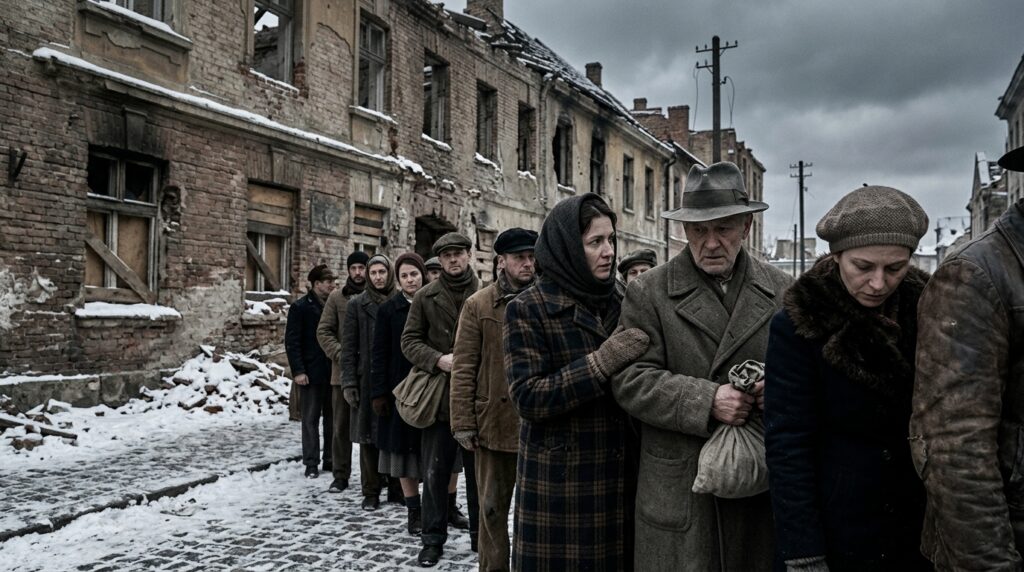
Women and children line up for food rations in besieged Leningrad, winter 1941–42 — a civilian population that endured 872 days of siege and never surrendered.
7. Technological Advantage Must Be Exploited Decisively
The Tiger I heavy tank entered combat with the Wehrmacht on the Eastern Front in August 1942. Armed with the 88mm gun and protected by armor that contemporary Allied anti-tank weapons could not reliably penetrate at typical combat ranges, it was among the most capable tanks on the battlefield in 1942 and 1943. Germany also fielded the world’s first operational jet fighter, the Messerschmitt Me 262, in 1944, while the Gloster Meteor entered RAF service in July of the same year. The V-2 ballistic missile, developed under Wernher von Braun at Peenemünde, was a technological leap that directly influenced the postwar development of ballistic missiles and space-launch vehicles in both the United States and Soviet Union. Germany had, in 1944, technologically advanced tanks, jet aircraft, and ballistic missiles.
The Tiger was produced in such small numbers, 1,347 in total across the war, that it could not alter the broader operational balance against a Soviet Union fielding thousands of T-34s. The Me 262 was affected by prolonged jet-engine development problems, while Hitler’s December 1943 order to emphasize the aircraft’s fighter-bomber variant diverted part of its production from the fighter role. By the time the Me 262 entered operational service in 1944, production shortages, fuel shortages, Allied attacks on its airfields, and the deteriorating training situation of the Luftwaffe severely limited its impact. The V-2 program consumed enormous amounts of resources and engineering effort, yet its wartime military effect was limited relative to that investment. The superweapon impulse, the belief that a single transformative technology can substitute for mass, logistics, and doctrine, did not produce the decisive results its proponents expected. The lesson from Germany’s experience is not that advanced weapons are useless. It is that technological superiority matters only when a weapon can be produced at scale, supplied in the field, and integrated into an effective military system.
This lesson has direct application to procurement debates that are happening right now. Hypersonic weapons such as the Russian Kinzhal, the Chinese DF-17, and the American Dark Eagle are moving from development toward operational use, but advanced capability does not eliminate the problems of testing, production, cost, sustainment, and integration. The U.S. experience with hypersonic programs has also shown how development schedules and acquisition challenges can complicate the path from prototype to fielded capability. Autonomous drone swarms are theoretically transformative but still face significant challenges in coordination, survivability, electronic warfare, and reliable operation at scale. AI-enabled command and control systems promise to compress decision cycles but require secure networks, data, computing infrastructure, and trained personnel that do not yet exist at scale across most militaries. Military planners who stake operational strategies on capabilities that exist only in prototype form risk repeating the central mistake of Germany’s 1944 technology portfolio without the engineering advantages that partially offset it. The lesson from Germany’s advanced weapons programs is not that sophisticated weapons are useless. It is that a weapons system that cannot be produced at operational scale, maintained in the field, and integrated into combined-arms doctrine is a technological achievement, not yet a military capability. The distinction matters, and procurement culture can confuse the two.
8. The Iran-Israel-US War of 2026 — WW2 Lessons in Real Time
The escalation between Israel and Iran began entering a new phase in June 2025, when Israel launched major strikes against Iranian military and nuclear targets and Iran responded with missile and drone attacks. The United States joined the fighting on June 21–22, striking Iranian nuclear facilities before a ceasefire ended the 12-day war. Hostilities escalated again on February 28, 2026, when the United States and Israel launched a major new campaign against Iran. The resulting conflict has become a live test of many of the military lessons examined in the preceding sections. Long-range strikes, missile and drone warfare, air and missile defense, intelligence, logistics, maritime security, and coalition warfare are all being tested simultaneously. What is unfolding in the Persian Gulf, the Strait of Hormuz, and across the regional network extending from Yemen to southern Lebanon is not a new kind of war. It is an old kind of war wearing new technology, and the war lessons WWII produced have never been more directly applicable to a live operational environment.
The Maginot Line problem showed up in different forms on both sides. Iran’s long-term strategy for deterring Israel and the United States relied partly on a combination of its own missile forces and a regional network of armed partners, often described as the “Ring of Fire.” Hezbollah accumulated a large arsenal of rockets and other standoff weapons in Lebanon, while Iran developed a substantial ballistic- and cruise-missile force and supplied missiles and drones to partners in Yemen, Iraq, Lebanon, and elsewhere. The underlying logic was deterrence through the ability to impose costs across multiple fronts. But the 2024–26 conflict has demonstrated the limits of that strategy as well as the limits of the opposing side’s defenses. Israeli and U.S. strikes have damaged Iranian air-defense, missile, and military infrastructure, while Iran has continued to launch missiles and drones against Israel and U.S. positions across the region. Israeli air defenses, including systems designed to intercept ballistic missiles, have successfully stopped many attacks but have also failed to intercept some missiles, including strikes that caused significant damage in Arad and other locations. Iran has likewise attacked U.S. military facilities in Kuwait, Bahrain, Jordan, and elsewhere, while many of those attacks were intercepted or caused limited damage. The result is a reciprocal contest in which neither side has been able to make itself completely immune from attack. The deeper WWII lesson is therefore not simply that one side’s defensive system failed. It is that fixed assumptions about deterrence and protection can break down when an adversary adapts, saturates defenses, finds gaps, and accepts the cost of repeated attacks.
The logistics dimension is exposing vulnerabilities on both sides. Iran’s forward military network historically depended on supply routes running through Iraq and Syria toward Lebanon, while weapons and other support also moved toward partners elsewhere in the region. Israel has repeatedly targeted weapons depots, convoys, and transit routes in Syria in an effort to disrupt that network, and Hezbollah’s losses during the earlier fighting have significantly reduced the size of the arsenal it can rely on. But the logistics burden is not one-sided. Israel and the United States are conducting sustained air and naval operations across a wide geographical area, consuming large quantities of precision weapons and air-defense interceptors and requiring continuous resupply from outside the immediate theater. The United States has already moved to accelerate production of AMRAAM, Patriot, and SM-6 missiles as its stocks have been depleted by operations in the Middle East and support for other conflicts. The Strait of Hormuz has added another layer of complexity by disrupting commercial shipping and regional fuel logistics. The parallel with Stalingrad is therefore not that Iran’s forces are simply waiting for an air bridge that cannot arrive. The broader lesson is that modern warfare can exhaust logistics faster than battlefield success can compensate for it, and even a technologically superior coalition must continually replace missiles, aircraft, fuel, spare parts, and other critical supplies.
Intelligence has again proven to be the sharpest instrument on the battlefield. Israeli intelligence had spent years studying Hezbollah’s communications, command structure, and procurement networks, and the pager and walkie-talkie attacks of September 2024 demonstrated what that access could achieve. Thousands of communication devices were secretly compromised and detonated, severely disrupting Hezbollah’s internal communications and exposing vulnerabilities in its procurement and security procedures. Israel has not publicly confirmed responsibility for the operation, and reports have attributed different roles to Mossad and Unit 8200, but the operation clearly demonstrated the military value of penetrating an adversary’s supply chain and communications architecture. The parallel to Midway is not literal, but the principle is similar: intelligence developed patiently can become strategically decisive when it is converted into action at the right moment. At the same time, the wider conflict has shown that intelligence is not a permanent advantage. Israel, Iran, Hezbollah, and other actors have all suffered intelligence failures, penetrations, and surprises as the conflict has evolved. Rochefort would recognize the fundamental pattern: the side that can turn information into timely operational decisions gains an advantage, but that advantage must be continually rebuilt..
The coalition dimension is the most dangerous variable in 2026. The United States and Israel have operated with closely aligned military objectives against Iran, but the broader coalition supporting their campaign is far less unified than the Allied coalition of World War II. Washington still depends heavily on access to allied bases, airspace, logistics networks, and regional partners, while many European and Middle Eastern governments have sought to distance themselves from offensive operations even when cooperating on defensive measures or protecting their own territory. Some regional states are now providing or considering defensive assistance against Iran-aligned attacks, while avoiding direct participation in the U.S.-Israeli offensive. This creates a coalition built around overlapping interests rather than a single shared war aim. The difference matters. Churchill, Roosevelt, and Stalin could disagree profoundly while remaining committed to defeating the Axis; today’s partners have more varied threat perceptions, domestic political constraints, and calculations about what happens after the fighting ends. The WWII lesson is therefore not simply that coalitions require political management. It is that the more limited and diverse the shared objective, the more difficult it becomes to maintain cohesion when a war becomes longer, more expensive, or more politically costly than expected.
Iran’s civilian resilience has also challenged assumptions that military pressure would quickly produce political collapse, echoing the German miscalculation of Soviet resilience in 1941. Iran has spent decades developing ways of sustaining its economy and state institutions under sanctions and external pressure, and the current war has demonstrated that severe military strikes do not automatically translate into the collapse of political authority. At the same time, this resilience should not be confused with an absence of cost. Iranian civilians have faced shortages, economic disruption, infrastructure damage, displacement, and renewed pressure from the security apparatus as the war has continued. The Blitz offers a useful but limited comparison: strategic bombing can damage infrastructure and impose enormous human costs, but it does not guarantee that a population will lose the will or capacity to continue resisting. The broader lesson for military planners is that assumptions about civilian fragility are dangerous when they substitute for evidence about how a society is actually organized, what pressures it has already endured, and how its population responds to external attack.
The 2026 Iran-Israel-US conflict is not the final exam for WWII lessons. Every war rewrites parts of the curriculum. But the degree to which these eighty-year-old frameworks are proving useful for interpreting a 21st-century Middle Eastern conflict is, to a serious analyst, either deeply reassuring or deeply unsettling, depending on whether you are the one who read the history or the one who did not.
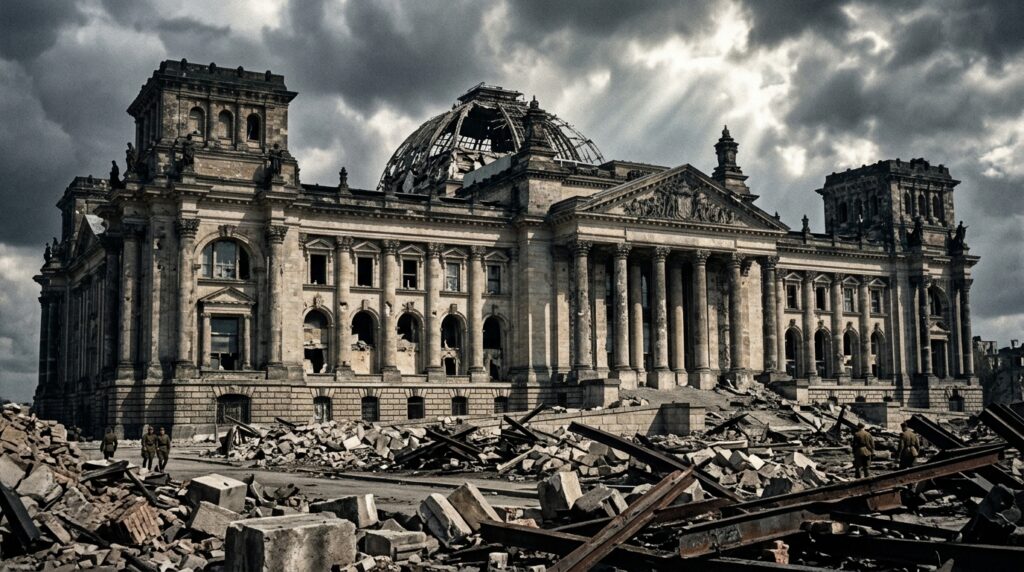
The ruined Reichstag building in Berlin, May 1945 — the endpoint of a war decided not by wonder weapons, but by logistics, coalition strength, and industrial mass.
The War Lessons WW2 Left Behind — What Military Planners Must Not Forget
The eight lessons extracted here are not eight separate arguments. They form a single coherent framework, and every one of them connects to the others in ways that military planners ignore at their professional peril.
The Maginot Line was not merely a failure of tactical imagination. It was also a resource-allocation problem, because France devoted enormous financial and engineering resources to a fixed defensive system that could be bypassed by a German advance through the Ardennes. It was a technology and doctrine problem, because French armored formations were not employed with the same concentration and combined-arms integration as German panzer forces. And it was an intelligence problem, because French operational planning underestimated the possibility and speed of a major German advance through the Ardennes. The Fall of France was not one mistake. It was the same strategic failure expressed simultaneously across multiple domains of warfare.
Operation Barbarossa demonstrates this convergence in reverse. The Wehrmacht’s operational brilliance in the summer of 1941, including the encirclements at Minsk, Smolensk, and Kiev that captured enormous numbers of Soviet troops, was ultimately undone by logistics, underestimation of Soviet and civilian resilience, and the failure to convert early operational victories into a sustainable strategic advantage. Germany won major battles and destroyed entire Soviet formations, but the Soviet Union continued to mobilize manpower, relocate industry, and rebuild its forces. Germany won the battles and lost the war. It is one of the clearest examples in military history of the gap between tactical and operational success and strategic outcome.
The Iran-Israel-US conflict of 2026 adds an eighth data point to this framework. Multi-domain warfare, simultaneous operations across cyber, air, missile, proxy, and economic dimensions, does not reduce the relevance of the war lessons WW2 left behind. It amplifies them. The operational environment is more complex, the decision cycles shorter, and the information volume larger, but the underlying requirements are identical: sound logistics, trusted intelligence, coherent coalitions, respected civilian resilience, and technology deployed at scale with integrated doctrine, not as a compensatory gesture for strategic shortfalls.
For military planners in 2026, the synthesis of these lessons resolves into a checklist that is neither complicated nor particularly original, which is what makes failing to apply it so damaging. Know the adversary’s actual capabilities, not the capabilities of the last adversary. Model logistics at realistic consumption rates, not planning assumptions. Treat control of the air as a central operational requirement, not a heritage assumption. Trust intelligence that contradicts the operational plan, especially when it contradicts the operational plan. Manage alliances as political instruments, because they will come under strain along political fault lines when military pressure intensifies. Invest in civilian resilience as a force multiplier, because assumptions about social fragility have repeatedly proved unreliable in major conflicts. And deploy technology at operational scale with doctrinal integration, or do not count it.
What binds these lessons is a single discipline: intellectual honesty about the conditions of the actual fight, as opposed to the fight that doctrine, procurement cycles, or political convenience has prepared for. The generals who won the Second World War, Zhukov, Eisenhower, Nimitz, and Slim, were not primarily brilliant in the sense of creative genius. They were disciplined about reality. They updated their understanding of what was actually happening faster than their adversaries did..
History’s lessons are never past. They are the operating system on which every future conflict will run. The only question is whether the institution is willing to read the manual before the shooting starts.
Related Reading: