How Small, Decentralized Forces Exert Outsized Strategic Leverage over Conventional Giants
By Editorial Staff · May 31, 2026 · 18 min read
Introduction: The Paradox of Kinetic Power
“The battlefield is a scene of constant chaos. The winner will be the one who can control that chaos, both his own and the enemy’s.”
— Napoleon Bonaparte (but also: the central puzzle of asymmetric theory)
How do small forces defeat larger armies? This is the central question of asymmetric warfare—a military discipline where unconventional guerrilla tactics, geographic advantages, and decentralized cell networks consistently humiliate material superpowers. There is a persistent fallacy in military planning that conflicts can be modeled on a spreadsheet. We count the tanks, weigh the budgets, and assume the actor with the superior physical metrics will inevitably grind down and defeat the weaker combatant.
Yet, some of the most profound military history lessons tell the opposite story. The most heavily funded, technologically advanced empires and superpowers are repeatedly humbled, exhausted, and forced into strategic retreat by vastly smaller, resource-constrained, and decentralized adversaries who leverage resolve asymmetry.
This is the Paradox of Kinetic Power. The attributes that make a conventional military force powerful heavy armor, complex logistical tails, centralized command structures, and high-cost weapons platforms frequently become severe vulnerabilities when pitted against an opponent who refuses to play by conventional rules.
This detailed analysis explores how small forces defeat larger armies. We will dissect the core mechanics of asymmetric warfare, examine four historical case studies where conventional giants were defeated, construct a strategic matrix of counters, and draw twelve crucial lessons that apply directly to leadership and strategy in any competitive domain.
What Is Asymmetric Warfare?
Broadly defined, asymmetric warfare is a conflict where the resources, structure, and tactics of the opposing sides differ significantly.
Rather than fighting strength-on-strength in symmetrical engagements, the weaker party seeks to bypass the stronger party’s conventional advantages by exploiting its systemic friction. Asymmetric warfare is not merely about unequal numbers; it is about different paradigms of conflict.
In a symmetric conflict (such as World War I or the tank battles of World War II), both sides share a common doctrine, structure, and metric of success. In an asymmetric conflict, one side operates on mass, structure, and control, while the other operates on speed, dispersal, and survival.
The Core Mechanics of Asymmetry
To understand why conventional armies struggle in asymmetric environments, we must analyze the three core mechanics that drive irregular warfare:
Resolve Asymmetry (The Will to Win)
In a conflict between a superpower and a smaller, local force, the stakes are almost never equal.
For the superpower, the war is a war of choice. It is often fought on foreign soil to defend peripheral interests, establish regional balance, or enforce policy. The superpower’s domestic population is highly sensitive to casualties, financial debt, and time.
For the asymmetric defender, the war is a war of survival. They are fighting on their own territory, protecting their homes, sovereignty, and way of life.
This creates a massive disparity in time horizons. The superpower wants a swift, decisive victory within political and budgetary constraints. The asymmetric defender only needs to survive and continue inflicting friction. The defender knows that, eventually, the superpower will decide the cost of occupation exceeds the political benefit of staying.
Tactical Asymmetry (The Guerrilla Doctrine)
The small force avoids the conventional force’s center of gravity. It does not defend fixed positions, cities, or borders if doing so invites destruction by heavy artillery and air strikes.
Instead, the asymmetric force adopts the Guerrilla Doctrine:
- Operational Elusiveness: Dispersing into small, autonomous units that blend into the local population or rugged geography.
- Selective Engagement: Engaging only when they possess local numerical superiority and the element of surprise, then vanishing before the conventional power can coordinate a response.
- Strategic Attrition: Focusing on the slow, psychological erosion of the enemy’s patience rather than the physical destruction of their army.
Cost Asymmetry
Conventional military operations are enormously expensive. A modern guided-missile destroyer costs billions; a main battle tank costs millions.
Asymmetric forces capitalize on this by using low-cost, decentralized counter-measures to disable or destroy expensive conventional assets. If an insurgent can destroy a $5,000,000 helicopter with a $10,000 shoulder-fired missile, or disable a $10,000,000 tank with a $500 drone, the economic exchange rate favors the asymmetric actor. Over time, this cost imbalance drains the occupier’s treasury and political capital.
Historical Case Studies: Defeating Giants
timeline
    title Epochs of Asymmetric Triumph
    9 AD : Teutoburg Forest : Germanic tribes neutralize Roman legionary discipline using terrain, weather, and deep tactical deception.
    1775 - 1783 : American Revolution : Washington uses the Fabian strategy of attrition to exhaust British domestic resolve.
    1955 - 1975 : Vietnam War : Viet Cong bypass US air/artillery superiority through subterranean networks and political exhaustion.
    1979 - 1989 : Soviet-Afghan War : Mujahideen leverage mountain sanctuaries and portable Stinger missiles to defeat Soviet armor/air.
The Teutoburg Forest (9 AD)
“The soldiers were unable to deploy their lines or make any effective use of their weapons, for the rain and wind prevented them from seeing or moving.”
Cassius Dio, Roman Historian
Context & Setup
In 9 AD, the Roman Empire, under Emperor Augustus, sought to pacify and annex Germania. Publius Quinctilius Varus, a high-ranking Roman administrator, marched three veteran Roman legions (the XVII, XVIII, and XIX) along with auxiliary troops—totaling roughly 20,000 men. The Roman legions represented the pinnacle of disciplined, heavy infantry warfare.
The Asymmetric Strategy
The Germanic tribes were fragmented, poorly armored, and incapable of facing a Roman legion in open combat. However, they had a brilliant leader in Arminius, a Germanic chieftain who had served as a Roman auxiliary officer. Arminius understood Roman doctrine, logistics, and weaknesses.
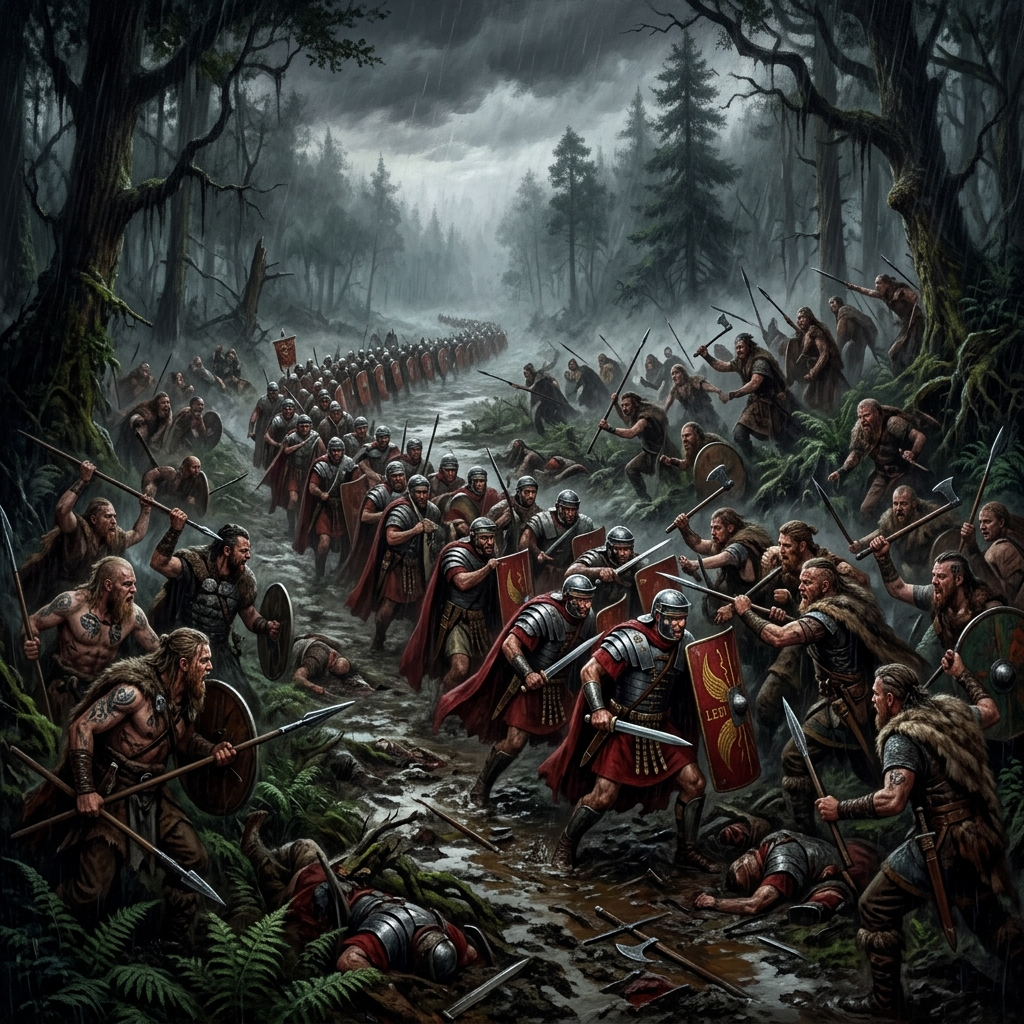
Arminius lured Varus deep into the dense, swampy forests of northern Germany by fabricating reports of a local uprising. In the narrow, waterlogged paths of the Teutoburg Forest, the Roman legionaries could not maintain their tight, disciplined cohorts. The column became elongated, stretching over several miles.
Using the heavy rain, mud, and dense canopy as cover, the Germanic warriors launched coordinated, hit-and-run ambushes from the high, wooded ridges. They neutralized Roman discipline by forcing them to fight in fragmented, chaotic skirmishes where individual mobility and local knowledge of the terrain were the decisive factors.
Outcome & Lessons
Over four days of continuous harassment, all three Roman legions were annihilated. The defeat halted Roman expansion beyond the Rhine, establishing it as the permanent border of the Empire and altering the course of European history.
The lesson: Conventional discipline and organization are useless if the environment prevents them from being deployed. Terrain is the ultimate equalizer.
The American Revolutionary War (1775–1783)
“We fight, get beat, rise, and fight again.”
— General Nathanael Greene
Context & Setup
The conflict pitted the global superpower of the 18th century Great Britain, boasting the world’s premier navy, a highly disciplined army, and massive financial reserves against thirteen fragmented colonies with no professional army, no navy, and limited manufacturing capability.
The Asymmetric Strategy
General George Washington recognized that his Continental Army was too weak to win a conventional war of maneuver against the British. Attempts to defend cities like New York and Philadelphia resulted in near-fatal defeats.
Washington adopted the Fabian Strategy, named after the Roman dictator Fabius Maximus:
- Avoid Pitched Battles: He focused on preserving the army at all costs. As long as the army survived, the revolution continued.
- Strategic Attrition: Washington and Nathanael Greene drew British columns deep into the American wilderness, forcing them to overextend their supply lines and live off a hostile countryside.
- Leverage Foreign Alliances: By demonstrating resilience and securing a major victory at Saratoga, the Americans convinced France and Spain to enter the conflict, turning a colonial counter-insurgency into a global war that Britain could no longer afford.
Outcome & Lessons
Exhausted by years of indecisive campaigns, mounting debt, and the threat of invasion at home by France, the British parliament voted to end the war.
The lesson: A weaker force can win by refusing to accept a decisive battle, converting a military struggle into a political and economic nightmare for the occupier.
The Vietnam War (1955–1975)
“You can kill ten of our men for every one we kill of yours. But even at those odds, you will lose and we will win.”
— Hồ Chí Minh
Context & Setup
The United States entered Vietnam with total technological, material, and kinetic supremacy. The US possessed absolute air superiority (B-52 bombers, helicopters, napalm), naval control, advanced communications, and massive firepower. They faced the North Vietnamese Army (NVA) and the Viet Cong—lightly armed forces lacking heavy armor or air support.
The Asymmetric Strategy
The Vietnamese forces neutralized the US firepower advantage through spatial and tactical adjustments:
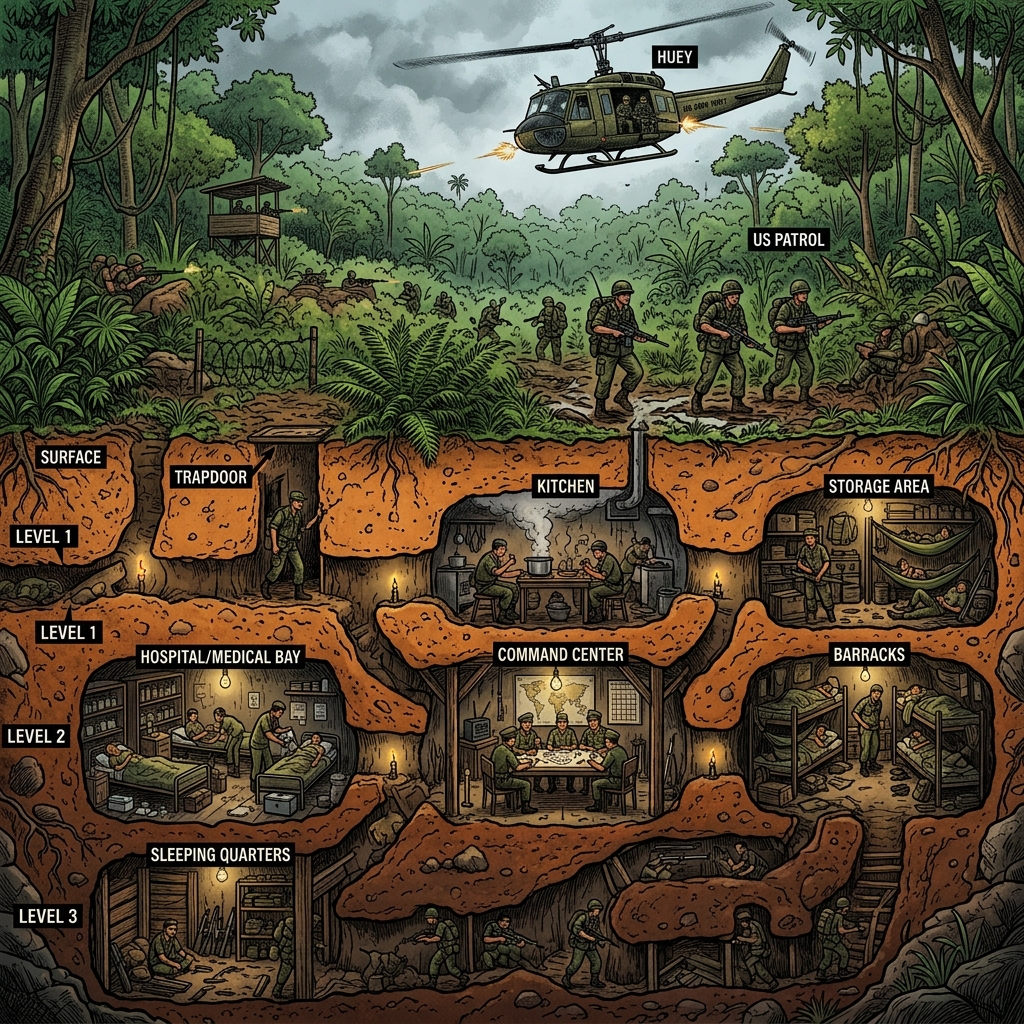
- Subterranean Warfare (The Tunnels): They constructed thousands of miles of complex, multi-level underground tunnel networks (such as the Củ Chi tunnels). These chambers contained kitchens, hospitals, barracks, and ammunition dumps, allowing fighters to survive B-52 strikes and pop up behind US patrols to launch sudden ambushes.
- “Clinging to the Belt”: Viet Cong fighters engaged US soldiers at extremely close range (often under 30 meters). This tactic prevented US commanders from calling in artillery or air support, as doing so would risk killing their own troops.
- The Ho Chi Minh Trail: A decentralized network of paths through neighboring Laos and Cambodia used to funnel supplies. Because it was hidden under triple-canopy jungle, the US could not permanently sever it despite dropping more bombs than were used in all of World War II.
Outcome & Lessons
Although the US won nearly every major tactical engagement and inflicted catastrophic casualties, the mounting economic cost and human toll eroded the political will of the American public. The US withdrew in 1973, leading to the unification of Vietnam under communist rule in 1975.
The lesson: Massive firepower is ineffective against an adversary that can disappear underground or merge with the local population. The ultimate battlefield is the domestic public opinion of the invading power.
The Soviet-Afghan War (1979–1989)
“We are in a war where the enemy does not fight in columns, does not hold defensive positions, but attacks from ambush and disappears into the mountains.”
Soviet Officer’s Report
Context & Setup
In December 1979, the Soviet Union invaded Afghanistan to prop up a communist client government. The Soviet 40th Army was a highly mechanized, modern force trained to fight a high-intensity war in Europe. They faced the Mujahideena decentralized coalition of tribal, religious, and regional militias operating in the rugged Hindu Kush mountains.
The Asymmetric Strategy
For the first half of the war, the Soviets used their mechanized armor and Mil Mi-24 “Hind” helicopter gunships to devastating effect. The Hind helicopters, heavily armored and heavily armed, dominated the Afghan valleys, hunting down Mujahideen patrols and cutting off their logistics.
The Mujahideen adapted through:
- Mountain Guerrilla Tactics: Utilizing the rugged topography to ambush Soviet armored columns on narrow mountain roads, turning tanks into sitting ducks.
- Cross-Border Sanctuaries: Relying on Pakistan as a safe haven to train, recruit, and resupply, preventing the Soviets from achieving a decisive encirclement.
- The Stinger Missile (The Tactical Equalizer): In 1986, the United States began supplying the Mujahideen with the FIM-92 Stinger, a man-portable, shoulder-fired surface-to-air missile (MANPADS). The Stinger was lightweight, easy to operate, and highly effective against low-flying aircraft.
Outcome & Lessons
The Stinger missile neutralized Soviet air superiority. The Mujahideen began shooting down Soviet helicopters at a rate of nearly one per day. Deprived of air support, Soviet forces could no longer secure their outposts or conduct offensive sweep operations. The war became an unsustainable quagmire, contributing to the collapse of the Soviet Union.
The lesson: Low-cost, portable defensive technology can neutralize expensive offensive platforms, restoring the tactical advantage to the decentralized defender.
The Strategic Counter-Matrix
The core of asymmetric warfare can be visualized as a matrix of conventional strengths and the specific, low-cost asymmetric counters that neutralize them:
| Conventional Military Strength | Asymmetric Vulnerability | Tactical Counter-Measure | Historical / Modern Example |
|---|---|---|---|
| Air Superiority (Bombers, Fighters, Helicopters) | High cost, complex maintenance, reliance on centralized airfields. | MANPADS (Stinger, Igla), underground tunneling, target dispersal. | Mujahideen vs. Soviet Air Force (1986); Viet Cong tunnel networks. |
| Heavy Armor (Main Battle Tanks, APCs) | Restricted mobility, poor visibility, high logistics/fuel demand. | Anti-Tank Guided Missiles (ATGMs), IEDs, FPV kamikaze drones. | Ukraine conflict (2022-Present); Hezbollah vs. Israel (2006). |
| Centralized Command (HQ, Satellites, Comm Towers) | High-value, static targets; vulnerability to “decapitation” strikes. | Decentralized Cell Structures, mission-command doctrine, peer-to-peer mesh networks. | Viet Cong decentralized cell networks; decentralized partisan groups. |
| Massive Logistics Train (Fuel, Ammunition, Food) | Long, linear lines of communication vulnerable to ambush. | Supply-Line Ambush, sabotage of rail/bridges, living off the land, local procurement. | Greene’s Southern Campaign (American Revolution); partisan sabotage in WWII. |
| Naval Hegemony (Cruisers, Destroyers, Carriers) | Highly expensive, centralized platforms vulnerable to swarm attacks. | Unmanned Surface Vessels (USVs), anti-ship missiles, marine mines. | Ukrainian sea-drone strikes on Russian Black Sea Fleet (2022-2024). |
Twelve Lessons We Learn from Asymmetric Warfare
These are the transferable principles that any leader in a boardroom, a classroom, a startup, or a squad can take from two centuries of asymmetric conflict.
Lesson 1: Material Superiority Is an Illusion
Military power cannot be measured by quantitative indices alone. A nation can possess 100% air superiority, a 10:1 ratio in military spending, and vastly superior industrial output, yet still lose the war if it cannot convert these physical assets into political outcomes. Intangible factors—such as local legitimacy, geographic familiarity, and ideological motivation—are massive force multipliers that often outweigh material advantages.
Apply it: In business, do not assume a massive budget or corporate size guarantees victory. Agility, customer alignment, and absolute focus often defeat slow, resource-heavy incumbents.
Lesson 2: Resolve Trumps Resources
The party fighting for survival will always possess a longer time horizon than the party fighting for policy. When an organization enters a conflict of choice, its political will is highly sensitive to friction, costs, and setbacks. When an organization is fighting for its life, its tolerance for pain is virtually limitless.
Apply it: Ensure your team understands the “existential why” behind your projects. Highly motivated teams aligned with a mission will outwork teams that are simply working for a paycheck.
Lesson 3: The Battlefield Is Cognitive, Not Just Kinetic
In asymmetric warfare, the ultimate center of gravity is the enemy’s political willpower. The guerrilla fights not to destroy the enemy’s physical force, but to convince the enemy’s domestic population, media, and leadership that the price of continuing the conflict is far higher than any potential benefit of victory.
Apply it: In public campaigns or branding, focus on narrative and perception. The side that tells the most compelling, authentic story often wins the market, regardless of product features.
Lesson 4: Terrain Is the Ultimate Force Multiplier
Rugged topography mountains, swamps, jungles, and dense cities neutralizes the advantages of high-technology, heavy armor, and linear mobility. It forces the conventional power to fight in fragmented, close-quarters skirmishes.
Apply it: Find your “terrain” in the market niche segments, specialized technologies, or localized customer needs where massive competitors cannot deploy their economies of scale.
Lesson 5: Decentralization Defeats Hierarchy
Conventional militaries are structured as hierarchies to manage massive logistics. However, hierarchies suffer from slow decision-making loops (OODA loops) and high vulnerability to decapitation. Asymmetric networks operate on a decentralized, self-organizing principle. Local cells make autonomous decisions based on immediate circumstances, making the network highly resilient.
Apply it: Flatten your organizational structure. Empower front-line employees to make decisions for customers without waiting for corporate approvals.
Lesson 6: Sanctuary Is Non-Negotiable
An asymmetric force cannot survive long-term without sanctuary. Sanctuary can be geographic (mountains), political (neighboring countries), or demographic (supportive local population). It provides a safe space to rest, rebuild, and plan without threat of immediate destruction.
Apply it: Create psychological safety and stable resource reservoirs within your organization. Teams need a “safe harbor” to fail, learn, and iterate without fear of immediate termination.
Lesson 7: Cost Imbalance Can Drain Empires
Using cheap means to combat expensive platforms destroys the adversary’s economic sustainability. When a conventional power must spend millions of dollars on defensive missiles to shoot down a $1,000 drone, the economic exchange rate is unsustainable.
Apply it: Focus on cost efficiency. Build high-leverage systems where small, repeatable inputs yield massive defensive or offensive market advantages.
Lesson 8: Avoid the Strength, Target the Weakness
Never engage in symmetric, strength-on-strength battles if you are the weaker party. If you face a massive competitor, do not attempt to compete in their core market with their own methods. Strike their vulnerable logistics, their slow customer service, or their overhead cost structure.
Apply it: Analyze your competitor’s business model to find their hidden dependencies such as high distribution costs or rigid pricing—and target those areas.
Lesson 9: The Population Is the Center of Gravity
The guerrilla lives among the population like a fish in water. Without the support, shelter, and intelligence provided by the local population, the insurgent force is easily isolated and destroyed by the conventional military.
Apply it: Customer loyalty is your demographic sanctuary. If you have deep, authentic relationships with your user base, competitors cannot displace you, regardless of how much capital they spend on marketing.
Lesson 10: Information Flow Is the New Weapon System
Narrative control on social and public networks is as important as physical ammunition. Asymmetric actors leverage global media to deter enemies, influence foreign policies, and recruit followers directly to their smartphones.
Apply it: Invest in organic, high-value content and open communication. Build a community that advocates for your brand, turning your users into a decentralized marketing force.
Lesson 11: Technology Demystifies Force
Low-cost commercial technology democratizes lethality. Highly sophisticated capabilities once reserved for wealthy nation-states are now accessible to anyone with a computer or a soldering iron.
Apply it: Leverage open-source software, cloud computing, and AI tools. Small teams can now build software and deploy systems that once required hundreds of developers and millions in capital.
Lesson 12: Strategic Patience Wins Wars
In asymmetry, time is the ally of the defender. The conventional force faces a ticking clock—budgets expire, political leadership changes, and public patience wears thin. The asymmetric force only has to keep the flame alive.
Apply it: Focus on long-term sustainability over short-term spikes. The ability to survive and outlast market volatility is often the ultimate competitive advantage.
Modern Applications: The Future of Irregular Conflict
The digital age has supercharged the principles of asymmetry, placing high-leverage capabilities into the hands of small cells and individuals:
The FPV Drone Revolution
In modern conflict, commercial quadcopters costing $500, outfitted with crude RPG warheads, are routinely destroying $10,000,000 main battle tanks. This represents a catastrophic disruption of cost asymmetry, rendering heavy armor highly vulnerable to cheap, distributed aerial threats. Furthermore, explosive unmanned surface vessels (USVs) have allowed forces without a functional navy to systematically destroy traditional naval fleets.
Cyber & Infrastructure Asymmetry
A small group of state-sponsored or non-state hackers operating out of a basement can bypass physical borders and air defenses. By targeting critical infrastructure—such as electrical grids, pipelines, hospital networks, and financial systems—they can inflict billions of dollars in economic damage at a fraction of the cost of a kinetic bombing campaign.
Cognitive Warfare
Asymmetric actors now leverage social media algorithms to wage psychological warfare on a mass scale. Using bots, deepfakes, and coordinated information campaigns, they can demoralize troops, influence foreign policy, and recruit followers worldwide.
The Megacity as the New Jungle
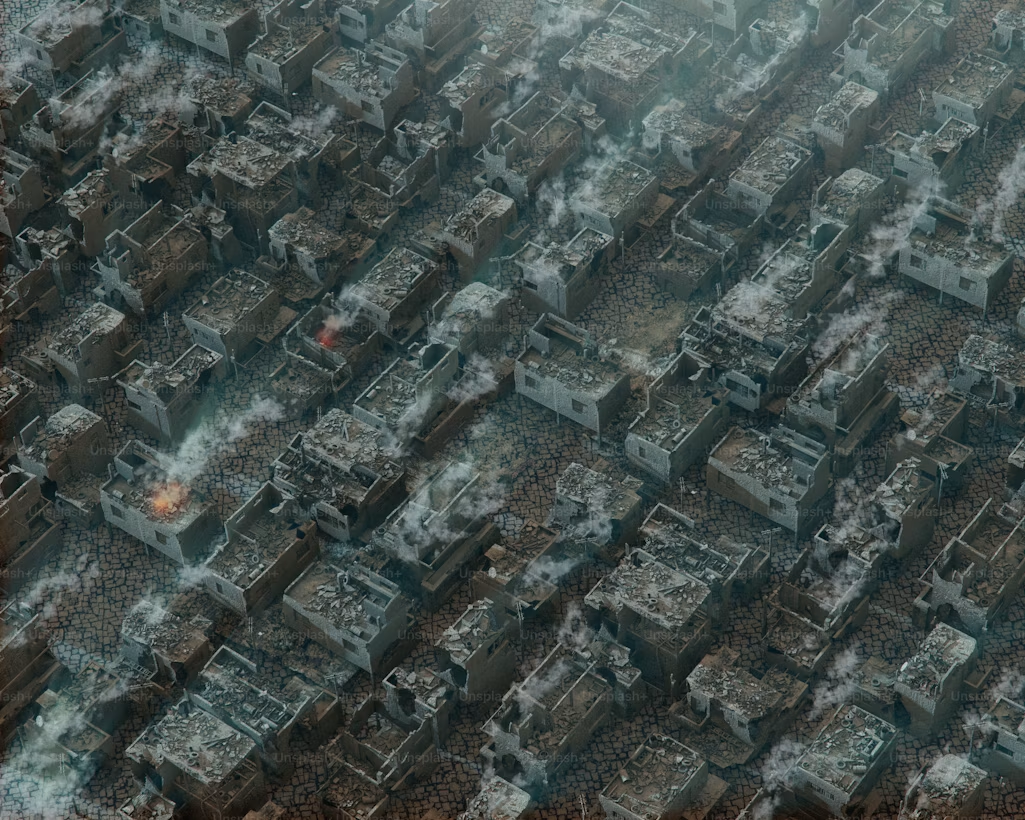
By 2050, 68% of the world’s population will live in urban areas. Modern concrete cities, with their vertical structures, subterranean subway lines, and dense civilian populations, act as the ultimate equalizers. They neutralize air superiority, restrict heavy armor, and provide perfect cover for asymmetric defenders.
Conclusion: The Permanent Reality of Asymmetric Friction
Asymmetric warfare is not a historical anomaly. It is the natural, permanent state of human conflict when power is unbalanced. Whenever there is a massive disparity in physical strength, the weaker side will inevitably seek irregular means to bypass the stronger side’s advantages.
History teaches us that material supremacy is a fragile shield. The Roman legions at Teutoburg Forest, the British Redcoats in the American colonies, the US military in the jungles of Vietnam, and the Soviet army in the mountains of Afghanistan all learned the same bitter lesson: force without local legitimacy, strategic patience, adaptability, and political resolve is ultimately hollow.
As the cost of technology continues to fall, the leverage possessed by the individual and the small cell will only increase. The future will belong not to those with the largest arsenals, but to those who can master the fluid, decentralized, and cognitive art of asymmetric resilience.
This article draws on historical analyses of irregular warfare, insurgent doctrines, and modern technological developments. For further reading, see:
- Why Big Nations Lose Small Wars by Andrew Mack (1975)
- On Guerrilla Warfare by Mao Zedong
- ADP 3-05: Unconventional Warfare (U.S. Army)
- Team of Teams by General Stanley McChrystal
- The Sling and the Stone by Colonel Thomas X. Hammes
© 2026. All rights reserved. If you found this article valuable, share it with a leader who needs to hear it.
Related Reading:
 Urban Warfare Doctrine: Lessons from Stalingrad to Mariupol