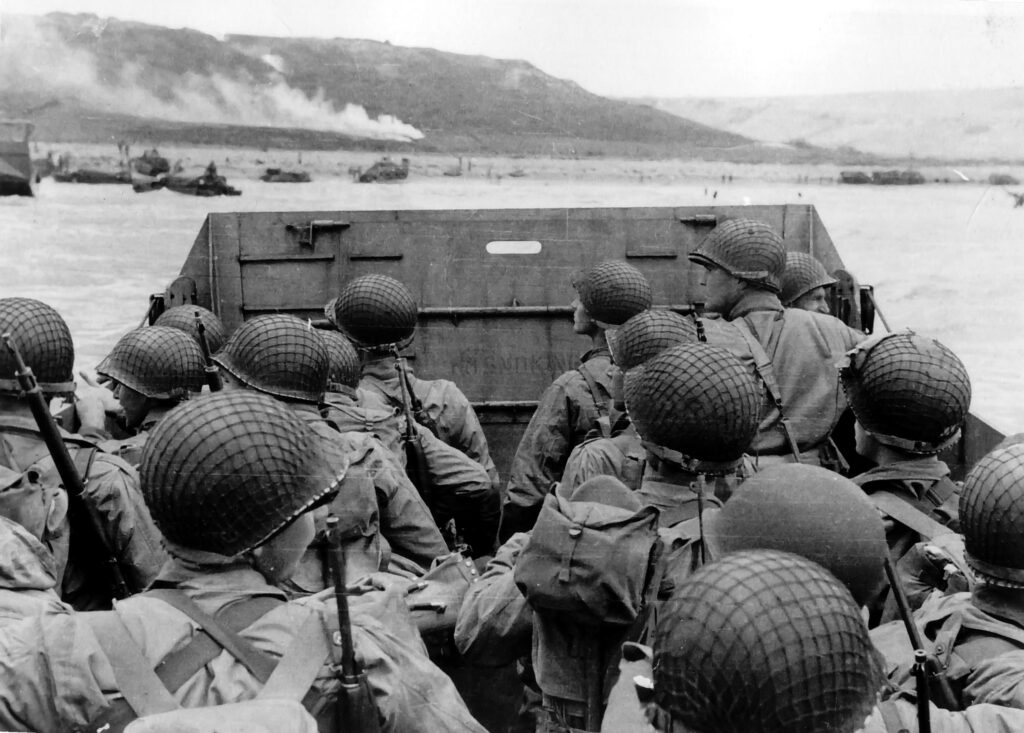
Landing an army on a defended coastline is one of the hardest things a military can attempt. The attacker gives up almost every advantage the moment the ramp drops. There’s no cover on open water, no way to dig in before the enemy sees you coming, and no easy way to retreat if things go wrong. A defender sitting behind concrete and barbed wire, with pre-registered artillery and interlocking machine-gun fire, holds most of the cards. History is full of amphibious assaults that ended in disaster for exactly this reason. Gallipoli in 1915 is the example every planner in 1944 had studied and feared repeating.
Operation Overlord had to solve this problem on a scale no one had attempted before: landing an estimated 156,000 men on a 50-mile stretch of French coastline in a single day, against an enemy that had spent four years fortifying the ground. It worked, but not because of one brilliant idea or one decisive weapon. It worked because Allied planners broke the invasion into separate problems, deception, air power, logistics, timing, and coordination, and solved each one well enough that the others could function. Pull any single piece out and the whole plan likely collapses.
Why Normandy?
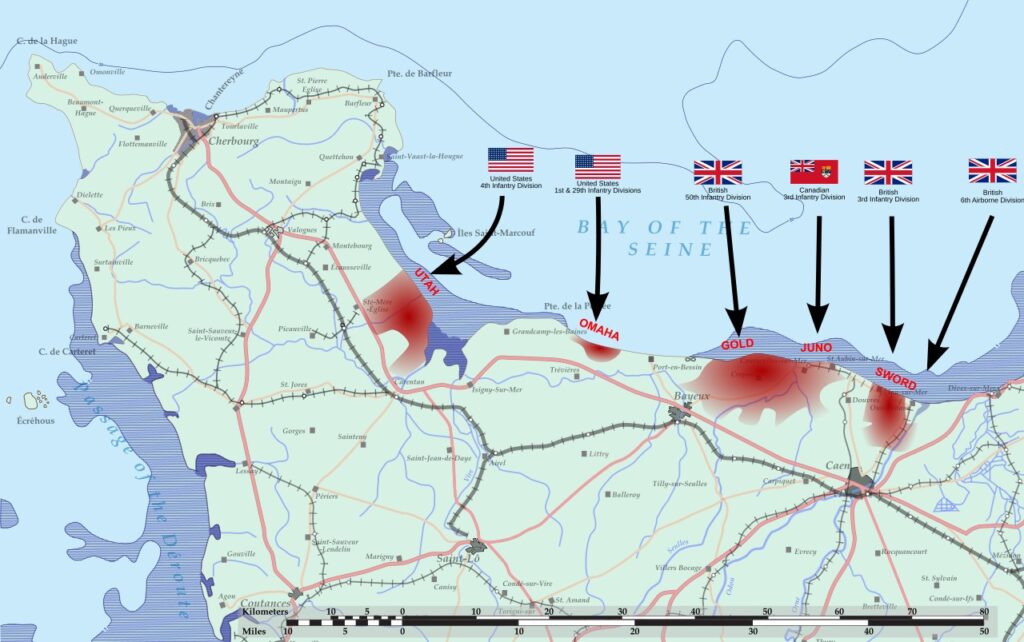
The obvious answer would have been the Pas-de-Calais. It’s the shortest crossing from England, barely 20 miles at the narrowest point, and it offered the fastest route toward Germany itself. The Germans knew this too, which is exactly why Hitler’s high command concentrated some of the strongest sections of the Atlantic Wall there, including heavy coastal batteries and the bulk of Fifteenth Army.
Normandy offered something the planners valued more than a short crossing: relative surprise, combined with terrain that could support a landing of this size. The beaches were gently sloped, suitable for the huge range of landing craft the Allies would be using. Cherbourg sat within reach as a deep-water port that could be captured and repaired to supply the invasion once the beachhead was secure. The Norman countryside, despite the hedgerow terrain that would cause its own problems later, gave the Allies room to build airfields and stage follow-on forces without being immediately squeezed against the coast.
Critically, Normandy was defended by Seventh Army, a weaker formation than Fifteenth Army, and the Germans had convinced themselves, with considerable Allied help, that any landing there would be a diversion ahead of the “real” invasion further north. Selecting Normandy meant giving up the shortest road to Germany in exchange for a coastline where the Allies could actually get ashore and stay there. That trade-off is the first decision that shaped everything else about the operation.
The First Problem: Keeping Germany Guessing
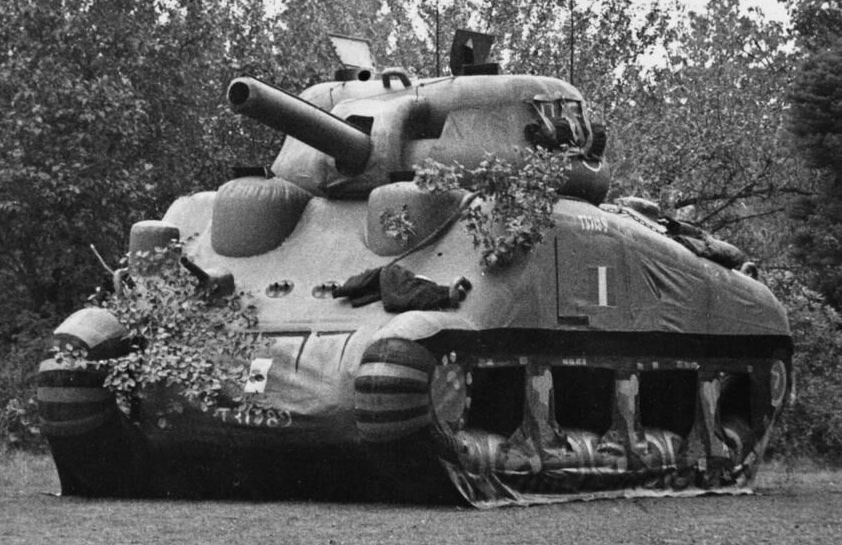
Inflatable dummy Sherman tank used by Allied forces for deception in World War II. Source: Wikimedia Commons, public domain (U.S. Army).None of the terrain advantages at Normandy mattered if German reserves could reach the beaches within a day or two of landing. So before a single soldier crossed the Channel, the Allies had to win a different kind of fight: convincing the German high command to look somewhere else.
Operation Fortitude was the centerpiece of this effort. It built an entirely fictional army, the First U.S. Army Group, supposedly massed in southeast England under George Patton, complete with dummy tanks, inflatable landing craft, fake radio traffic, and a command structure real enough that German intelligence tracked its “movements” for months. Patton’s presence gave the deception credibility; the Germans respected him as a commander and assumed the Allies wouldn’t waste him on a secondary landing.
Double agents, run by the British through the Double Cross System, fed Berlin a steady stream of false reports reinforcing the idea that Calais was the target and Normandy, if it happened at all, was a feint. The deception didn’t need to convince every German officer. It only needed to keep Hitler and his senior commanders unwilling to commit Fifteenth Army to Normandy in the critical first days after the landing, and in that narrow sense, it worked. Panzer divisions that could have overwhelmed the beachhead sat idle near Calais for weeks, waiting for a second invasion that never came.
Winning the Air War Before the Landings
Ground troops couldn’t move safely, and German reinforcements couldn’t arrive quickly, unless the Allies controlled the sky first. This part of the campaign started months before June 6, with a sustained bombing effort against French and Belgian rail networks, bridges, and marshalling yards under the Transportation Plan. The goal wasn’t simply to destroy German equipment. It was to make it nearly impossible for the Wehrmacht to move reinforcements by rail into Normandy once the invasion began.
By the spring of 1944, Allied fighters had also largely swept the Luftwaffe from the skies over northern France. German pilots who did get airborne on June 6 found themselves badly outnumbered; contemporary accounts describe a handful of Luftwaffe sorties over the beaches compared to thousands of Allied aircraft. That imbalance meant Allied troops on the ground rarely had to worry about air attack, while German units moving toward the coast faced strafing runs on open roads in daylight. Air superiority didn’t win the battle by itself, but it set the conditions under which the ground battle could be won.
The Airborne Gamble
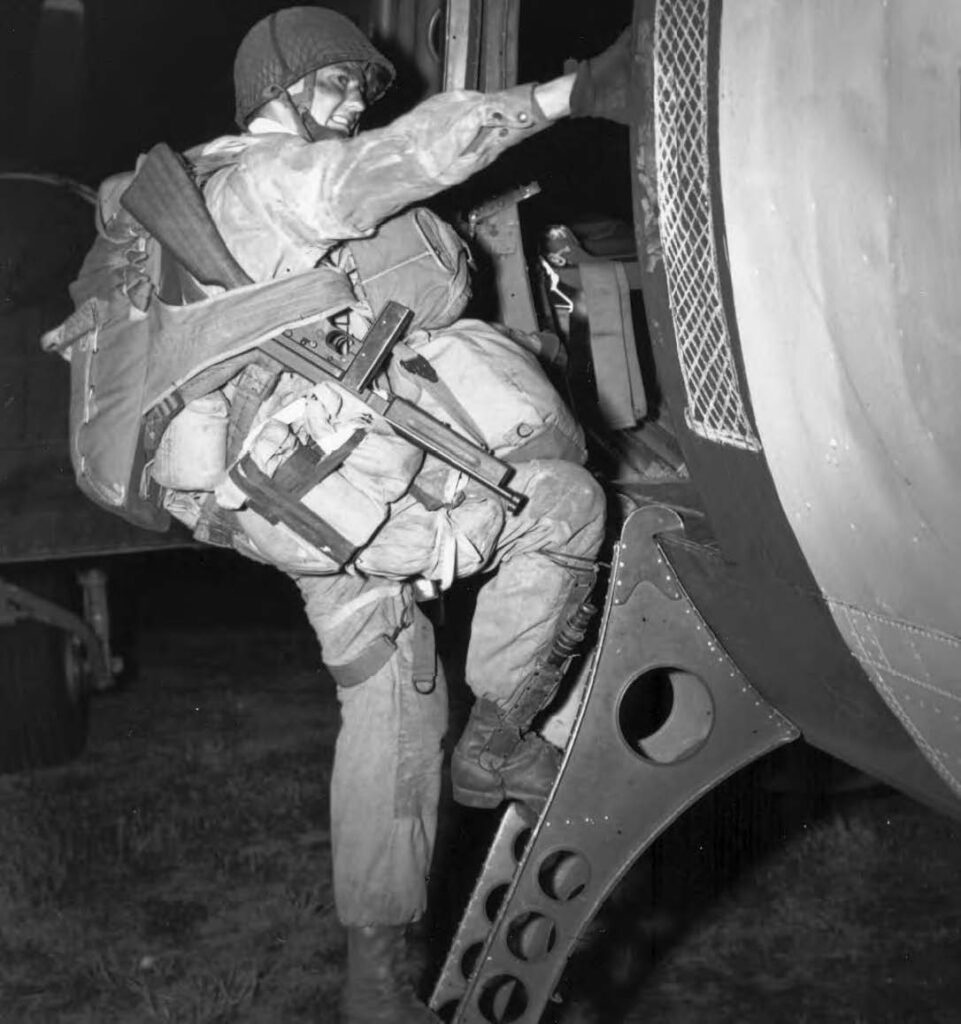
Before dawn on June 6, three airborne divisions, the American 82nd and 101st and the British 6th, dropped behind the beaches to secure key roads, bridges, and causeway exits before the seaborne assault arrived. The idea was sound: seize the terrain that would otherwise let German reserves counterattack the beaches quickly, and disrupt German command and communication in the process.
The execution was messier than the plan intended. Cloud cover, anti-aircraft fire, and pilot inexperience scattered American paratroopers across a much wider area than intended. Some drops landed miles from their targets, and individual units spent hours or days reassembling. British glider forces at Pegasus Bridge fared considerably better, achieving one of the most precise landings of the operation and holding a critical crossing until relieved.
Oddly, the dispersion of American paratroopers may have helped as much as it hurt. Scattered small groups of soldiers, cut off from their chain of command, created the impression of a much larger force operating throughout the countryside, adding to German confusion about where the main effort actually was. That doesn’t excuse the planning failures. Casualties among the airborne divisions were significant, and some units never assembled into anything resembling a coherent fighting force in the first hours. It’s a useful reminder that even a flawed execution can still contribute to the overall objective, so long as the underlying plan accounts for enough redundancy to absorb the mistakes.
The Five Beaches
Overlord’s assault frontage was divided into five sectors, each assigned to different national forces and each presenting its own tactical problem. Casualty figures for D-Day were never tabulated into a single official count, and historians’ estimates vary, so the numbers below should be read as generally accepted approximations rather than exact totals.
Utah
The westernmost beach, assigned to American forces, turned out to be the easiest landing of the day, partly through skill and partly through luck. Strong currents pushed the landing craft roughly a mile south of the intended sector, onto a stretch of coastline that was actually less heavily defended. Brigadier General Theodore Roosevelt Jr., accompanying the first wave, made the call to press inland from where they’d actually landed rather than try to correct course under fire. It’s a decision credited with keeping losses at Utah far lower than anywhere else along the invasion front, with roughly 200 American deaths reported for the sector, a fraction of what planners had expected.
Omaha
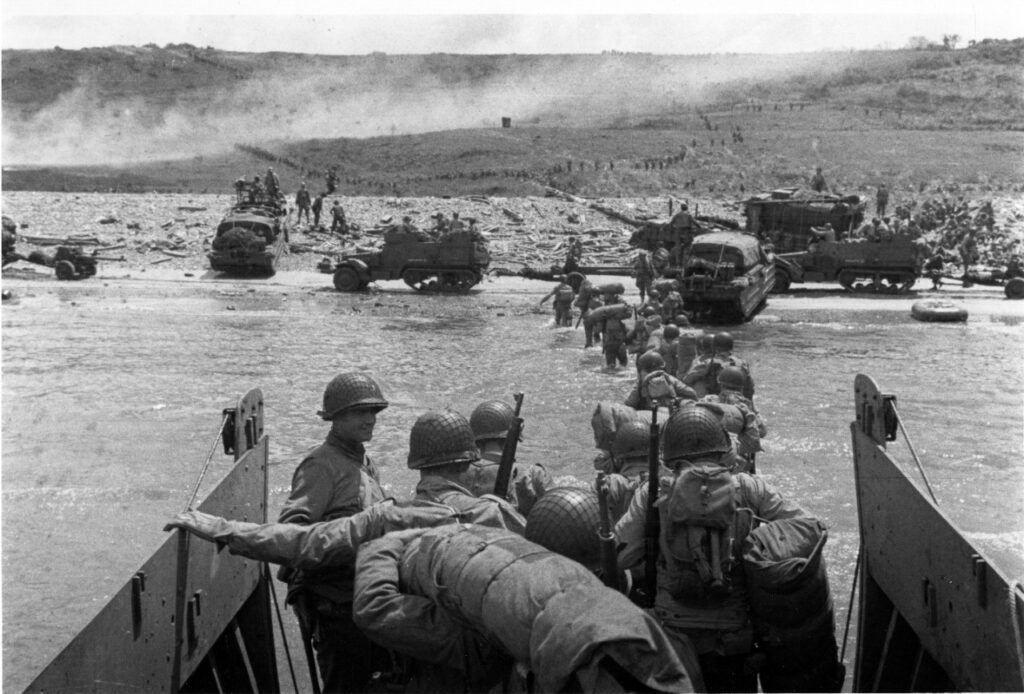
Omaha was the opposite story, and it’s the beach most associated with the human cost of D-Day. American planners underestimated the strength of the German defenses here, missing the presence of a full German infantry division that had moved into the sector shortly before the invasion. Steep bluffs gave defenders clear fields of fire onto the beach, and pre-invasion naval and air bombardment largely missed the German positions, leaving bunkers and machine-gun nests intact. Many landing craft were dropped too far from shore, forcing men to wade through deep water under fire, and several DD “swimming” tanks meant to support the infantry sank before reaching the beach. Estimates commonly cited by the National Archives and the National WWII Museum put American casualties at Omaha at around 2,400, by far the highest of any sector that day. The result was hours of men pinned against a seawall with almost no cover, and it took small groups of soldiers improvising routes off the beach, rather than any single coordinated maneuver, to finally break the deadlock by midday.
Gold, Juno, and Sword
The three eastern beaches, assigned to British and Canadian forces, faced their own obstacles but generally made faster progress than Omaha. At Gold, British troops dealt with resistance around Le Hamel but pushed several miles inland by the end of the day. At Juno, Canadian forces encountered some of the highest concentrations of beach obstacles anywhere along the invasion front, along with a defended seawall; commonly cited estimates put Canadian deaths there at roughly 340, still a heavy toll for the sector’s size. At Sword, British units linked up with the airborne troops holding Pegasus Bridge but were slowed short of the day’s objective, Caen, which would not fall for weeks. Combined British losses at Gold and Sword are generally estimated at around 2,000 casualties.
Taken together, Allied casualties across all five beaches and the airborne drops on June 6 are commonly estimated at roughly 10,000, including an estimated 4,400 dead, though historians caution these figures are reconstructions rather than a verified official tally. German losses on D-Day itself are even harder to pin down, with estimates ranging from about 4,000 to 9,000.
The German Defense
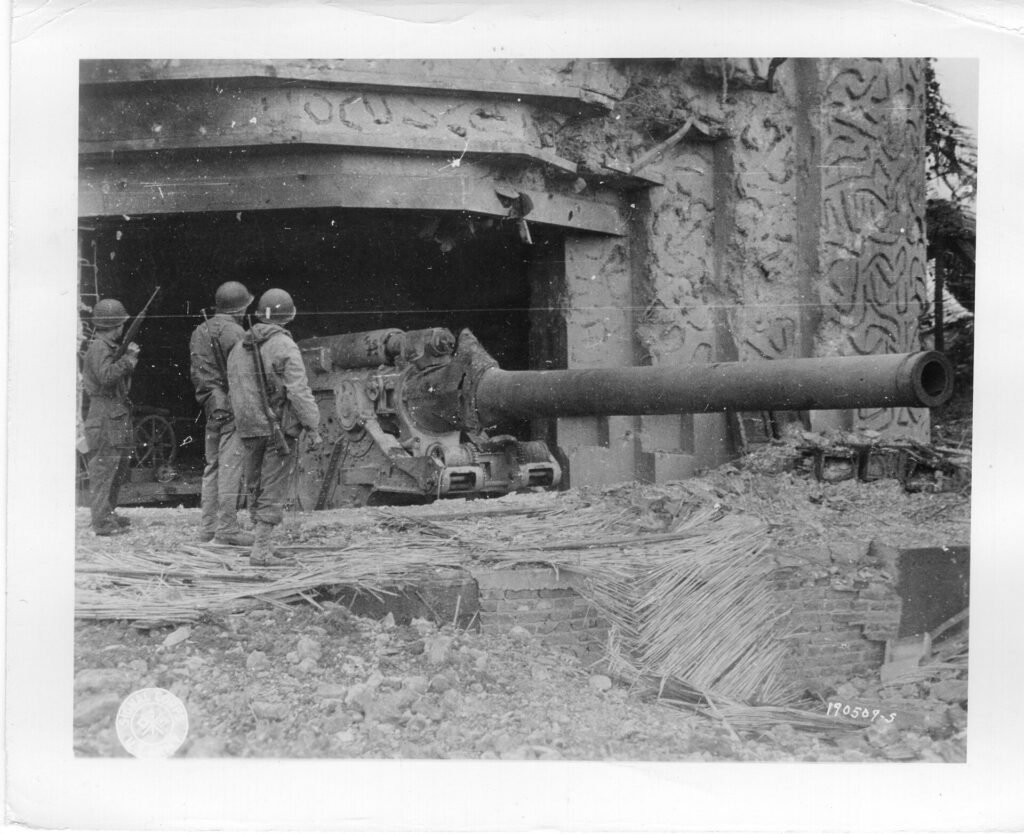
German coastal defense doctrine, shaped largely by Field Marshal Erwin Rommel, called for stopping the invasion at the waterline, on the theory that Allied air power made it too dangerous to move reserves once a beachhead was established. That theory was correct, but the Atlantic Wall itself was far from the impenetrable barrier German propaganda described. Fortifications were strongest around obvious targets like Calais and major ports; the Normandy sector, while heavily mined and studded with obstacles designed to rip open landing craft at high tide, had thinner troop concentrations and, in several sectors, static divisions made up of older soldiers and conscripted foreign troops rather than front-line German infantry.
Command confusion made things worse for the defenders. Rommel was in Germany for his wife’s birthday when the invasion began. Hitler’s insistence on personally approving the release of panzer reserves meant that key armored divisions sat idle for crucial hours on June 6 because no one wanted to wake him. The defense that did exist, at Omaha especially, was formidable at the tactical level. At the operational level, it was hampered by exactly the kind of rigid, centralized decision-making that a fast-moving crisis punishes.
The Logistics Problem
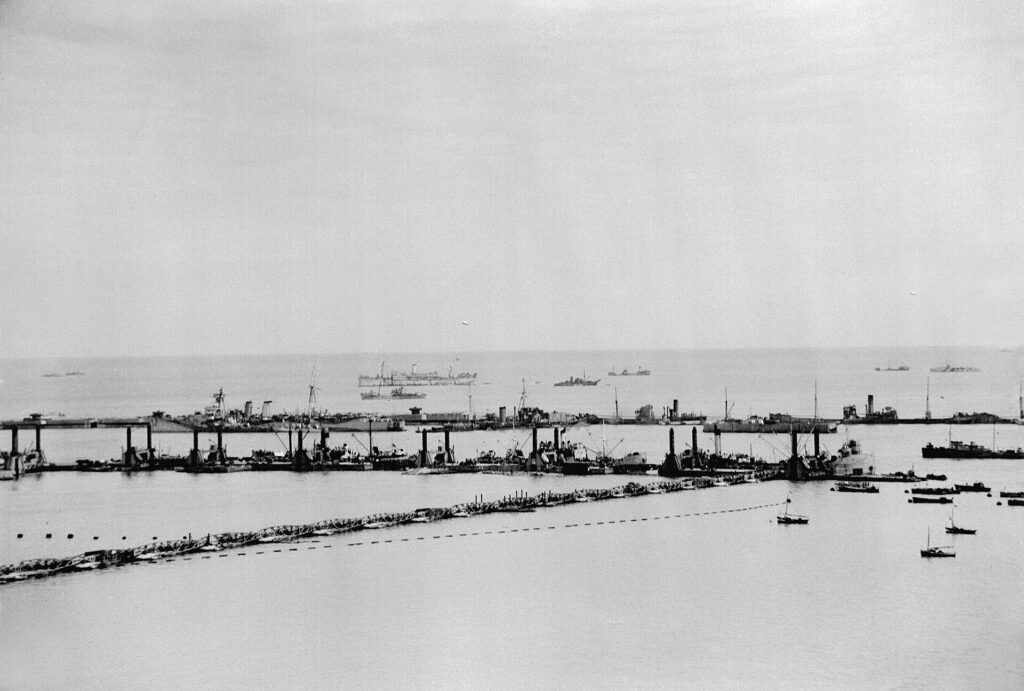
Getting ashore was the beginning of the problem, not the end of it. An invasion force this size needed a constant flow of ammunition, fuel, food, replacement troops, and medical evacuation, and none of the captured French ports were immediately usable. Cherbourg wouldn’t fall for weeks, and German demolition crews wrecked it thoroughly once it did.
The Allied solution was to bring their own harbors. Two prefabricated Mulberry harbors, built in sections in England and towed across the Channel, were assembled off the invasion beaches to allow cargo ships to unload directly onto the coast rather than relying on the beaches themselves. A storm on June 19 destroyed the American Mulberry at Omaha, but the British Mulberry at Arromanches remained in use for months. Fuel presented a separate challenge, solved through PLUTO, short for Pipeline Under The Ocean, a set of undersea fuel lines eventually laid across the Channel to feed Allied forces without relying entirely on tanker deliveries that German aircraft or submarines might intercept.
None of this happened by improvisation under fire. It was planned in as much detail as the assault itself, because Allied planners understood something that’s easy to overlook when studying the beach landings in isolation: a tactical victory on June 6 that couldn’t be resupplied by June 10 would have been worthless.
What Went Wrong
D-Day is often remembered as a triumph of planning, which obscures how much of it went wrong in the moment. The original date, June 5, was postponed a full day because of poor weather, and the June 6 landings still went forward under marginal conditions that Eisenhower accepted as the best available window rather than an ideal one. Airborne drops were scattered well beyond acceptable margins. Naval and air bombardment missed key German positions at Omaha. Several DD tanks sank in rough seas before reaching shore. Communication between units, and between the beach and higher headquarters, broke down repeatedly in the first hours, leaving local commanders to make decisions with almost no picture of what was happening a few hundred yards away.
None of this was a footnote to an otherwise clean operation. Omaha in particular came close to failure in the classic sense. Momentum stalled, casualties mounted, and for several hours in the morning there was genuine uncertainty about whether the beach could be held at all. What saved it wasn’t a revised plan executed from headquarters. It was small groups of soldiers and junior officers finding gaps in the German defense and pushing through them without waiting for orders. Overlord succeeded despite a long list of failures, not because everything happened as intended.
Why D-Day Succeeded
No single factor explains the outcome. Deception kept German reserves out of position for weeks. Air superiority meant German units that did try to move toward Normandy were harassed constantly and arrived late, if they arrived at all. Naval gunfire, however imperfect at Omaha, was decisive support at the other four beaches. Allied industrial capacity meant landing craft, tanks, and aircraft existed in numbers Germany couldn’t match by 1944. American, British, and Canadian forces coordinated a joint operation across services and nationalities that, while far from flawless, held together under stress.
On the German side, the failures compounded each other. Rigid command structures delayed the panzer response. Rommel’s absence removed the one commander pushing hardest for an aggressive response at the water’s edge. The deception operation meant that even commanders who suspected Normandy was the real landing lacked the authority to act on that suspicion. Strip away any one of these Allied advantages, or remove any one of these German failures, and the calculation looks considerably less favorable. The invasion succeeded because enough things went right, and enough German responses went wrong, at the same time.
What D-Day Teaches About Warfare
Preparation reduces uncertainty, but it doesn’t eliminate it. Overlord was rehearsed and planned to an extraordinary degree, and the operation still unfolded nothing like the plan on paper. The value of planning wasn’t in predicting events correctly. It was in building enough flexibility and redundancy into the force that it could absorb the plan going wrong in a dozen places at once.
Deception can substitute for firepower you don’t have. The Allies couldn’t guarantee they’d outfight Fifteenth Army if it arrived at Normandy in force. Operation Fortitude meant they never had to find out. Keeping an enemy’s best forces looking the wrong way is sometimes more valuable than any weapon that could be aimed at them.
Logistics determines whether a tactical win becomes a strategic one. Getting ashore on June 6 would have meant little without the Mulberry harbors and PLUTO pipeline sustaining the force in the weeks after. Plenty of amphibious operations in history have secured a beachhead only to be strangled by their own supply lines.
A joint operation needs integration, not just participation. American, British, and Canadian forces, alongside naval and air components from multiple nations, had to function as one operation rather than several parallel ones. That kind of coordination has to be built well before the operation begins. It can’t be improvised on the day.
Plans survive contact with reality only if they’re built to. The scattered airborne drops and the near-disaster at Omaha didn’t sink the invasion because the overall plan had enough slack in it to tolerate serious local failures. A plan built around everything going correctly is a plan built to fail.
Air and naval superiority set the terms for the ground fight. Ground troops at Normandy operated with a freedom of movement, and German troops without it, largely because the Allies had already won the fight for the sky and the sea months before June 6. Ground campaigns are frequently won or lost before the first ground unit engages.
Strategic outcomes are usually the sum of small advantages, not one decisive stroke. No single beach, unit, or decision made D-Day succeed. It was the accumulation of a dozen partial advantages, some earned through planning and some through German mistakes, that tipped the balance.
Conclusion
The question of how the Allies solved the problem of amphibious warfare doesn’t have a single answer, and that’s really the point. D-Day succeeded because the invasion wasn’t planned as an assault on a beach. It was planned as a system of interlocking problems, each with its own solution, each dependent on the others working well enough to matter. Deception bought time. Air power bought freedom of movement. Logistics bought endurance. None of these were sufficient on their own, and several came close to failing outright. What got the Allies from the beach to the German border wasn’t a perfect plan. It was a plan good enough to survive its own imperfections, executed by soldiers willing to keep moving forward when the plan itself had already broken down around them.
Sources and Further Reading
- U.S. Army Center of Military History: Overlord operational histories
- Imperial War Museums: Operation Overlord collections
- UK National Archives: Operation Fortitude and deception records
- U.S. National Archives, “80 Years Later: Documenting the Loss and Honoring the Sacrifices of D-Day”
- Cornelius Ryan, The Longest Day
- Stephen Ambrose, D-Day: June 6, 1944
- Antony Beevor, D-Day: The Battle for Normandy
- Max Hastings, Overlord: D-Day and the Battle for Normandy
- Carlo D’Este, Decision in Normandy
Related Reading: