Cities have always been where civilizations concentrate their power, their wealth, and their people. They are also, increasingly, where wars are decided. From the frozen rubble of Stalingrad to the shattered apartment blocks of Mariupol, urban warfare has defined the most consequential military engagements of the last century and it will define the conflicts of the next. The doctrine that governs how armies fight in cities is not an academic abstraction. It is a body of knowledge written in blood, revised in failure, and tested against the hardest environment that modern combat has to offer.
Introduction: Why Cities Are the Future of War
In 1950, roughly 30 percent of the world’s population lived in cities. Today, that figure exceeds 56 percent. By 2050, the United Nations projects that nearly 70 percent of all humans will be urban dwellers. The implications for military strategy are profound and unavoidable: the future of armed conflict is overwhelmingly urban.
Cities are not merely incidental backdrops to modern warfare. They are strategic objectives in themselves centers of political authority, economic production, cultural identity, and population density. Controlling a capital city often means controlling a country. Destroying a city often means losing the war, even if every tactical engagement is won. This paradox that cities must be fought for but cannot be destroyed in the fighting lies at the heart of urban warfare’s unique difficulty.
Urban terrain is the great equalizer. It negates many of the advantages that technologically superior forces enjoy in open terrain: air supremacy is constrained by vertical obstacles, armored maneuver is channeled into narrow corridors, precision-guided munitions lose effectiveness against enemies who fight from basements and tunnels, and the fog of war thickens to near-opacity in a three-dimensional environment where threats can come from above, below, and from within the walls themselves.
The history of urban warfare offers a curriculum of hard-won lessons. Each major urban battle from Stalingrad to Hue, from Mogadishu to Grozny, from Fallujah to Mosul to Mariupol has forced militaries to confront the same fundamental challenges, and each has contributed something essential to the doctrine that governs urban operations today.
This article traces that evolution, examines the defining battles that shaped it, and extracts the doctrinal lessons that will determine success or failure in the urban conflicts to come.
I. Stalingrad (1942–1943): The Birth of Modern Urban Combat
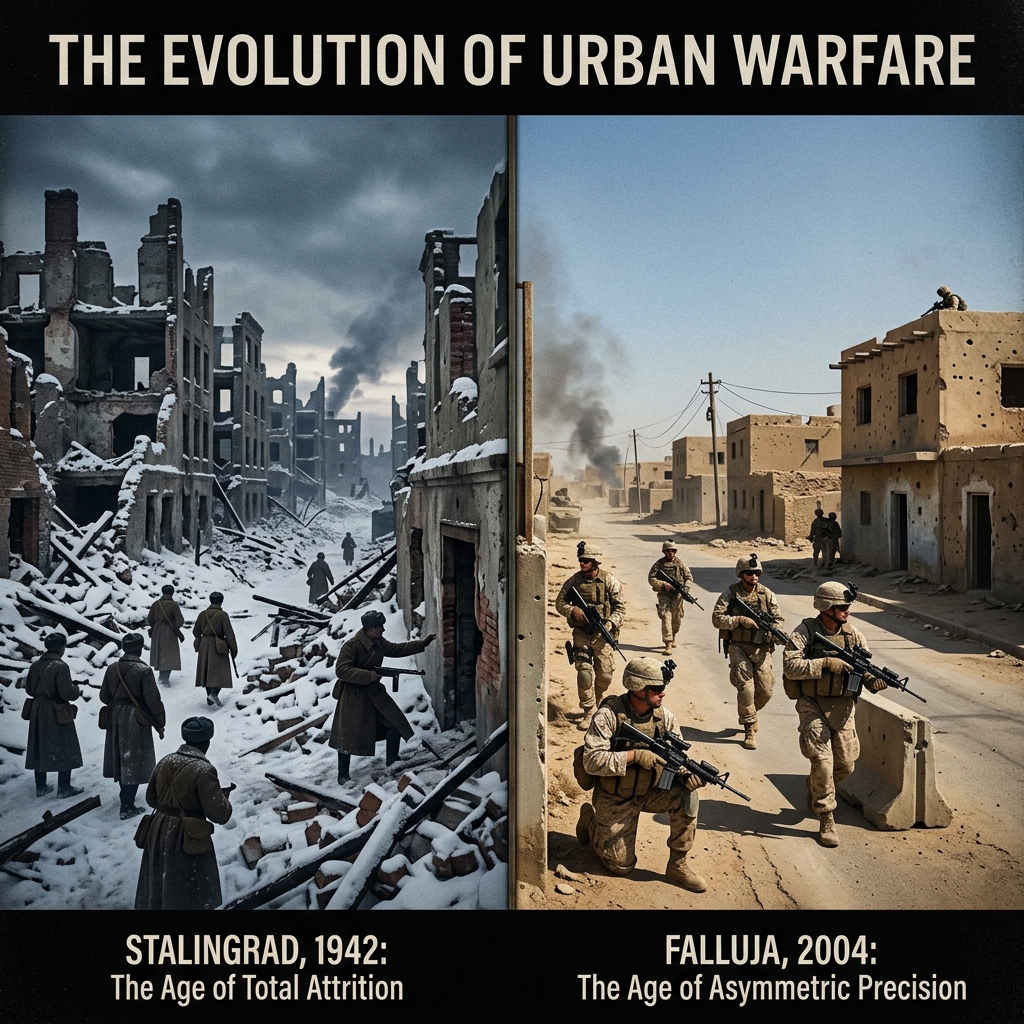
No discussion of urban warfare can begin anywhere other than Stalingrad. The battle that raged from August 1942 to February 1943 was not the first urban engagement in military history, but it was the engagement that established urban combat as a distinct domain of warfare with its own logic, its own tactics, and its own costs.
When the German Sixth Army under General Friedrich Paulus advanced into Stalingrad in the late summer of 1942, the Wehrmacht’s operational concept was built around the same principles that had delivered rapid victories across Europe: overwhelming firepower, mechanized speed, and combined-arms coordination in open terrain. The Luftwaffe was tasked with reducing the city from the air before ground forces moved in to clear what remained.
The bombing campaign succeeded in destroying Stalingrad and in doing so, it created the conditions for Germany’s most catastrophic defeat.
The Paradox of Firepower
The aerial bombardment and subsequent artillery barrages leveled the city’s buildings, but the rubble did not disappear. Instead, it transformed Stalingrad into a labyrinth of broken concrete, twisted steel, and collapsed structures that was impassable to vehicles and ideal for defense. German Panzer divisions, which had swept across the steppes with devastating effectiveness, found themselves immobilized. The wide boulevards that tanks required for maneuver became kill zones. The rubble piles that blocked streets became fortified positions.
The Soviets, initially overwhelmed, quickly adapted. General Vasily Chuikov, commanding the 62nd Army, developed tactics specifically designed for this environment:
- “Hugging” the enemy: Soviet troops maintained positions as close as possible to German lines often within grenade-throwing distance to prevent the Germans from using their artillery and air support without hitting their own forces.
- Storm groups: Small, autonomous units of 6–8 soldiers armed with submachine guns, grenades, and demolition charges were tasked with seizing individual buildings. These groups operated with a degree of tactical independence that was revolutionary for the Red Army.
- Sniper warfare: Soviet snipers, most famously Vasily Zaitsev, turned the rubble-scape into a killing field. German officers became priority targets, disrupting command and control at the tactical level.
- Vertical warfare: Fighting was not limited to the horizontal plane. Engagements took place simultaneously on rooftops, upper floors, ground floors, and in basements and sewers sometimes in the same building.
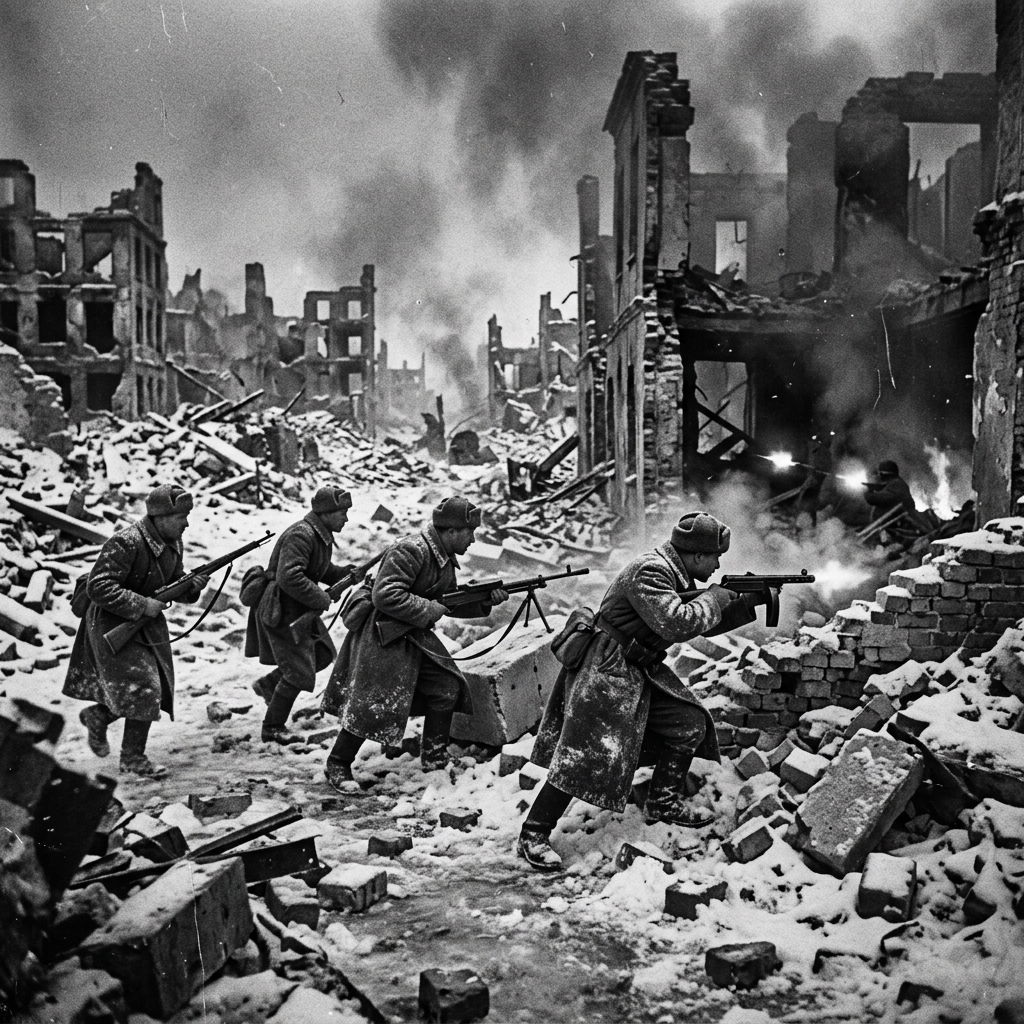
The Germans called it Rattenkrieg “Rat War.” It was combat stripped of all operational elegance, reduced to its most primal form: men killing each other at point-blank range in darkened rooms, over individual staircases, for control of single buildings. The front line, which on the Eastern Front was typically measured in kilometers, was measured in Stalingrad in meters.
The Strategic Lesson
Stalingrad demonstrated three principles that would prove enduring:
- Firepower applied indiscriminately in urban terrain can be counterproductive, creating obstacles that favor the defender more than the attacker.
- Urban combat is inherently infantry-centric. Armor, artillery, and air power are supporting arms in the city; the infantry squad is the decisive element.
- The attacker needs overwhelming numerical superiority to clear a defended city. The commonly cited ratio that an attacking force needs a 3:1 advantage in open terrain but a 10:1 advantage in urban terrain finds its origins in the Stalingrad experience.
The Soviet Union lost approximately 1.1 million casualties at Stalingrad. Germany lost its entire Sixth Army — over 800,000 killed, wounded, or captured. It remains the deadliest battle in human history and the foundational case study for urban warfare doctrine worldwide.
II. Hue City (1968): The Three-Dimensional Battlefield
The Battle of Hue during the Tet Offensive of 1968 introduced a new dimension to urban warfare doctrine: the integration of political, cultural, and informational considerations into tactical planning.
When North Vietnamese Army (NVA) and Viet Cong forces seized the ancient imperial capital of Hue on January 31, 1968, U.S. Marines and South Vietnamese forces faced a challenge that went beyond the purely military. Hue was not just a city it was Vietnam’s cultural heart, home to the Imperial Citadel, a UNESCO-recognized complex of palaces and temples. Destroying it to save it was not an acceptable option.
The Challenge of Constrained Warfare
American forces initially attempted to retake Hue using the same tactics they employed in the countryside calling in air strikes, naval gunfire, and heavy artillery. But the political and cultural constraints quickly became apparent. The South Vietnamese government explicitly prohibited the destruction of the Citadel’s most significant structures. American commanders were forced to adapt.
The resulting battle which lasted 26 brutal days produced several doctrinal innovations:
- Room-to-room clearance with minimal heavy weapons: Marines learned, through heavy casualties, to clear buildings systematically using small-unit tactics, grenades, and close-quarters marksmanship rather than calling in air strikes on every contested structure.
- “Mouseholing”: Rather than advancing through streets that had become kill zones, Marines blew holes through the interior walls of adjacent buildings, moving through entire blocks without ever stepping outside. This technique, improvised under fire at Hue, became a standard doctrine for urban operations.
- Combined arms at the micro level: Tanks were brought forward to fire directly into fortified positions at close range, while infantry teams cleared rooms immediately behind the point of impact. The coordination required was far more granular than anything practiced in open-terrain operations.
- The information dimension: The battle of Hue was broadcast on American television in near-real time. The images of Marines fighting house-to-house in a burning city contributed directly to the erosion of public support for the Vietnam War — demonstrating that urban warfare has an information dimension that can be strategically decisive.
The Enduring Lesson
Hue established that urban warfare cannot be separated from its political and cultural context. A military force may achieve tactical success in clearing a city, but if the method of clearance destroys the very thing that made the city worth fighting for or if the imagery of the fighting undermines political support at home the tactical victory becomes a strategic defeat.
This lesson would be learned and relearned in every major urban engagement that followed.
III. Mogadishu (1993): The Asymmetric Trap
The Battle of Mogadishu immortalized in Mark Bowden’s Black Hawk Down was a brief engagement (roughly 18 hours) that had an outsized impact on American military thinking about urban operations.
On October 3, 1993, U.S. Army Rangers and Delta Force operators conducted a daylight raid into the heart of Mogadishu to capture lieutenants of the Somali warlord Mohamed Farrah Aidid. The operation was planned as a rapid snatch-and-grab mission — 30 minutes in and out.
It became a 15-hour running battle through the streets of a hostile city.
What Went Wrong
When two MH-60 Black Hawk helicopters were shot down by Somali militia using RPG-7 rocket-propelled grenades, the mission shifted from a raid to a rescue operation in one of the world’s most densely populated urban environments. The American force — among the best-trained soldiers in the world found themselves:
- Surrounded and outnumbered: An estimated 2,000–4,000 Somali militia fighters converged on the crash sites, using the city’s maze-like streets and alleyways to maneuver undetected.
- Unable to leverage technology: GPS was in its infancy; vehicle convoys became lost in Mogadishu’s unmarked streets. Helicopter support was constrained by the density of the urban environment and the volume of ground fire.
- Trapped by terrain: The narrow streets channeled American vehicles into ambush corridors. Tires were shredded by debris, intersections became kill zones, and the convoy that was supposed to extract the ground force spent hours lost in the city.
Eighteen American soldiers were killed and 73 wounded. Somali casualties were estimated at 500–1,000 killed and 3,000–4,000 wounded. The strategic consequences were even more significant: the United States withdrew from Somalia entirely, and the debacle contributed to American reluctance to intervene in Rwanda the following year.
The Doctrinal Impact
Mogadishu forced a fundamental rethinking of American urban operations doctrine:
- The “Mogadishu Mile” problem: Extraction from urban terrain is at least as dangerous as insertion. Every urban operation must plan for the worst-case extraction scenario, not the best case.
- Helicopter vulnerability: The assumption that helicopters provided an asymmetric advantage in urban terrain was shattered. Low-flying rotary-wing aircraft are highly vulnerable to RPGs and small-arms fire in dense urban environments.
- The crowd as weapon: Somali fighters used civilians including women and children as shields, spotters, and ammunition carriers. The American rules of engagement, which prohibited firing on apparent non-combatants, were exploited systematically.
- Communications failure: The urban environment degraded radio communications, making coordination between dispersed units extremely difficult. This drove subsequent investment in urban-specific communications systems.
IV. Grozny (1994–1995 & 1999–2000): The Two Approaches
The Russian experience in Grozny across two separate battles provides perhaps the most instructive contrast in urban warfare doctrine: the catastrophic failure of an unprepared assault versus the devastating effectiveness of an unrestricted one.
The First Battle: A Catastrophe
On New Year’s Eve 1994, Russian forces launched a mechanized assault directly into the center of Grozny, the Chechen capital. The plan reflected the Soviet-era doctrine of overwhelming armored force columns of tanks and infantry fighting vehicles advancing along the city’s main avenues toward the presidential palace.
The result was a slaughter. Chechen fighters many of them former Soviet soldiers who knew Russian tactics intimately had prepared kill zones along every major avenue. Russian armored columns were ambushed from multiple floors simultaneously:
- RPGs struck the lead and rear vehicles, trapping the column.
- Fighters on upper floors fired down into the thinly armored tops of vehicles.
- Fighters in basements targeted the vulnerable undersides of tanks.
- Marksmen picked off crews as they attempted to escape burning vehicles.
The Russian 131st Motorized Rifle Brigade lost 102 of its 120 armored vehicles in the first 48 hours. The brigade effectively ceased to exist as a fighting force. Overall Russian casualties in the first battle were estimated at 1,500–2,000 killed in the opening weeks alone.
The first Grozny was a textbook case of what happens when a conventional force applies open-terrain doctrine to urban terrain without adaptation.
The Second Battle: Unrestricted Warfare
When Russian forces returned to Grozny in late 1999, they had learned the tactical lessons of the first battle but the solution they chose was one of unrestricted destruction.
Rather than repeating the armored assaults of 1994, Russian forces subjected Grozny to weeks of sustained aerial bombardment and artillery fire including thermobaric weapons, cluster munitions, and unguided rockets. The bombardment was not designed to support a ground assault; it was designed to destroy the city entirely before ground forces entered.
The tactic worked in purely military terms. Chechen resistance was broken, and the city was captured. But Grozny was effectively erased the United Nations called it “the most destroyed city on Earth.” Tens of thousands of civilians were killed. The devastation radicalized a generation of Chechens and fueled an insurgency that continued for years.
The Doctrinal Tension
Grozny’s two battles crystallize the central tension of urban warfare doctrine:
- The first battle demonstrates that urban assault without adequate preparation, intelligence, and adapted tactics leads to catastrophic losses.
- The second battle demonstrates that unrestricted firepower can achieve military objectives in urban terrain but at a cost that is strategically, politically, and morally unsustainable in most contexts.
The challenge for modern doctrine is to find the space between these two extremes: an approach that is effective enough to achieve military objectives but restrained enough to preserve the political legitimacy of the operation.
V. Fallujah (2004): The Doctrinal Model
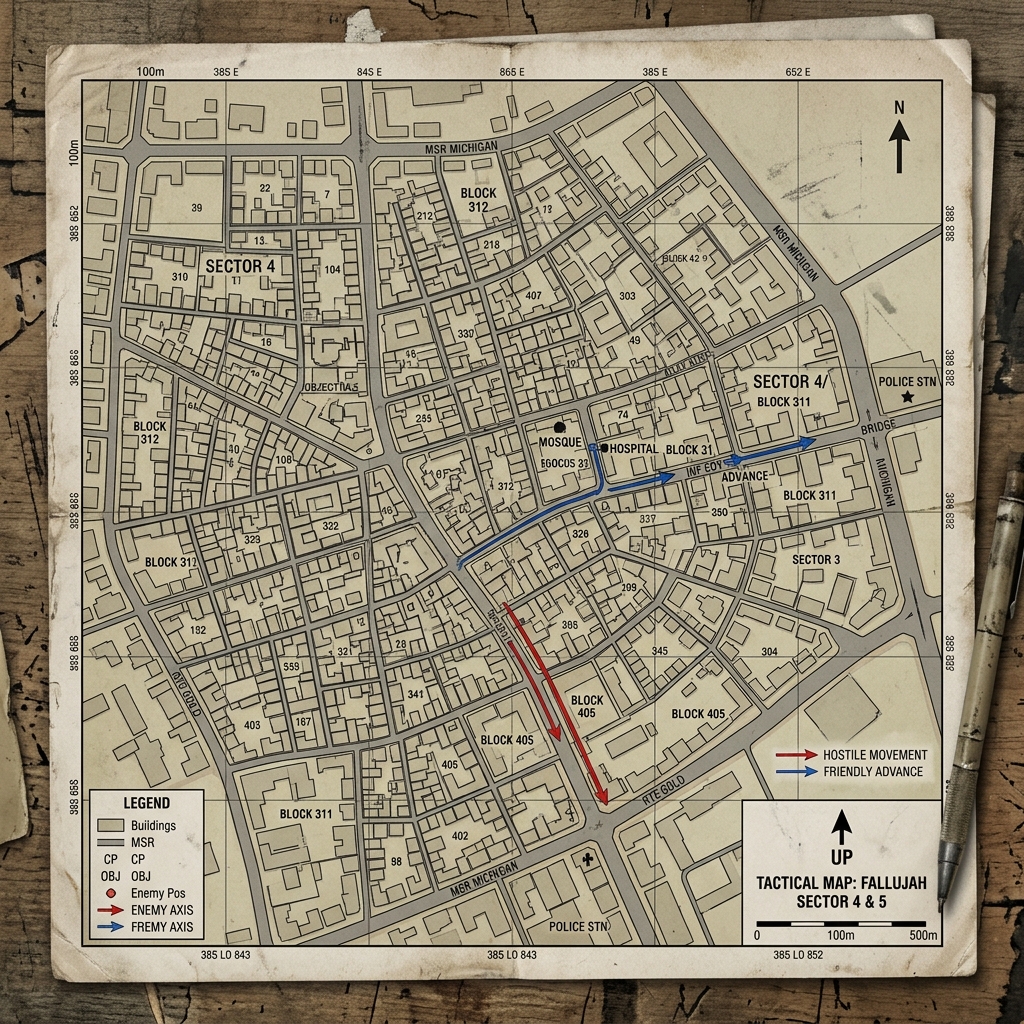
The two Battles of Fallujah in 2004 are widely regarded as the most significant urban combat operations conducted by Western forces since World War II — and the Second Battle, in particular, is considered the doctrinal model for how a modern professional military should approach urban warfare.
The First Battle: Political Failure
Operation Vigilant Resolve, launched in April 2004 in response to the killing and mutilation of four Blackwater security contractors, was halted after less than a month due to political pressure. Iraqi government officials, international media coverage of civilian casualties, and concerns about the operation’s impact on broader counterinsurgency efforts led to a ceasefire and withdrawal.
The first battle demonstrated a principle that Hue had established decades earlier: an urban operation that loses the information war is an operation that fails, regardless of tactical progress.
The Second Battle: Methodical Clearance
Operation Phantom Fury (Al-Fajr), launched in November 2004, represented the most thorough application of modern urban warfare doctrine in a generation. Before a single shot was fired, coalition forces conducted extensive shaping operations:
- Civilian evacuation: Approximately 250,000 of Fallujah’s 300,000 residents were evacuated in the weeks preceding the assault, dramatically reducing the civilian protection burden.
- Intelligence preparation: Extensive ISR (intelligence, surveillance, and reconnaissance) mapped insurgent positions, IED locations, weapons caches, and tunnel networks throughout the city.
- Isolation: The city was sealed roads blocked, bridges controlled, surrounding terrain dominated to prevent reinforcement or escape.
- Information operations: Coalition forces conducted a sustained information campaign to explain the operation’s objectives and prepare the political environment.
The assault itself was a masterclass in combined-arms urban operations:
- Infantry-armor teams: Marine and Army infantry squads advanced block by block, supported by M1 Abrams tanks and Bradley fighting vehicles that provided direct fire against fortified positions.
- Precision air support: AC-130 gunships, attack helicopters, and precision-guided munitions were used to strike specific targets, a far cry from the indiscriminate bombing that characterized Grozny.
- Engineers forward: Combat engineers were integrated at the squad level, breaching fortified buildings, clearing IEDs, and creating alternative routes of advance.
- Vertical envelopment: Rooftops were seized early in each engagement, denying insurgents the high ground and providing observation posts for the advancing force.
The Second Battle of Fallujah resulted in approximately 95 American killed and 560 wounded. Insurgent losses were estimated at 1,200–1,500 killed out of an estimated force of 3,000–4,000 fighters. The city was cleared in approximately six weeks.
The Doctrinal Legacy
Fallujah established the modern Western template for urban operations one built on preparation, precision, combined arms, and graduated escalation. Its key principles have been incorporated into the urban warfare doctrine of virtually every NATO military:
- Shape the battlefield before entering it.
- Evacuate civilians when possible.
- Isolate the objective area.
- Clear systematically, block by block, building by building.
- Integrate infantry, armor, engineers, and air support at the lowest tactical level.
- Maintain the information advantage throughout.
VI. Mosul (2016–2017): The Megacity Challenge
The Battle of Mosul the campaign to liberate Iraq’s second-largest city from the Islamic State was the largest urban battle of the 21st century. It lasted nine months, involved over 100,000 combatants, and took place in a city of nearly 2 million people most of whom could not or did not evacuate.
Scale and Complexity
Mosul presented challenges that dwarfed previous urban engagements:
- Population density: Unlike Fallujah, where the population was largely evacuated, hundreds of thousands of civilians remained in Mosul throughout the battle. ISIS deliberately used them as human shields, positioning fighting positions in hospitals, mosques, and residential buildings.
- Subterranean networks: ISIS had constructed an extensive tunnel network estimated at over 100 kilometers beneath the city, enabling fighters to move undetected, launch surprise attacks, and retreat from untenable positions.
- IED saturation: Mosul was the most heavily mined and booby-trapped urban environment in modern military history. Virtually every building, doorway, and street corner in ISIS-held territory was rigged with explosives. Vehicle-borne IEDs (VBIEDs) armored cars and trucks packed with explosives were used as guided missiles against advancing forces.
- The Old City: Western Mosul’s Old City a dense warren of narrow alleyways, ancient stone buildings, and covered markets was essentially impenetrable to armored vehicles. It had to be cleared on foot, building by building, in conditions that more closely resembled medieval siege warfare than modern combined-arms operations.
Doctrinal Evolution
Mosul advanced urban warfare doctrine in several important ways:
- Drone warfare: Both sides used commercial and military drones extensively. ISIS used modified commercial drones to drop grenades and conduct surveillance. Coalition forces used drones for ISR, target acquisition, and battle damage assessment. Mosul was the first major urban battle in which drones were a primary tactical tool for both attacker and defender.
- Civilian protection under fire: The presence of hundreds of thousands of civilians forced Iraqi and coalition forces to develop new procedures for civilian evacuation under active combat conditions, including humanitarian corridors, protected movement routes, and forward screening points.
- Sustained urban operations: Unlike Fallujah (six weeks), Mosul lasted nine months. This duration imposed enormous logistical, psychological, and political burdens on the attacking force and required sustained commitment that few militaries can maintain.
The battle resulted in an estimated 40,000 civilian deaths (according to some investigations), massive destruction of western Mosul, and the effective elimination of ISIS’s territorial control in Iraq. It demonstrated that even with modern doctrine, technology, and overwhelming numerical superiority, clearing a large, defended city remains one of the most difficult and destructive operations in warfare.
VII. Mariupol (2022): The Siege Returns
The siege of Mariupol during Russia’s 2022 invasion of Ukraine demonstrated that the most ancient form of urban warfare — the siege — remains devastatingly effective in the 21st century.
When Russian and separatist forces encircled Mariupol in early March 2022, the city’s Ukrainian defenders primarily the Azov Brigade and elements of the 36th Marine Brigade conducted a defense that drew directly on the principles established at Stalingrad eight decades earlier.
The Modern Siege
Russian forces applied the same approach they had used in Grozny’s second battle: systematic destruction through overwhelming firepower. Mariupol was subjected to weeks of bombardment from air, artillery, naval vessels, and multiple-launch rocket systems. Entire residential districts were leveled. Critical infrastructure water, electricity, heating was destroyed in the opening days.
The Ukrainian defense of the Azovstal steel plant a vast Soviet-era industrial complex with extensive underground facilities — became a symbol of urban resistance. For weeks, a garrison of approximately 2,500 fighters held out in a position surrounded on all sides, conducting defensive operations from the plant’s network of bunkers, tunnels, and basements while enduring continuous bombardment.
Lessons Reinforced and Lessons New
Mariupol reinforced several established urban warfare principles while introducing new ones:
- Fortified industrial terrain: The Azovstal plant demonstrated that large industrial complexes with their reinforced concrete, underground facilities, and labyrinthine layouts function as natural fortresses in urban combat. Future doctrine must account for the defensive potential of industrial infrastructure.
- Information warfare as force multiplier: The Ukrainian defenders’ ability to communicate with the outside world — through social media, satellite communications, and media engagement turned a military defeat into a political and moral victory. The siege of Mariupol galvanized international support for Ukraine and exposed Russian military conduct to global scrutiny.
- The siege as strategy: Despite possessing overwhelming conventional superiority, Russian forces ultimately relied on starvation, attrition, and the destruction of civilian infrastructure to compel surrender methods unchanged since antiquity. This suggests that for all the advances in military technology, the siege remains an available and effective instrument of urban warfare.
- Civilian catastrophe: The United Nations estimated that over 90 percent of Mariupol’s residential buildings were damaged or destroyed, and civilian casualties may have exceeded 20,000. The humanitarian cost of the siege was staggering and demonstrated, once again, that urban warfare’s heaviest burden falls on non-combatants.
VIII. Doctrinal Lessons: What History Teaches
The collective experience of urban warfare from Stalingrad to Mariupol yields a body of doctrinal lessons that any military force operating in urban terrain must internalize. These are not theoretical propositions they are conclusions validated by blood, repeatedly, across eight decades of combat.
Lesson 1: The City Fights Back
Urban terrain is not neutral. It actively favors the defender. Buildings provide cover and concealment. Narrow streets channel attackers into kill zones. Underground infrastructure enables undetected movement. Elevated positions provide observation and fields of fire. The attacker must contend not just with the enemy, but with the city itself.
The commonly cited force ratio for urban assault 10:1 in the attacker’s favor reflects not theoretical modeling but the observed reality of Stalingrad, Grozny, and Fallujah.
Lesson 2: Infantry Is the Decisive Arm
In open terrain, armor, artillery, and air power can be decisive independently. In urban terrain, they are supporting arms. The decisive element is the infantry squad small units of soldiers trained in close-quarters combat, breaching, room clearance, and the integration of supporting fires at extremely close range. Every major urban battle confirms this: the city is won or lost by the soldiers who clear it room by room.
Lesson 3: Combined Arms Must Be Integrated at the Lowest Level
Urban combat requires that infantry, armor, engineers, and fire support be integrated not at the battalion or company level, but at the platoon and squad level. A Marine fire team clearing a building in Fallujah needed a tank on the street behind it, an engineer to breach the next wall, and an air controller on the rooftop all operating within the same city block, in real time.
This level of integration demands training, trust, and communication capabilities that most militaries struggle to achieve.
Lesson 4: Preparation Determines Outcome
The contrast between the first and second Battles of Fallujah and between the first and second Battles of Grozny demonstrates that the outcome of an urban battle is largely determined before the first shot is fired. Intelligence preparation, civilian evacuation, isolation of the objective area, shaping operations, and information campaigns are not optional precursors to urban combat. They are the most important phases of the operation.
Lesson 5: Firepower Must Be Precise, Not Overwhelming
The Grozny and Mariupol experiences demonstrate that unrestricted firepower can achieve military objectives in urban terrain — but at a cost that is almost always strategically counterproductive. The destruction of Grozny radicalized the Chechen population. The destruction of Mariupol galvanized international opposition to Russia. In contrast, the precision-fires approach used in Fallujah achieved military objectives with comparatively limited collateral damage.
The doctrinal principle is clear: in urban warfare, restraint is not weakness it is strategic discipline.
Lesson 6: The Subterranean Domain Is Non-Negotiable
From the sewers of Stalingrad to the tunnels of Mosul to the bunkers of Azovstal, the subterranean domain has been a decisive factor in every major urban engagement. Forces that ignore or are unprepared for underground operations will be outmaneuvered by an enemy that exploits them.
Modern doctrine must treat the subterranean environment as a co-equal domain alongside the surface and aerial dimensions of urban combat.
Lesson 7: Civilians Are at the Center of Everything
Urban warfare, by definition, takes place among civilian populations. Every tactical decision from the choice of weapons to the route of advance to the timing of the assault has implications for civilian safety. Forces that fail to plan for civilian protection will face:
- Legal consequences under international humanitarian law.
- Political consequences as civilian casualties erode domestic and international support.
- Tactical consequences as a hostile or panicked civilian population impedes military operations.
The most successful urban operations in modern history including the Second Battle of Fallujah incorporated civilian evacuation and protection as a central planning consideration, not an afterthought.
Lesson 8: The Information Dimension Is a Battlefield
Hue demonstrated it in 1968. Mogadishu confirmed it in 1993. Mariupol made it undeniable in 2022. Urban warfare takes place under the gaze of the world. Every airstrike, every civilian casualty, every act of heroism or brutality is recorded, broadcast, and judged in real time.
Forces that fail to manage the information dimension of urban operations will lose the war of perception even as they win the war on the ground. Information operations, media engagement, and narrative management are not supporting activities they are decisive ones.
Lesson 9: Logistics Win Sieges
Urban combat is extraordinarily resource-intensive. Ammunition expenditure rates are three to five times higher than in open terrain. Casualty rates are higher. Vehicle attrition is higher. The physical and psychological demands on soldiers are extreme. Operations that are planned for days often extend to weeks or months.
The force that sustains its logistics and degrades its opponent’s wins the urban fight. This was true at Stalingrad, where Soviet logistics across the Volga were decisive, and it was true at Mariupol, where the severance of Ukrainian supply lines ultimately determined the outcome.
Lesson 10: Urban Combat Demands Psychological Resilience
The psychological burden of urban combat is qualitatively different from other forms of warfare. The constant proximity of the enemy, the three-dimensional threat environment, the inability to distinguish combatants from civilians, the claustrophobia of enclosed spaces, the presence of dead and wounded civilians all of these factors impose a psychological toll that degrades combat effectiveness rapidly.
Doctrine must account for rotation, rest, psychological support, and unit cohesion as operational necessities, not welfare amenities.
Lesson 11: Technology Amplifies but Does Not Replace Fundamentals
Drones in Mosul, precision munitions in Fallujah, satellite communications in Mariupol technology has transformed many aspects of urban combat. But it has not changed the fundamentals. The city still favors the defender. Infantry is still the decisive arm. Close-quarters combat is still brutal, chaotic, and human.
Technology should be integrated into urban doctrine as a force multiplier, not a substitute for the tactical competence, physical endurance, and moral courage that urban combat demands.
Lesson 12: There Is No Quick Urban Victory
Every major urban engagement in modern history has lasted longer, cost more, and produced more destruction than its planners anticipated. The German Sixth Army expected to take Stalingrad in weeks. The Russian army expected to take Grozny in days. The coalition expected to clear Mosul in months it took nine.
Urban warfare punishes optimism. Doctrine, planning, and resourcing must be built on realistic timelines and worst-case assumptions, not best-case hopes.
IX. The Future: Urban Warfare in 2030 and Beyond
The trajectory of global urbanization, combined with the evolution of military technology, suggests that urban warfare will become more frequent, more complex, and more consequential in the coming decades. Several trends will shape its future:
The Megacity Problem
By 2030, the world will have over 40 megacities urban areas with populations exceeding 10 million. Many of these will be in regions of instability: Lagos, Dhaka, Karachi, Kinshasa, Cairo. The prospect of military operations in a city of 15 or 20 million people with its sprawling informal settlements, failing infrastructure, and ethnic and sectarian fault lines represents a challenge of a different order of magnitude than anything in the historical record.
No existing military doctrine is adequate for megacity operations. The scale alone overwhelms traditional clearing methodologies. New approaches potentially including area control, population management, and selective engagement rather than systematic clearance will need to be developed.
Autonomous Systems and AI
The integration of artificial intelligence and autonomous systems into urban operations will accelerate dramatically. Unmanned ground vehicles for reconnaissance and IED clearance, swarms of small drones for building-by-building surveillance, AI-assisted target identification, and autonomous logistics platforms will all become standard elements of the urban warfare toolkit.
However, the ethical and legal implications of autonomous systems in urban environments where the distinction between combatant and civilian is already extremely difficult will pose profound challenges.
The Subterranean Frontier
Investment in subterranean warfare capabilities is accelerating across NATO and other advanced militaries. The U.S. Army has established dedicated subterranean training facilities and is developing doctrine, equipment, and specialized units for underground operations. As adversaries increasingly exploit tunnel networks as seen in Mosul, Gaza, and numerous other theaters — the ability to detect, map, and operate in underground environments will become a core competency.
Cyber and Electronic Warfare in the City
The modern city is a networked environment dependent on electrical grids, telecommunications, water systems, and digital infrastructure. Cyber operations that target these systems can degrade an adversary’s ability to function, communicate, and sustain a population without firing a shot. Conversely, defending one’s own urban infrastructure against cyber attack will become a critical military requirement.
Conclusion: The Hardest Fight
Urban warfare is the hardest thing that a military can be asked to do. It is the most demanding environment for the individual soldier, the most complex planning challenge for commanders, the most resource-intensive operation for logisticians, and the most morally fraught domain for political leaders. It destroys the very things it is fought to protect. It kills the people it is fought to liberate. It scars the soldiers who fight it in ways that other forms of combat do not.
And it is the future.
The lessons of Stalingrad, Hue, Mogadishu, Grozny, Fallujah, Mosul, and Mariupol are not historical curiosities. They are a warning and a guide a body of doctrine that has been paid for at an almost incomprehensible cost. The militaries, political leaders, and societies that study these lessons and internalize them will be better prepared for the conflicts to come. Those that ignore them will rediscover the same truths, at the same price, in the cities of tomorrow.
The city is not going away. Neither is the fight for it.
The views expressed in this article are those of the editorial team and are intended to foster informed discussion on matters of defense strategy, military doctrine, and the human dimensions of armed conflict.
Related Reading:
- The Cold War’s Forgotten Proxies: Lessons for Managing Modern Conflict — How superpower competition through third parties shaped the modern world — and what it means for today.
- Mission Command and Decentralized Leadership: Lessons for the Modern Battlefield — Why pushing decision-making to the lowest level transforms military effectiveness.
- The Three-Block War Revisited: Humanitarian Operations in Hostile Urban Terrain — Navigating combat, peacekeeping, and aid delivery simultaneously.