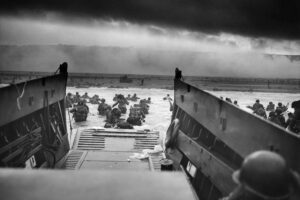
The Cold War was never cold for those who fought it. While Washington and Moscow avoided direct confrontation, millions perished in proxy wars across Asia, Africa, and Latin America — conflicts that reshaped nations and left scars still visible today. As great-power competition returns with new intensity, the forgotten lessons of those wars have never been more urgent.

Introduction: The Wars Behind the Wall
Between 1947 and 1991, the United States and the Soviet Union waged a global struggle for power and ideological influence without fighting each other directly. What became known as the “Long Peace” was defined by the absence of direct war between the two superpowers, even as conflicts elsewhere became entangled with their rivalry. Rather than confronting each other on the battlefield, Washington and Moscow often supported governments, insurgencies, and armed movements through weapons, funding, training, intelligence, and political backing..
The human cost was enormous. Across Asia, Africa, Latin America, and the Middle East, wars connected to Cold War rivalries killed and displaced millions of people. Entire societies were destabilized, while civilians often paid the highest price for decisions made in Washington, Moscow, Beijing, and other foreign capitals. Many of these conflicts have since faded from public memory, overshadowed by better-known episodes such as the Berlin Wall, the Cuban Missile Crisis, and the nuclear arms race.
Today, great-power competition is again shaping conflicts far beyond the borders of the states involved. The United States, China, Russia, and other powers use a wider range of tools than during the Cold War, including military aid, intelligence support, cyber operations, economic pressure, and partnerships with local actors. The methods have changed, but the basic problem remains familiar: outside powers can influence a conflict without bearing all of its costs themselves.
To navigate this new era, we must revisit the old one. Not the Cold War of textbooks and summits, but the Cold War as it was actually experienced in the jungles of Southeast Asia, the highlands of Afghanistan, the savannas of Angola, and the mountains of Central America. These forgotten proxies hold lessons that no amount of modern strategic theory can replace.
I. The Anatomy of a Proxy War
Before examining individual conflicts, it is essential to understand what made Cold War proxy wars distinct — and what made them so destructive.
A proxy war is an indirect conflict in which a state or other powerful actor supports a belligerent while avoiding, or limiting, direct involvement in the fighting. That support can include weapons, funding, intelligence, training, diplomatic backing, and sometimes personnel. The local actors usually do most of the fighting, but they also pursue their own political and military objectives, which do not always match those of the outside power. That tension between sponsor and partner is one of the defining features of proxy warfare.
Cold War proxy wars shared several structural features:
- Ideological framing: Local grievances, land reform, ethnic autonomy, anti-colonial nationalism were recast as fronts in the global struggle between capitalism and communism. This flattened complex local dynamics into a binary framework that rarely reflected ground truth.
- Escalation without accountability: Because great powers operated at one remove, they could escalate commitments incrementally without triggering the domestic political costs of a declared war until, as in Vietnam, the costs became impossible to ignore.
- Abandonment cycles: Proxy relationships were inherently transactional. When strategic calculus shifted, great powers routinely abandoned their local partners often with catastrophic consequences for those left behind.
- Civilian devastation: Proxy wars were fought overwhelmingly in the developing world, among populations with the least capacity to absorb the costs of conflict. The civilian-to-combatant casualty ratios in Cold War proxies were consistently among the worst in modern warfare.
Understanding these dynamics is not merely an academic exercise. Each of these patterns is visible in today’s conflicts.
II. The Forgotten Theaters
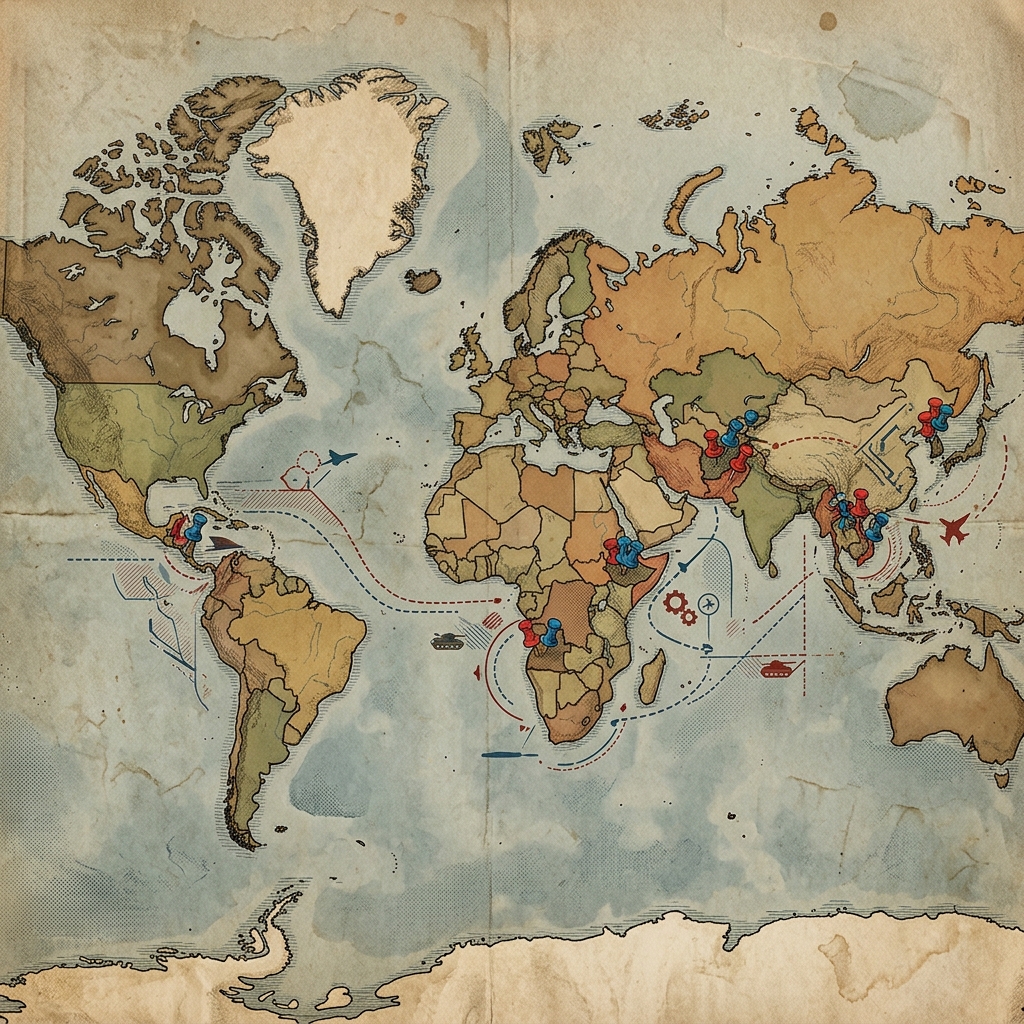
Korea (1950–1953): The Template
The Korean War is often called “the forgotten war,” which is itself instructive. It was the first major Cold War proxy conflict and established the template for all that followed. When North Korean forces, backed by Soviet arms and Chinese manpower, crossed the 38th parallel in June 1950, the United States intervened under the banner of the United Nations. What followed was three years of devastating warfare that killed an estimated 2.5 million civilians, leveled nearly every major city in the North, and ended in a stalemate that persists to this day.
Korea demonstrated several enduring truths: that proxy wars tend to expand beyond their originators’ intentions; that conventional military superiority does not guarantee strategic success; and that armistices without political resolution create frozen conflicts that can reignite decades later. The Korean Peninsula remains one of the most militarized borders on Earth a living monument to the unfinished business of the Cold War’s first proxy.
Vietnam (1955–1975): The Quagmire Doctrine
Vietnam remains the most extensively studied Cold War proxy, and for good reason. It was the conflict that most visibly exposed the limits of superpower intervention. The United States committed over 2.7 million military personnel over the course of the war, dropped more tonnage of bombs than were used in all of World War II, and still failed to prevent the reunification of Vietnam under communist rule.
The lessons of Vietnam are by now canonical but they bear repeating, because they are routinely ignored:
- Military force cannot substitute for political legitimacy. The South Vietnamese government never achieved the popular mandate necessary to sustain a counterinsurgency campaign, regardless of American firepower.
- Escalation has diminishing returns. Each increase in American commitment deepened the quagmire without fundamentally changing the strategic equation.
- Domestic politics constrain foreign wars. The anti-war movement and the erosion of public support ultimately made the war politically unsustainable — a dynamic that applies to any democracy fighting a protracted conflict abroad.
- The human cost outlasts the strategic rationale. Agent Orange, unexploded ordnance, and generational trauma continue to affect Vietnam more than fifty years after the last American helicopter left Saigon.
Angola (1975–2002): The African Chessboard
Angola represents perhaps the purest case of Cold War proxy warfare and one of its most tragic. When Portugal abruptly withdrew from its largest African colony in 1975, three liberation movements immediately turned on each other: the Soviet- and Cuban-backed MPLA (People’s Movement for the Liberation of Angola), the American- and South African-backed UNITA (National Union for the Total Independence of Angola), and the smaller FNLA (National Front for the Liberation of Angola).
What followed was 27 years of civil war one of the longest in modern history. The Soviet Union and Cuba deployed up to 50,000 Cuban troops at the war’s peak. The United States funneled hundreds of millions of dollars in covert aid to UNITA through the CIA, while apartheid South Africa conducted repeated military incursions from neighboring Namibia. China also briefly backed the FNLA.
Angola’s war outlived the Cold War itself. Even after Soviet and American interest waned in the early 1990s, the conflict continued, fueled by Angola’s vast oil and diamond resources a phenomenon scholars call the “resource curse” of post-proxy wars. By the time UNITA leader Jonas Savimbi was killed in 2002, an estimated 1.5 million Angolans had died and 4 million had been displaced.
The Angolan case teaches a brutal lesson: proxy wars create self-sustaining conflict economies that persist long after the original sponsors lose interest. The weapons, the warlords, and the grievances do not disappear when the superpowers move on.
Afghanistan (1979–1989): The Graveyard’s Lesson
The Soviet invasion of Afghanistan in December 1979 triggered the largest covert operation in CIA history. Under Operation Cyclone, the United States working through Pakistan’s Inter-Services Intelligence (ISI) channeled an estimated $3 billion in arms and funding to the Afghan mujahideen. Saudi Arabia matched the American contribution dollar for dollar. China, Egypt, and the United Kingdom also provided support.
The strategy worked in the narrowest sense. The mujahideen bled the Soviet military for a decade, contributing to Moscow’s decision to withdraw in 1989 and, ultimately, to the collapse of the Soviet Union itself. It was hailed as one of the great strategic victories of the Cold War.
But the aftermath was catastrophic. The United States disengaged from Afghanistan almost immediately after the Soviet withdrawal, leaving behind a shattered country awash in weapons and fractured among competing warlord factions. The power vacuum that followed gave rise to the Taliban and provided sanctuary to al-Qaeda setting the stage for the September 11 attacks and two decades of American military involvement in the very country it had once armed from afar.
Afghanistan stands as the Cold War’s starkest warning about blowback the unintended consequences of arming non-state actors for short-term strategic gain. The mujahideen who received American Stinger missiles in the 1980s became the insurgents who targeted American soldiers in the 2000s. The lesson could not be clearer, and yet it continues to be repeated.
Nicaragua and Central America (1979–1990): The Covert War
Central America in the 1980s was the Western Hemisphere’s primary Cold War battleground. In Nicaragua, the Sandinista revolution of 1979 alarmed the Reagan administration, which responded by organizing, funding, and directing the Contras — a guerrilla force composed largely of former members of the deposed Somoza regime’s National Guard.
The Contra war was fought largely in Nicaragua’s rural north, devastating the country’s economy and killing an estimated 30,000 people in a nation of barely 3 million. The conflict became mired in scandal when the Iran-Contra affair revealed that the Reagan administration had secretly sold arms to Iran and used the proceeds to fund the Contras in violation of congressional prohibitions.
Simultaneously, the United States was deeply involved in the civil wars in El Salvador and Guatemala, backing governments accused of widespread human rights abuses including massacres of indigenous communities. The Salvadoran civil war alone killed approximately 75,000 people, the vast majority civilians.
Central America illustrates a lesson that resonates powerfully today: when great powers prioritize geopolitical alignment over governance and human rights, they create long-term instability that far outlasts the immediate strategic threat. The gang violence, institutional weakness, and mass migration that characterize Central America’s Northern Triangle today are, in significant part, legacies of Cold War-era intervention.
The Horn of Africa (1974–1991): Switching Sides
The Cold War in the Horn of Africa produced one of history’s most cynical episodes of proxy warfare. In 1974, a Marxist military junta the Derg seized power in Ethiopia, aligning the country with the Soviet Union. This prompted neighboring Somalia, which had been a Soviet client, to switch allegiance to the United States.
When Somalia invaded Ethiopia’s Ogaden region in 1977, the Soviet Union airlifted $1 billion in arms and 17,000 Cuban troops to defend its new Ethiopian ally the same Ethiopia it had been cultivating for barely two years, and against the same Somalia it had armed just months earlier.
The result was a devastating regional war, followed by the Ethiopian famine of 1983–1985 (which killed an estimated 1 million people and was exacerbated by the Derg’s military spending and forced resettlement policies), and the eventual collapse of the Somali state in 1991 producing a failed state whose consequences the international community is still managing today.
The Horn of Africa demonstrates that proxy relationships are fundamentally opportunistic. Ideology was a veneer; the real currency was strategic access. Both superpowers switched partners with ruthless pragmatism when it suited them, leaving local populations to absorb the consequences of geopolitical whiplash.
III. The Modern Echo: Today’s Proxy Landscape
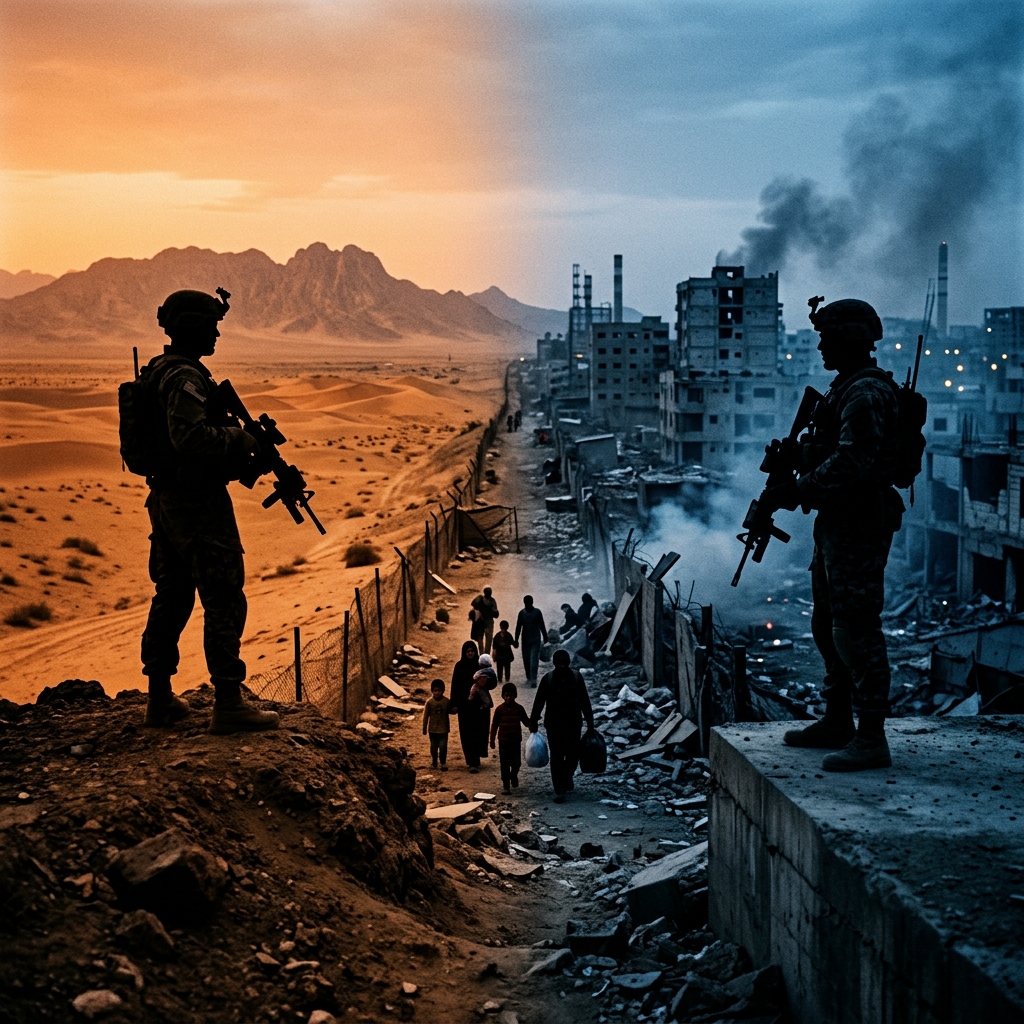
The Cold War ended in 1991, but proxy warfare did not. If anything, it has become more complex, more diffuse, and harder to attribute. Consider the contemporary landscape:
- Ukraine (2014–present): Russia’s annexation of Crimea and support for separatists in the Donbas followed by the full-scale invasion of 2022 has produced a conflict in which Western nations provide extensive military, financial, and intelligence support to Ukraine without directly engaging Russian forces. The parallels to Cold War-era proxy dynamics are unmistakable, though the scale of Western support is unprecedented.
- Syria (2011–present): The Syrian civil war became a proxy battlefield involving Russia, Iran, Turkey, the United States, Saudi Arabia, Qatar, and numerous non-state actors. The result is a fractured country with overlapping zones of foreign influence and no clear path to political resolution.
- Yemen (2014–present): The Saudi- and UAE-led intervention against the Houthi movement, which receives Iranian support, has produced what the United Nations has called the world’s worst humanitarian crisis — with over 150,000 dead and millions facing famine.
- The Sahel (2020s): The withdrawal of French forces and the expansion of Russian private military contractors (notably the Wagner Group) across Mali, Burkina Faso, and Niger represents a new model of proxy influence one based on mercenary economics rather than ideological alignment.
- The Indo-Pacific: While not yet a shooting war, the intensifying competition between the United States and China in the Indo-Pacific involves many classic proxy dynamics arms transfers, security partnerships, economic leverage, and the cultivation of local allies as buffers against a rival power.
Each of these conflicts exhibits patterns that Cold War historians will recognize immediately. The question is whether today’s policymakers will recognize them too and learn from them.
IV. Lessons for Managing Modern Conflict
The Cold War’s proxy wars, taken together, offer a body of strategic experience that is directly applicable to the challenges of the 2020s and beyond. The following lessons are not abstract principles; they are conclusions drawn from specific historical outcomes, paid for in millions of lives.
Lesson 1: There Are No Cheap Wars
The fundamental appeal of proxy warfare for great powers is that it appears to offer strategic leverage at reduced cost. Someone else does the fighting. Someone else absorbs the casualties. The financial expenditure, while significant, is a fraction of what a direct intervention would cost.
This calculus is an illusion. The costs of proxy wars are not eliminated; they are externalized onto local populations, onto regional stability, and onto the future. Angola’s 27-year civil war, Afghanistan’s four decades of conflict, Somalia’s state collapse: these are the true costs of proxy warfare, and they are borne for generations.
For modern policymakers: Every decision to arm, fund, or support a belligerent in a foreign conflict should be accompanied by an honest accounting of long-term costs not just to the supporting power, but to the country and region where the fighting takes place.
Lesson 2: Arms Transfers Create Path Dependencies
Once weapons flow into a conflict zone, they do not disappear when the conflict ends. They circulate, they proliferate, and they fuel the next war. The Stinger missiles sent to Afghanistan in the 1980s remained a security concern for decades. The weapons poured into Libya after 2011 spread across the Sahel, fueling insurgencies in Mali, Niger, and beyond.
Moreover, arming a proxy creates a relationship of dependency that constrains the sponsor’s future options. Having invested credibility and resources in a partner, great powers find it politically difficult to withdraw support even when the partner’s behavior becomes counterproductive a dynamic visible in the American relationship with South Vietnam, the Soviet relationship with the Derg, and the Saudi relationship with various Yemeni factions.
For modern policymakers: Arms transfer decisions should include rigorous end-use monitoring, sunset clauses, and explicit contingency planning for what happens when the strategic rationale for the transfer changes.
Lesson 3: Local Dynamics Always Dominate
The single most consistent failure of Cold War proxy warfare was the tendency of great powers to impose an ideological framework on conflicts whose drivers were fundamentally local. The war in Vietnam was not primarily about communism versus capitalism; it was about nationalism, land reform, and the legacy of colonialism. The war in Angola was not primarily about Marxism versus democracy; it was about ethnic rivalry, resource control, and post-colonial power.
When great powers misread local dynamics, they make predictable errors: they choose the wrong partners, they set unachievable objectives, and they are blindsided when local actors pursue agendas that diverge from their sponsors’ interests.
For modern policymakers: Deep, granular understanding of local political, ethnic, economic, and social dynamics is not optional — it is the single most important determinant of whether an intervention will succeed or fail. Imposing a geopolitical template onto a local conflict is a recipe for strategic failure.
Lesson 4: Exit Strategies Are Not Optional
The United States left Afghanistan in 1989 without a plan for what would follow. The result was the Taliban. The Soviet Union left its African clients without sustainable institutions. The result was state collapse. France left the Sahel without a transition plan. The result was Wagner.
The pattern is unambiguous: disengagement without transition planning produces outcomes worse than the original problem. And yet, great powers consistently fail to plan for the aftermath of their proxy engagements — in part because the political incentive is to declare victory and move on, and in part because the messy work of post-conflict stabilization lacks the strategic glamour of the intervention itself.
For modern policymakers: Every proxy engagement should include, from its inception, a detailed plan for disengagement — including political transition, institutional support, disarmament, and economic reconstruction. If no credible exit strategy exists, the engagement should be reconsidered.
Lesson 5: Humanitarian Consequences Are Strategic Consequences
Cold War-era policymakers tended to treat civilian casualties and humanitarian crises as unfortunate but secondary byproducts of proxy warfare. This was not only morally indefensible it was strategically foolish. Humanitarian disasters generate refugee flows, radicalization, state fragility, and regional instability that persist for decades and ultimately demand far greater intervention than early prevention would have required.
The famine in Ethiopia, the refugee crisis from Central America, the displacement of millions in Angola these were not side effects of Cold War proxy wars. They were among the most consequential outcomes, and they continue to shape global politics today.
For modern policymakers: Humanitarian impact assessments should be integrated into strategic planning from the outset. The question is not whether civilian harm is regrettable it always is but whether it is being factored into the strategic calculus with the weight it deserves.
Lesson 6: Multilateral Frameworks Reduce Risk
The Cold War proxy conflicts that achieved the most durable resolutions such as the Namibian independence process and the Mozambican peace agreement — were those in which multilateral institutions played a meaningful role. When the United Nations, regional organizations, or multilateral negotiating frameworks were engaged, the results were consistently better than when great powers acted unilaterally or through bilateral patron-client relationships.
This is not because multilateral institutions are inherently more virtuous, but because they provide mechanisms for burden-sharing, legitimacy, monitoring, and accountability that unilateral action lacks. They also create diplomatic space for face-saving compromises that are impossible in zero-sum bilateral competitions.
For modern policymakers: Strengthening multilateral conflict-resolution mechanisms including the UN Security Council, regional organizations, and international courts — is not idealistic; it is a pragmatic investment in reducing the costs of managing conflict.
Lesson 7: Non-State Actors Are Not Controllable
Perhaps the most dangerous illusion of proxy warfare is the belief that non-state actors can be reliably controlled by their state sponsors. The Cold War record is unequivocal on this point: they cannot. The mujahideen did not remain loyal clients of the United States. The Contras did not share the Reagan administration’s democratic aspirations. Cuban forces in Angola pursued their own agenda alongside Moscow’s.
Non-state actors have their own interests, their own internal politics, and their own calculations about when cooperation with a great power serves their purposes and when it does not. The sponsor-proxy relationship is, at best, a temporary convergence of interests not a command-and-control hierarchy.
For modern policymakers: Any engagement with non-state armed actors should be premised on the assumption that the relationship will eventually diverge. Building institutional checks, diversifying partnerships, and maintaining independent intelligence capabilities are essential hedges against the inevitable loss of proxy control.
V. The Moral Dimension
No analysis of Cold War proxy warfare is complete without confronting its moral dimension. The Cold War’s forgotten proxies were not abstractions. They were wars fought by real people farmers conscripted into militias, children maimed by landmines, families torn apart by displacement and violence in pursuit of objectives that were frequently unclear and occasionally cynical.
The moral burden of proxy warfare is not equally distributed. The populations of Angola, Afghanistan, Vietnam, Nicaragua, and the Horn of Africa paid the highest price for a geopolitical contest in which they had no say. The great powers that orchestrated these conflicts bore minimal domestic consequences which is precisely what made proxy warfare so politically attractive, and so morally corrosive.
As proxy warfare returns to prominence in the 21st century, this moral dimension demands explicit engagement. The question facing policymakers today is not merely “Can we achieve our strategic objectives through proxies?” but “Should we and at what cost to those who have no voice in the decision?”
History suggests that when this question is not asked, the consequences are borne by those least equipped to bear them.
Conclusion: Remembering What Was Forgotten
The Cold War’s proxy wars were not peripheral to the main event. They were the main event the places where the Cold War’s abstract ideological competition was translated into concrete human suffering on a massive scale. That they have been largely forgotten in the public consciousness of the nations that instigated them is itself a lesson in how great powers process the costs of their foreign policies.
Today, the return of great-power competition has reintroduced proxy dynamics into the international system with alarming speed. Ukraine, Syria, Yemen, the Sahel, the Indo-Pacific the roster of potential and active proxy conflicts grows longer by the year. The tools have evolved: cyber operations, private military companies, economic warfare, and information operations have supplemented the traditional toolkit of arms transfers and covert action. But the fundamental dynamics the externalization of costs, the instrumentalization of local actors, the absence of exit strategies, the humanitarian devastation remain unchanged.
The Cold War’s forgotten proxies offer a curriculum in what works, what fails, and what costs are incurred when great powers fight through others. The lessons are there for anyone willing to learn them. The question is whether today’s leaders will study that curriculum or whether they will insist on learning the same lessons again, at the same price, paid by the same people who can least afford it.
The views expressed in this article are those of the editorial team and are intended to foster informed discussion on matters of international security, conflict management, and strategic policy.
Related Reading:
- Mission Command: Why Decentralized Leadership Wins Battles — And the Timeless Mission Lessons It Teaches Every Leader.
- The New Great Game: China, Russia, and the Contest for the Global South — Mapping the emerging competition for influence in the developing world.
- From Kabul to Kyiv: The Evolution of Western Military Assistance — How the model of supporting partners has changed since Afghanistan.