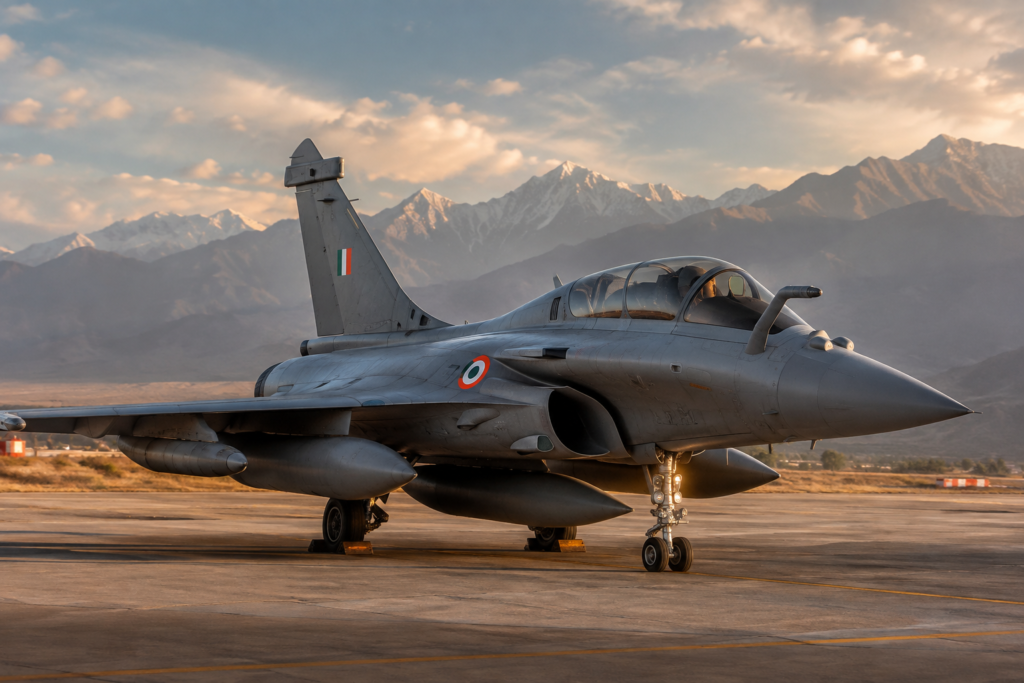
In early August, Dassault Aviation handed India’s Ministry of Defence a formal proposal to sell 114 more Rafale fighter jets. It’s a follow-on order that would dwarf the 36-aircraft deal India signed with France back in 2016. Reports put the package at roughly ₹3.25 lakh crore, somewhere in the $34–35 billion range, with the bulk of the aircraft to be assembled inside India rather than flown in from France. The proposal is now sitting with India’s Acquisition Wing and the Indian Air Force for evaluation, and if the numbers hold, a contract could be signed by late 2026 or early 2027.
On paper, this reads like a straightforward arms deal. It isn’t. Buried inside the procurement math is a harder question the Indian Air Force has been wrestling with for over a decade: can buying more of a very good foreign fighter actually fix a readiness problem that has structural roots. Or does it just delay the reckoning?
Why the Indian Air Force needs more fighters
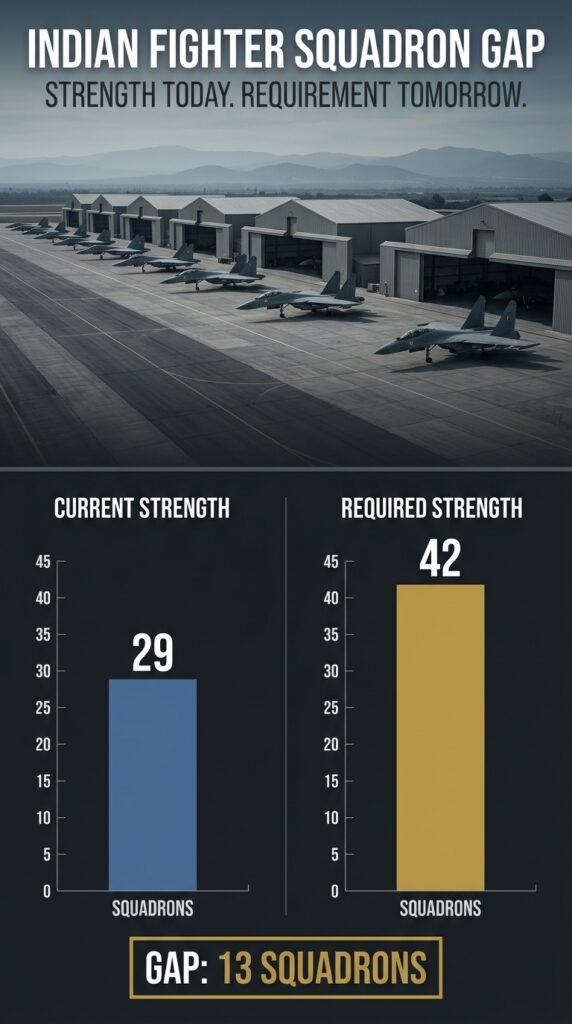
Start with the number that explains almost everything else in this story: 29. That’s how many fighter squadrons the IAF currently fields, against a government-sanctioned strength of 42. The gap isn’t new. It has been widening for years as older Soviet-era airframes, particularly the MiG-21 fleet, have been retired faster than replacements have arrived to take their place.
A fighter squadron isn’t just a line item. It’s a set of trained pilots, ground crews, spare-parts pipelines, and maintenance infrastructure built around a specific aircraft type. When squadrons retire faster than they’re replaced, the air force doesn’t just get smaller. It gets thinner in exactly the places that matter during a crisis: surge capacity, sortie generation rates, and the ability to fight on two fronts at once, which has been a standing planning assumption for the IAF given its neighbors.
The 114-aircraft MRFA competition exists because of that shortfall. It isn’t really about wanting the “best” jet in some abstract sense. It’s about closing a squadron-count gap that has been growing since well before this specific competition began.
The Rafale proposal, in plain terms
Dassault’s submission splits the order roughly into a small batch of jets built in France and delivered “flyaway,” with the much larger share assembled domestically. Reporting varies between 18 and 20 flyaway aircraft and 94 to 96 built in India, with Tata Advanced Systems Limited already contracted to build fuselages in Hyderabad. Dassault has said it wants to avoid the mistakes of the earlier 126-jet MMRCA program from a decade ago, which collapsed largely over unresolved questions about who would be accountable for aircraft built under license in India. This time, Dassault is reportedly taking direct responsibility for the manufacturing partnership rather than leaving it to a state-run intermediary, and picking its own Indian suppliers rather than inheriting a government-assigned one.
If the deal closes as proposed, India would end up operating roughly 176 Rafales in total once its existing Air Force and Navy orders are counted together. That’s a scale that would make India, alongside France, one of only two countries flying both land-based and carrier-capable Rafale variants.
That scale matters beyond raw aircraft count. A fleet of that size changes the economics of spares, simulators, training pipelines, and maintenance depots. Having 176 aircraft of one type is a fundamentally different logistics proposition than the 36 India has flown until now, closer to a genuine backbone fleet than a boutique capability held in reserve for special missions.
Rafale versus India’s indigenous fighter ambitions
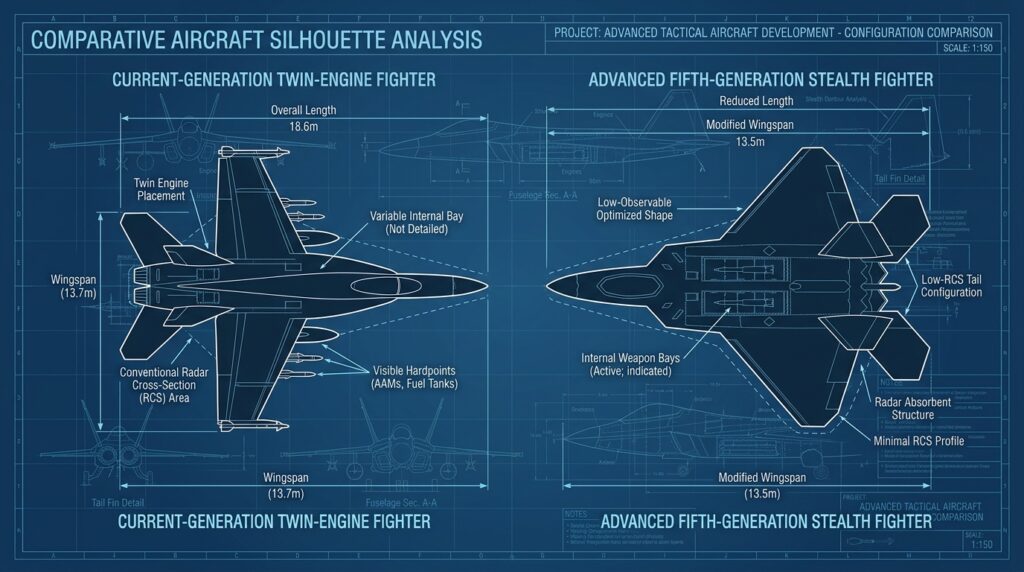
Here’s where the story gets more complicated than “India buys more jets.” At the same time Dassault has been pushing its MRFA proposal, India has also been moving slowly toward fielding its own fifth-generation stealth fighter, the Advanced Medium Combat Aircraft, or AMCA.
The AMCA program has had a busy year. In May, the Ministry of Defence issued requests for proposals to three private-sector-led consortia, including groupings led by Tata, L&T, and Bharat Forge, to build the first five AMCA prototypes, marking the first time a major Indian fighter program has bypassed state-run Hindustan Aeronautics Limited as the lead developer. France’s Safran has also signed on to help co-develop a more powerful future engine for a later AMCA variant. But the honest version of the AMCA timeline is: first flight isn’t expected until around 2028, certification is targeted for roughly 2032, and induction into squadron service isn’t expected before the mid-2030s. Even optimistic observers note that Indian aerospace programs have a long history of schedule slippage, and the AMCA’s own engineering-development phase is still working through basic supply questions, including unresolved contracts for the jet engines needed just to fly the prototypes.
That leaves a gap of roughly a decade between now and whenever AMCA squadrons are actually combat-ready. That’s a decade during which the IAF’s squadron shortfall doesn’t pause and wait. The Rafale MRFA buy exists precisely to bridge that decade. It is not a competitor to the AMCA program; it’s a stopgap for the years the AMCA can’t yet cover.
The tension is less “foreign jet versus indigenous jet” and more a question of sequencing and risk. Every rupee and every unit of institutional attention spent finalizing and absorbing a 114-aircraft Rafale order is a rupee and a unit of attention not spent accelerating AMCA, Tejas Mark 2, or the engine programs that both ultimately depend on. Defense planners in New Delhi have to manage both clocks running at once, the near-term readiness clock and the long-term indigenous-capability clock, without letting either stall the other.
What 114 more aircraft could actually change
If the deal proceeds, the practical effects go beyond adding to a fleet count:
- Sortie generation. More airframes, spread across more bases, means more aircraft available on any given day once maintenance cycles are accounted for, directly addressing the surge-capacity problem that a shrinking squadron count creates.
- A genuine industrial base. Manufacturing 94-plus airframes domestically, alongside components already contracted to Indian firms, is a different proposition than assembling a handful of jets as a political gesture. At that volume, suppliers can justify real investment in tooling, workforce training, and long-term capacity. That’s the kind of investment that doesn’t show up after a 6- or 18-aircraft order.
- Technology transfer, with caveats. Reports indicate a long-running dispute over access to the Rafale’s source code and software architecture remains unresolved even as the proposal moves forward. Historically, India’s defense deals have delivered manufacturing know-how more readily than they’ve delivered access to the software and systems integration knowledge that would let India meaningfully modify or upgrade the aircraft on its own terms later. Whether this deal closes that gap, or simply repeats the pattern, is one of the more consequential open questions in the negotiation.
- Export ambitions. Some Indian and French commentary has floated the idea of India becoming a second global production hub for the Rafale, supplying export customers across Asia, West Asia, and Africa. That’s a genuinely interesting possibility, but worth treating with some skepticism until it’s tested. Any such exports would still be negotiated directly with Dassault and the French government, since the aircraft’s core design remains French-owned regardless of where it’s assembled.
What recent conflicts have taught India about airpower
The MRFA push isn’t happening in a vacuum. Recent air campaigns, from the sustained use of long-range precision strikes and layered air defense in the Russia-Ukraine war, to India’s own limited air engagements along its western border in recent years, have reinforced a few lessons that show up repeatedly in Indian defense planning discussions.
First, that quality alone doesn’t substitute for quantity when a conflict runs longer than a few days: attrition, maintenance cycles, and munitions stockpiles matter as much as any single aircraft’s individual capability. Second, that networked capability, meaning datalinks, stand-off weapons, and integration with ground-based air defense, increasingly determines outcomes more than any one platform’s specifications in isolation. Third, that supply chains matter under pressure: a fighter fleet that depends on a single foreign source for spares, munitions, or software updates carries strategic risk that becomes very concrete the moment a conflict actually starts.
Each of these lessons cuts in a specific direction for the Rafale decision. Buying a proven, combat-tested aircraft addresses part of the quantity and readiness problem quickly. But unless the domestic manufacturing and technology-transfer components of the deal are real, meaning not just partial assembly but genuine access to sustainment, upgrades, and eventually export-grade know-how, India risks solving today’s squadron-count problem while recreating tomorrow’s supply-chain dependency problem.
Does buying more advanced fighters solve the underlying problem?
This is the question that tends to get skipped in coverage that treats the MRFA proposal as simply a big-ticket purchase. The honest answer is: partially, and only if paired with things that have nothing to do with the aircraft itself.
Adding 114 airframes addresses squadron count, the most visible symptom of the IAF’s current shortfall. It does not, by itself, fix the deeper issues that produced the shortfall in the first place: a domestic fighter-development pipeline (Tejas Mark 1A, Tejas Mark 2, AMCA) that has repeatedly run behind schedule; an engine-development and licensing process that has taken years longer than planned; and an acquisition bureaucracy that has, in the past, let programs like the original MMRCA competition collapse under their own procedural weight.
A large Rafale order buys the IAF time. It does not, on its own, buy India the kind of sovereign fighter-production capability that would let it stop having this exact conversation again in another fifteen years. Whether this specific deal becomes the exception, genuinely transferring capability rather than just assembly work, will depend on details still being negotiated: the software-access dispute, the depth of the technology-transfer terms, and whether the domestic supply chain built for this order is structured to outlast the order itself.
What to watch next
France was given until mid-August to file its formal response to India’s Letter of Request, after which pricing negotiations are expected to begin in earnest. Final sign-off rests with India’s Cabinet Committee on Security, chaired by the prime minister, following the Defence Acquisition Council’s earlier clearance. Dassault’s own leadership has expressed hope that a contract of this scale could be signed before the end of 2026. That’s an aggressive timeline for a deal this large, and one worth tracking against India’s own history of protracted fighter negotiations.
The more interesting story to follow over the next year isn’t whether the deal gets signed. Most signs point toward eventual signature, given how far the process has already progressed. It’s what the fine print says about source-code access, about how much of the manufacturing value actually stays in India long-term, and about whether the AMCA program’s timeline holds steady or slips further while the Rafale buy fills the gap it was designed to fill.
Sources:
Disclaimer:
Based on publicly available reporting and official statements. Figures and timelines reflect information available at time of publication.
Related Reading:
The Mecca Pact Wasn’t Really About Iran — Here’s Who’s Actually Losing Sleep Over It. The Mecca pact never named a target but Iran, Israel, and the UAE all reacted like it was aimed straight at them, for three very different reasons.”
The Peril of Hubris: How Overconfidence Leads to Military Defeat in the US-Iran Conflict. The ongoing 2026 US-Israel-Iran conflict highlights a timeless military reality: the belief in a quick, decisive victory through overwhelming force often blinds strategists to the realities of prolonged asymmetric warfare and ultimately leads to military defeat.