Introduction: The Paradox of Control
“The more you tighten your grip, the more star systems will slip through your fingers.”
— Princess Leia Organa, Star Wars (but also: every defeated general in history)
There is a deeply human instinct among leaders , military and civilian alike, to seek control. More information. More checkpoints. More approvals. The logic seems airtight: the person with the broadest view should make the calls, and everyone else should follow orders.
And yet, the most devastating military victories in modern history were won not by generals who controlled everything, but by those who controlled almost nothing — except the one thing that mattered: the clarity of purpose they gave their subordinates before the first shot was fired.
This is the doctrine of Mission Command, and it is arguably the single most important leadership philosophy to emerge from the last two centuries of warfare. It has shaped how NATO fights, how special operations forces operate, and increasingly, how the world’s most effective companies organize themselves.
This article explores what Mission Command is, where it came from, why it consistently defeats rigid, centralized alternatives, and most critically what every leader, in any domain, can learn from it.
What Is Mission Command?
Mission Command is a leadership philosophy and warfighting function that empowers subordinate leaders to exercise disciplined initiative within the commander’s intent. Rather than issuing detailed, step-by-step orders, a commander communicates the desired end state the what and why and delegates the how to the people closest to the action.
The U.S. Army’s doctrinal manual, ADP 6-0 (Mission Command: Command and Control of Army Forces), defines it as:
“The exercise of authority and direction by the commander using mission orders to enable disciplined initiative within the commander’s intent to empower agile and adaptive leaders.”
In simpler terms: tell people what needs to happen and why it matters, then get out of their way.
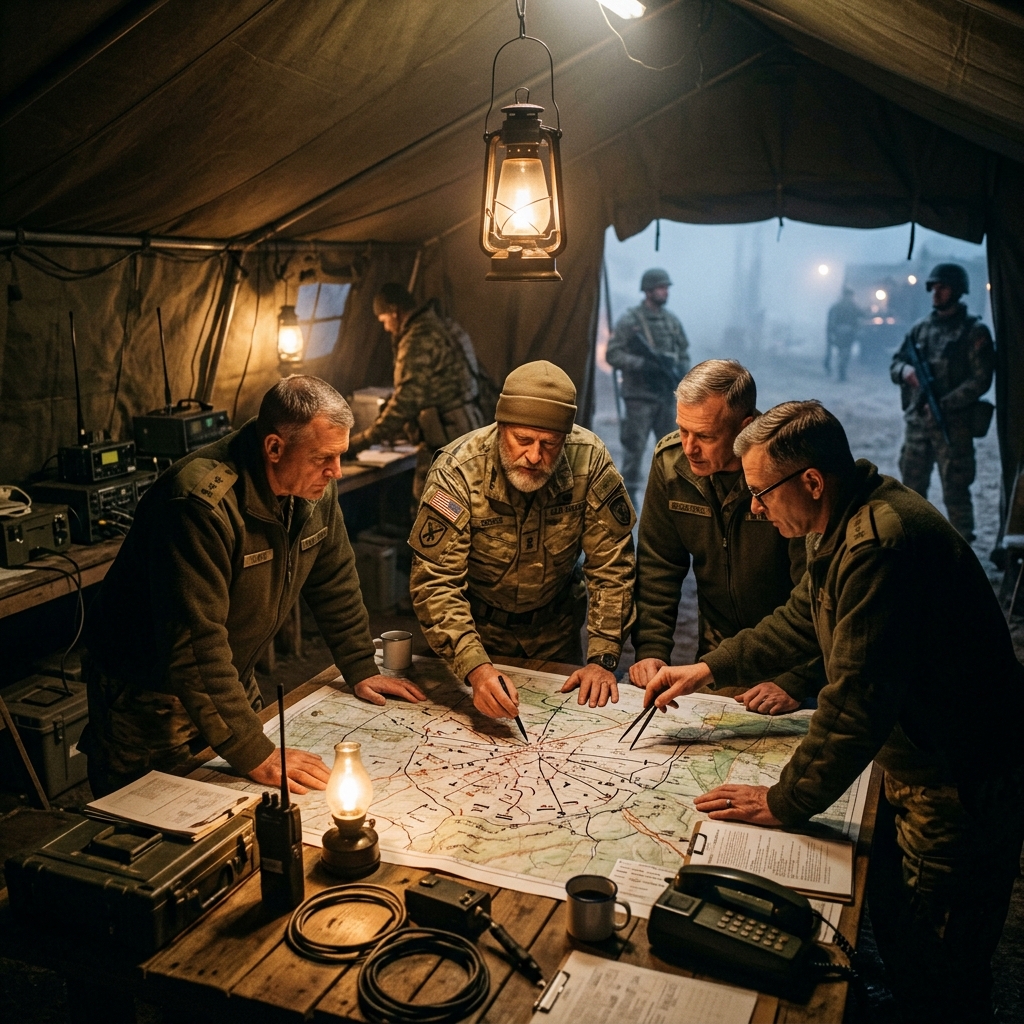
This stands in sharp contrast to Detailed Command (sometimes called Befehlstaktik), where senior leaders prescribe specific actions, timings, routes, and methods. In a detailed command structure, a battalion commander might be told exactly which road to use, which hill to seize first, and what time to begin. In Mission Command, that same officer would be told: “Prevent the enemy from reinforcing the eastern sector before dawn. I need that corridor denied. You decide how.”
The difference is not just procedural. It is philosophical. It reflects a fundamentally different belief about where intelligence, judgment, and competence reside in an organization.
Historical Roots: From Auftragstaktik to Modern Doctrine
Mission Command did not appear overnight. It was forged through catastrophic defeat and institutional soul-searching.
The Prussian Crucible
The story begins in 1806, when Napoleon’s armies annihilated the Prussian military at the twin battles of Jena and Auerstedt. The Prussians renowned for their discipline and rigid command hierarchies were routed in a single day. Their officers, trained to wait for orders from above, froze when communications broke down. Units stood idle while the battle swirled around them.
The defeat was so total that it triggered a complete reimagining of Prussian military philosophy. Reformers like Gerhard von Scharnhorst, August von Gneisenau, and later Helmuth von Moltke the Elder rebuilt the Prussian army around a radical idea: subordinate commanders must be trained, trusted, and empowered to act on their own judgment when circumstances demanded it.
Moltke codified this as Auftragstaktik — literally, “mission-type tactics.” His famous dictum captures its essence:
“No plan of operations extends with any certainty beyond the first contact with the main hostile force.”
If no plan survives first contact, then the organization must be designed so that the people at the point of contact are capable of making sound decisions without waiting for permission.
World War II: Proof of Concept
The German Wehrmacht’s devastating early successes in World War II particularly the Blitzkrieg campaigns in Poland, France, and the early Eastern Front were built on Auftragstaktik. Junior officers and NCOs routinely made battlefield decisions that would have required a general’s approval in other armies. When a panzer column found an unexpected gap in the enemy line, the lieutenant on the spot didn’t radio division headquarters for permission to exploit it. He drove through it.
Meanwhile, the Soviet Red Army in 1941 still recovering from Stalin’s purges of its officer corps operated under suffocating centralized control. Units that could see the enemy could not fire without authorization from commanders who could not see the battlefield. The results were catastrophic.
By war’s end, the Soviets had learned. The Red Army of 1944–45 practiced a form of decentralized tactics that would have been unrecognizable to the army of 1941.
The NATO Adoption
After World War II, the Western allies particularly the United States and United Kingdom studied German operational methods extensively. By the 1980s, the U.S. Army formally adopted Mission Command as its command philosophy, embedding it in doctrine through the AirLand Battle concept and successive field manuals. Today, it is the foundational command philosophy of NATO.

The Six Principles of Mission Command
The U.S. Army identifies six core principles that underpin Mission Command. Each is essential. Remove any one and the system collapses.
1. Build Cohesive Teams Through Mutual Trust
Trust is the non-negotiable foundation. A commander must trust subordinates to make sound decisions. Subordinates must trust that they will be supported not punished for exercising initiative. This trust is not assumed; it is built through shared training, shared hardship, and a track record of honest communication.
Key insight: Trust is not a feeling. It is a structural requirement. Organizations that do not invest in building trust cannot practice Mission Command no matter what their doctrine says.
2. Create Shared Understanding
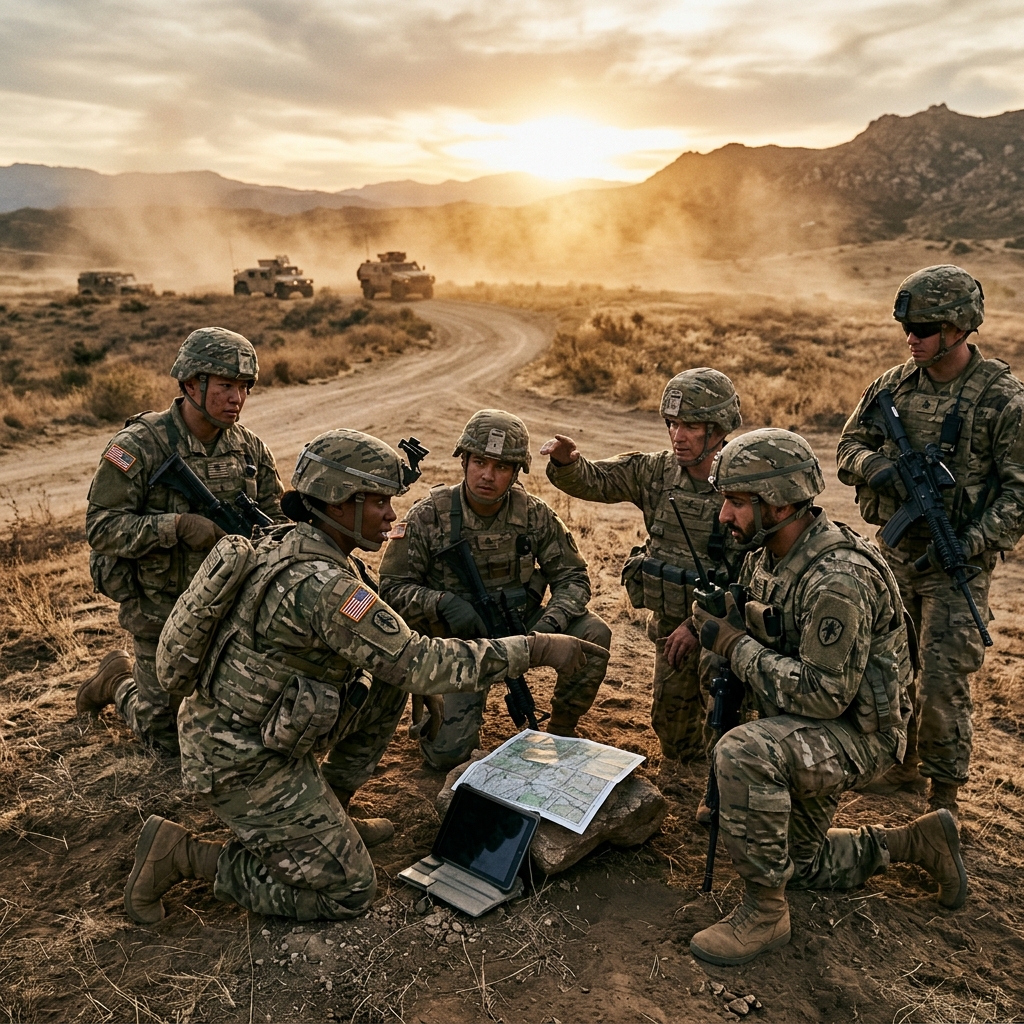
Before anyone can act independently toward a common goal, everyone must understand the situation, the commander’s intent, and their role within the larger operation. This requires thorough briefings, war-gaming, rehearsals, and critically the opportunity for subordinates to ask questions and push back.
3. Provide a Clear Commander’s Intent
The commander’s intent is the single most important communication in Mission Command. It describes the desired end state, the purpose of the operation, and the key tasks that must be accomplished. It does not prescribe methods. A well-crafted intent allows any subordinate, even if cut off from communication, to make decisions aligned with the commander’s goals.
A good commander’s intent answers three questions:
- What is the purpose? (Why are we doing this?)
- What is the end state? (What does success look like?)
- What are the key tasks? (What absolutely must happen?)
4. Exercise Disciplined Initiative
This is the hardest principle for most organizations to internalize. Subordinates are expected to required to act when they see an opportunity or a threat, even without orders. “Disciplined” means the initiative must be aligned with the commander’s intent. It is not freelancing; it is informed, purposeful action taken by a prepared leader who understands the bigger picture.
5. Use Mission Orders
Mission orders are a specific format for conveying tasks. They emphasize what to achieve, not how to achieve it. They specify the minimum necessary coordination and leave maximum freedom for subordinates to adapt to local conditions.
6. Accept Prudent Risk
Mission Command requires leaders at all levels to accept that subordinates will sometimes make imperfect decisions and that this is acceptable. The alternative paralysis while waiting for perfect information or higher approval is far more dangerous than a well-intentioned mistake by a prepared leader.
Why Centralized Command Fails Under Pressure
The case for decentralization is not merely theoretical. Centralized command structures exhibit predictable, recurring failure modes in complex and contested environments:
Information Bottleneck. In a centralized system, information must travel up the chain before decisions travel back down. In a fast-moving situation, this creates lethal delays. By the time a decision reaches the front line, the situation that prompted the request may have changed completely.
Single Point of Failure. If the central decision-maker is killed, captured, incapacitated, or simply overwhelmed, the entire system seizes. There is no graceful degradation — only catastrophic failure.
Decision Fatigue. A single senior leader cannot process the volume and velocity of decisions that a modern operation demands. Cognitive overload leads to poor choices, delayed responses, and eventually, shutdown.
Initiative Suppression. When subordinates learn that independent action is punished or discouraged, they stop taking it. They wait for orders. They defer upward. The organization loses the distributed intelligence of every leader and soldier in the formation.
Brittleness. Centralized systems are optimized for predicted scenarios. When the unexpected happens — and it always does — they shatter. Decentralized systems bend. They adapt. The human being on the spot improvises, and the organization absorbs the shock.
Case Studies: Decentralized Leadership in Action
D-Day: Normandy, 1944
The Allied invasion of Normandy on June 6, 1944, is one of history’s most powerful demonstrations of Mission Command under extreme duress.
The plan was meticulous. The reality was chaos. Airborne units were scattered across miles of hedgerow country, landing far from their objectives. On Omaha Beach, the first wave was nearly annihilated, and the elaborate timetable disintegrated in minutes.
What saved the invasion was not the plan. It was the quality of junior leaders who understood the intent get off the beach, get inland, link up, secure the beachhead and improvised relentlessly to achieve it.
Brigadier General Norman “Dutch” Cota, arriving on Omaha Beach amid carnage, famously rallied frozen soldiers with a simple declaration of intent: “Gentlemen, we are being killed on the beaches. Let us go inland and be killed.” He did not issue a detailed order. He clarified the purpose, and men followed.
Small groups of soldiers and NCOs, completely cut off from their chain of command, self-organized, found gaps in the German defenses, and began moving inland. They did this not because someone told them which gap to exploit, but because they understood the mission, and they had been trained to act.
Lesson: When your plan dies on contact with reality, the only thing that survives is the clarity of your intent and the competence of your people.
Operation Desert Storm, 1991
The 1991 Gulf War showcased Mission Command at the operational level. General H. Norman Schwarzkopf and his corps commanders issued clear intent to eject Iraqi forces from Kuwait through a massive flanking maneuver and allowed division and brigade commanders extraordinary latitude in execution.
The famous “left hook” through the Iraqi desert was executed by armored divisions moving at speed over vast distances, making tactical decisions in real time without waiting for approval from theater headquarters. When VII Corps commander General Fred Franks moved more cautiously than Schwarzkopf wanted, it was a friction point but the system still delivered one of the most lopsided victories in military history. The ground war lasted 100 hours.
By contrast, the Iraqi army operated under Saddam Hussein’s highly centralized command system. Division commanders could not reposition without Baghdad’s approval. When coalition forces struck with speed and unpredictability, Iraqi units were unable to get orders from above so they simply could not respond.
Lesson: Speed kills but only if your organization can make decisions at the speed of the battle, not at the speed of the bureaucracy.
The Ukraine Conflict, 2022–Present
The Russian invasion of Ukraine in February 2022 offered a stark, modern contrast between centralized and decentralized approaches.
The Russian military’s initial assault was characterized by extreme centralization. Senior officers reportedly made tactical decisions that should have been handled by captains and sergeants. When generals moved forward to force action, they were killed in remarkable numbers at least a dozen general officers in the first year because they were operating at the front doing work that junior leaders should have owned.
The Ukrainian military, trained for years by NATO advisors in Mission Command principles, demonstrated the opposite. Small-unit leaders made rapid tactical decisions ambushing convoys, repositioning artillery, exploiting social media for intelligence without waiting for orders from Kyiv. The results were devastating to the Russian advance.Ukrainian forces also adopted asymmetric warefare to inflict heavy loses on russian side.You can also read more about asymmetric warefare in our other article.
Ukraine’s success in the early weeks was not primarily about technology or terrain. It was about a command philosophy that treated every sergeant as a decision-maker and every platoon as a semi-autonomous element capable of independent action in pursuit of a shared objective.
Lesson: In the age of transparent battlefields and precision weapons, the side that distributes decision-making authority to the edge will consistently outperform the side that hoards it at the top.
Mission Command Beyond the Battlefield
The principles of Mission Command are not confined to military operations. They describe a universal truth about how complex organizations function under pressure and uncertainty.
Technology and Startups
Companies like Amazon, Netflix, and Spotify have explicitly adopted Mission Command-inspired organizational models. Amazon’s “two-pizza teams” operate with remarkable autonomy, aligned by clear leadership principles and customer-obsession (the “commander’s intent” of the company). Netflix’s culture memo “highly aligned, loosely coupled” is Mission Command in corporate language.
Healthcare
Emergency departments and trauma teams function on Mission Command principles daily. The lead physician sets the intent (stabilize the patient), and nurses, technicians, and specialists execute with disciplined initiative based on their training and the situation in front of them. There is no time to seek approval for every action.
Open Source Software
The open-source movement is, structurally, a massive exercise in Mission Command. A project maintainer sets the vision and standards (intent). Contributors around the world, unknown to each other, independently write code, fix bugs, and build features aligned by shared purpose, coordinated by shared standards, and empowered to act without permission.
Crisis Response
Every effective disaster response from wildfire fighting to pandemic management relies on distributed decision-making. The incident commander sets objectives. Teams in the field adapt to conditions on the ground. Organizations that try to centrally manage every aspect of a crisis response invariably fail.
Twelve Lessons We Learn from Mission Command
These are the transferable principles that any leader in a boardroom, a classroom, a startup, or a squad can take from two centuries of Mission Command doctrine and practice.
Lesson 1: Intent Is Everything
The most important thing a leader does is communicate why and what — not how. If your people understand the purpose and the desired end state, they can navigate any amount of chaos. If they only know the procedure, they are helpless the moment the procedure breaks.
Apply it: Before delegating any task, ask yourself: Does this person understand why this matters and what success looks like? If not, you haven’t led yet.
Lesson 2: Trust Is Not Optional – It Is Infrastructure
Mission Command is impossible without trust, and trust is impossible without investment. You cannot flip a switch and have a high-trust organization. It requires consistent behavior over time: keeping promises, supporting people who take reasonable risks, admitting mistakes, and sharing information openly.
Apply it: Audit your organization for trust. Where are people afraid to act? Where do they wait for permission they shouldn’t need? Those are your trust deficits.
Lesson 3: Competence Must Be Distributed
Decentralization without competence is just chaos. Mission Command works because the Prussians and every military since invested enormously in training subordinate leaders to think, not just to obey. Every NCO in a Mission Command army is trained to do the job one and two levels above their own.
Apply it: Your front-line people need to understand the strategic context of their work, not just the mechanics of their tasks.
Lesson 4: Plans Are Hypotheses, Not Scripts
Moltke’s insight “no plan survives first contact” is not a counsel of despair. It is a design principle. Build plans that are robust to disruption, not plans that require everything to go right.
Apply it: When planning, ask: What happens when this breaks? If the answer is “we stop,” your plan is too rigid.
Lesson 5: Speed of Decision Beats Quality of Decision
A good decision now almost always beats a perfect decision later. In competitive environments military, business, or otherwise the ability to observe, orient, decide, and act faster than your opponent (Boyd’s OODA Loop) is often the decisive advantage.
Apply it: Push decision-making authority to the lowest level where sufficient information exists. Reduce approval chains. Accept imperfection in exchange for speed.
Lesson 6: Centralized Control Is a Fragility
Every authority you centralize is a single point of failure you create. If one person must approve every expenditure, initiative stops when that person is in a meeting. If one system must process every transaction, the organization halts when that system goes down.
Apply it: Identify the decisions that are currently centralized in your organization. For each one, ask: What would happen if this person were unavailable for 48 hours? If the answer is “nothing moves,” you have a structural vulnerability.
Lesson 7: Culture Eats Doctrine for Breakfast
You can write Mission Command into every manual and policy document. If your culture punishes initiative, rewards compliance, and promotes people who never take risks, your doctrine is fiction. The Soviets had excellent tactical doctrine by 1944. What changed was the culture — commanders were finally permitted to use their judgment.
Apply it: Watch what gets rewarded and punished in your organization. That — not your values statement — is your actual culture.
Lesson 8: Communication Must Flow in All Directions
Mission Command is not just top-down. Subordinates must communicate upward reporting their situation, their decisions, and their reasoning so that senior leaders can adjust the overall plan. And laterally coordinating with peers so that independent actions don’t create fratricide or interference.
Apply it: Create simple, reliable channels for bottom-up and lateral communication. Listen to what comes up those channels. Act on it visibly.
Lesson 9: Accept Prudent Risk, Punish Only Recklessness
People will not exercise initiative if they believe failure will be punished. Mission Command distinguishes between prudent risk (a considered decision that doesn’t work out) and recklessness (action taken without thought or in violation of intent). The first is accepted and even celebrated. The second is corrected.
Apply it: When someone takes initiative and it doesn’t work, your first question should be: “What did you know, and what were you trying to achieve?” not “Who authorized this?”
Lesson 10: Shared Understanding Requires Continuous Investment
Briefings are not one-time events. Shared understanding degrades as situations evolve, people rotate, and new information arrives. Mission Command requires ongoing communication updates, rehearsals, back-briefs, and candid dialogue to keep everyone aligned.
Apply it: Schedule regular alignment sessions. Not status updates alignment sessions where people discuss intent, priorities, and how the situation has changed.
Lesson 11: The Leader’s Job Changes at Scale
In a small team, the leader can directly control most actions. At scale, direct control is impossible. The leader’s job shifts from deciding to enabling: setting intent, building trust, developing subordinate leaders, and creating the conditions for good decisions to happen everywhere.
Apply it: If you find yourself making all the decisions, you are the bottleneck. Your job is to build an organization that makes good decisions without you.
Lesson 12: Decentralization Is a Competitive Advantage
This is the meta-lesson. In any competitive environment characterized by uncertainty, speed, and complexity which is to say, nearly every competitive environment, the organization that distributes decision-making authority will outperform the one that centralizes it. This is not a trend. It is a structural law, demonstrated repeatedly across two centuries of warfare and confirmed by modern organizational research.
Apply it: Make decentralization a strategic priority, not a nice-to-have. Invest in it with the same seriousness you invest in technology, training, or capital.
The Risks and Limits of Decentralization
Intellectual honesty requires acknowledging that Mission Command is not a panacea. It carries real risks:
- Coordination failures. Independent units acting without adequate lateral communication can work at cross-purposes or create gaps. The German army’s Auftragstaktik sometimes produced exactly this problem — aggressive subordinates outrunning their logistics or flanking units.
- Inconsistency. Decentralized decision-making can produce inconsistent outcomes. What one leader decides in Sector A may contradict what another decides in Sector B.
- Requires high-quality leaders at every level. This is the most significant constraint. Mission Command demands an enormous investment in leader development. Organizations that promote based on seniority rather than competence, or that do not invest in training, cannot decentralize effectively.
- Not suitable for all situations. Some operations — nuclear weapons release authority, rules of engagement in sensitive political contexts, safety-critical industrial processes — require centralized control by design. The key is to centralize only what must be centralized and decentralize everything else.
- Cultural prerequisites. Mission Command is difficult to implement in cultures — national or organizational — that have strong hierarchical traditions, low tolerance for ambiguity, or a blame-oriented response to failure.
The answer to these risks is not to abandon decentralization. It is to invest more heavily in the enablers trust, training, communication, and shared understanding that make it work.
Conclusion: Trust as a Weapon System
The history of Mission Command teaches a deceptively simple lesson: the organization that trusts its people will defeat the organization that controls its people.
This is not sentimentality. It is not a motivational poster. It is a structural reality confirmed by two centuries of the most rigorous testing environment humans have devised: the battlefield, where bad ideas are punished with death.
The Prussians learned it after the humiliation of 1806. The Israelis practiced it in 1967. The Americans used it in 1991. The Ukrainians demonstrated it in 2022. And in every case, their opponents — the armies that centralized control, that distrusted subordinates, that demanded permission before action — were defeated.
The lesson extends far beyond war. Every organization operates in a fog of uncertainty. Every leader faces situations where the plan fails, communications break, and the people at the point of action know more about the situation than the people at the top. The question is: have you built an organization where those people are equipped and empowered to act?
Mission Command answers that question with a philosophy that is equal parts humbling and liberating. It asks leaders to give up the illusion of control. It asks subordinates to accept the burden of initiative. It asks everyone to invest in the trust, competence, and shared understanding that make decentralized action possible.
The battles of the future — whether fought in deserts, boardrooms, operating rooms, or codebases — will be won by the organizations that take these lessons seriously.
This article draws on U.S. Army doctrine (ADP 6-0), historical analysis of Prussian military reform, and contemporary operational studies. For further reading, see:
- ADP 6-0: Mission Command: Command and Control of Army Forces (U.S. Army, 2019)
- The Art of Action by Stephen Bungay
- Team of Teams by General Stanley McChrystal
- Certain to Win by Chet Richards
- Boyd: The Fighter Pilot Who Changed the Art of War by Robert Coram
Related Reading: