By Strategic Affairs Desk · May 31, 2026 · 15 min read
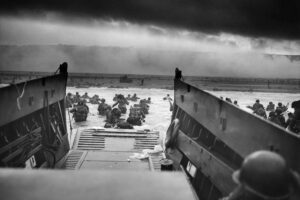
In the damp, subterranean basement of Pearl Harbor’s Administration Building, a group of eccentric cryptanalysts, wearing slippers and bathrobes, changed the course of the Second World War. Six months after the devastation of December 7, 1941, the United States Navy faced a catastrophe: an overwhelming Imperial Japanese Navy fleet was steaming toward the strategic outpost of Midway Atoll to finish what they had started. What followed was not merely a clash of steel and fire, but a triumph of intelligence, military deception, and raw tactical audacity that permanently pivoted the balance of power in the Pacific.
Introduction: The Shadow of Imperial Dominance
By the spring of 1942, the Empire of Japan’s expansion across the Pacific appeared unstoppable. From the naval bases of Truk and the shipyards of Kure, Japanese fleets had swept across the Philippines, the Dutch East Indies, Malaya, and Singapore. The United States Asiatic Fleet had been practically destroyed, and the British Royal Navy had been driven out of the Indian Ocean.
The strategic doctrine of the Imperial Japanese Navy (IJN), orchestrated by Admiral Isoroku Yamamoto, was centered on the concept of the Kantai Kessen — the “Decisive Battle.” Yamamoto believed that the US Pacific Fleet, though wounded at Pearl Harbor, remained a mortal threat so long as its aircraft carriers remained afloat. To force these carriers into a final, fatal engagement, Yamamoto designed a massive, multi-pronged offensive targeting Midway Atoll, a tiny pair of islands situated 1,300 miles northwest of Oahu.
If Japan captured Midway, they would establish an unsinkable airbase at Hawaii’s doorstep, force the evacuation of the US Navy from Pearl Harbor back to the West Coast, and potentially compel the United States to negotiate for peace.
For the United States, the situation was desperate. Admiral Chester W. Nimitz, Commander in Chief of the Pacific Fleet, possessed only three operational carriers the Enterprise, the Hornet, and the hastily patched-up Yorktown to face a Japanese armada of four frontline fleet carriers, eleven battleships, and hundreds of supporting warships. To survive, Nimitz could not afford to fight a conventional campaign of attrition. He needed to know exactly when, where, and in what strength the enemy would strike.
I. The Silent Weapon: Station HYPO and the Art of Cryptanalysis
The primary weapon that leveled the playing field at Midway was not forged in an armor foundry or a munitions factory. It was constructed of paper, index cards, and vacuum tubes in a windowless basement in Hawaii known as “The Dungeon.”
This was Station HYPO, the Combat Intelligence Unit at Pearl Harbor, commanded by Commander Joseph J. Rochefort. An atypical officer who frequently worked in a red smoking jacket and felt slippers, Rochefort assembled a brilliant, eclectic team of cryptanalysts, linguists, and mathematicians. Among them were jazz musicians, chess masters, and classicists minds suited to finding patterns in chaos.
Deciphering the JN-25 Code
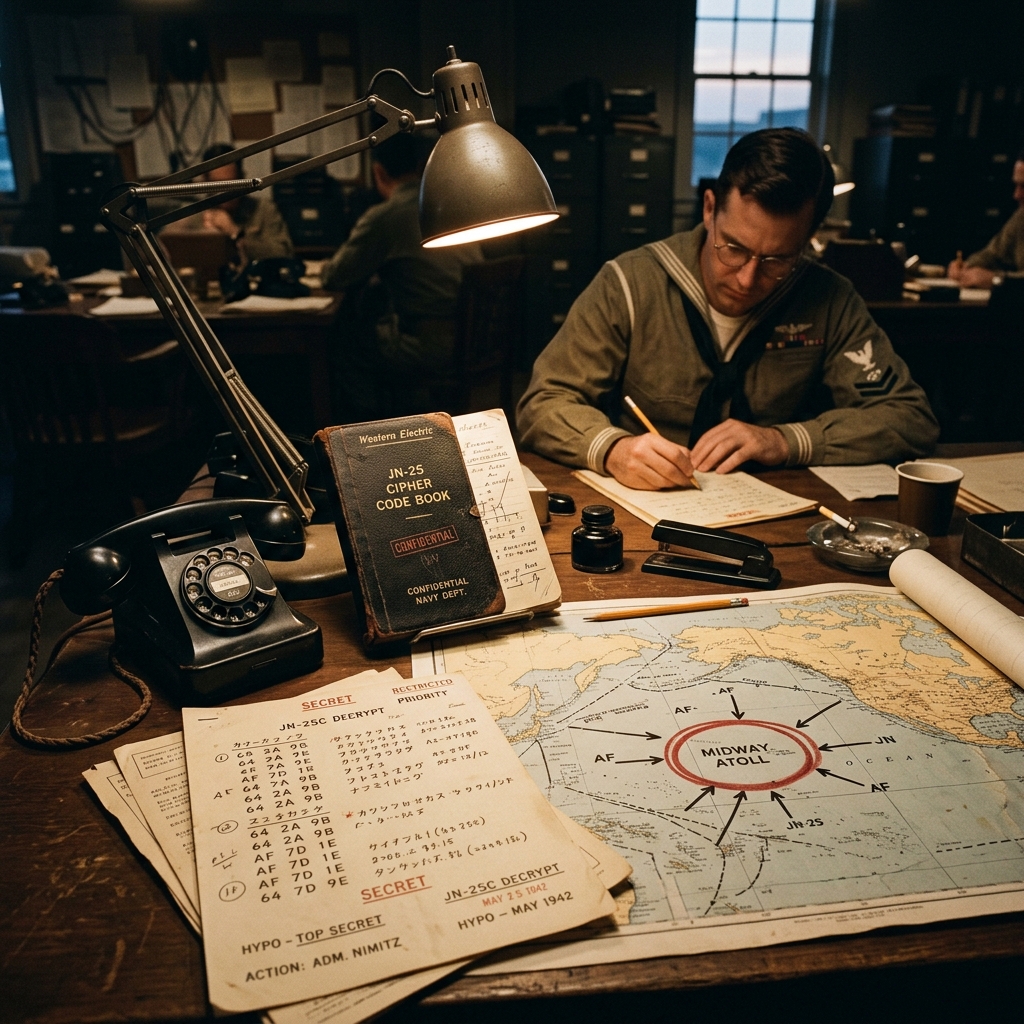
The target of Station HYPO’s efforts was the Japanese Navy’s primary operational code, designated by the US Navy as JN-25. Specifically, the Japanese were using the variant JN-25b, a super-enciphered system consisting of approximately 45,000 five-digit code groups, which were then modified by a secondary table of random additive numbers.
Decryption was a grueling, manual process:
- Interception: Listening posts throughout the Pacific intercepted raw Japanese radio transmissions.
- Subtraction: Cryptanalysts stripped away the additive encipherment using mathematical tables.
- Translation: Analysts matched the resulting code numbers against a dictionary of Japanese naval terms.
- Collation: Index card databases tracked the recurring usage of specific codes to deduce their meanings.
By early May 1942, Rochefort’s team was decrypting up to 10 to 15 percent of the traffic within JN-25 transmissions. While it was a fractional decryption, it was enough to reveal that a massive operation was in the offing. The intercepted messages referenced a grand offensive, but the exact target remained masked behind a two-letter geographic designator: AF.
II. The Deception Plan: Confirming Target ‘AF’
While Rochefort was convinced that “AF” stood for Midway, Washington’s naval intelligence unit, OP-20-G, disagreed. Officers in the capital argued that the Japanese fleet was destined for the South Pacific, perhaps targeting Port Moresby or even the coast of Alaska.
To resolve the dispute and secure permission from Admiral Nimitz to position the Pacific Fleet’s scarce carriers for an ambush, Rochefort needed absolute confirmation. He conceived a simple but elegant deception plan, executing a classic ruse of passive intelligence verification.
The Freshwater Condenser Ruse
In mid-May, Rochefort contacted the military commander at Midway Atoll via a secure underwater telegraph cable, which could not be intercepted by the Japanese. He instructed the garrison to broadcast a message in the clear unencrypted radio reporting that Midway’s freshwater distillation plant had suffered a major casualty, leaving the island short of fresh water.
The trap was sprung. As Rochefort anticipated, Japanese monitoring stations intercepted the transmission.
Two days later, Station HYPO intercepted a JN-25 message sent by a Japanese intelligence unit. The message reported that “AF is short of fresh water.”
The deception was a total success:
- It mathematically confirmed that “AF” was Midway.
- It convinced Nimitz to reject Washington’s alternate theories.
- It allowed the US Navy to plan an ambush rather than a blind defense.
Armed with this intelligence, Rochefort’s team went further, deciphering the Japanese order of battle, the date of the attack (scheduled for June 3 or 4), and the direction from which the Japanese carriers would approach. Armed with these details, Admiral Nimitz began moving his forces into position.
III. The Fleet in Motion: Yamamoto’s Grand Design vs. Nimitz’s Ambush
Admiral Isoroku Yamamoto’s plan for the Battle of Midway was a complex masterpiece of classical naval doctrine, but it suffered from a fatal flaw: it assumed the Americans were blind.
Yamamoto split his massive force into several distinct groups:
- The Northern Force: A diversionary strike force sent to bomb and occupy Dutch Harbor in the Aleutian Islands, designed to draw the American fleet north.
- The Mobile Force (Kido Butai): Composed of the four elite carriers Akagi, Kaga, Soryu, and Hiryu under Vice Admiral Chuichi Nagumo, tasked with suppressing Midway’s air defenses and destroying any American ships that intervened.
- The Main Body: Led by Yamamoto himself aboard the super-battleship Yamato, positioned hundreds of miles behind the carriers to clean up the remnants of the American fleet in a decisive gun duel.
Yamamoto’s strategy was highly sequential. He believed that the American carriers, demoralized and disorganized, would not sail from Pearl Harbor until after Midway was attacked.
Nimitz’s Counter-Deployment
Because Nimitz possessed the Japanese playbook, he bypassed the Aleutian diversion entirely. He concentrated his forces northeast of Midway at a point designated “Point Luck,” roughly 325 miles from the atoll.
Nimitz’s tactical deployment was spearheaded by two Task Forces:
- Task Force 16: Composed of the carriers Enterprise and Hornet, commanded by Rear Admiral Raymond A. Spruance (who replaced the ill William “Bull” Halsey).
- Task Force 17: Centered on the carrier Yorktown, commanded by Rear Admiral Frank Jack Fletcher.
The inclusion of the Yorktown was itself a feat of industrial mobilization. Severely damaged during the Battle of the Coral Sea in May, the carrier had been estimated to require three months of repairs at Bremerton. Nimitz ordered the Pearl Harbor Navy Yard to repair the ship in 72 hours. Work crews swarmed the hull, patching steel plate and rewiring electronics even as the ship sailed back to sea.
By June 2, the three American carriers were in position at Point Luck, waiting in ambush for a Japanese fleet that believed they were hundreds of miles away in port.
IV. The Climax in the Clouds: Five Minutes That Changed the Pacific
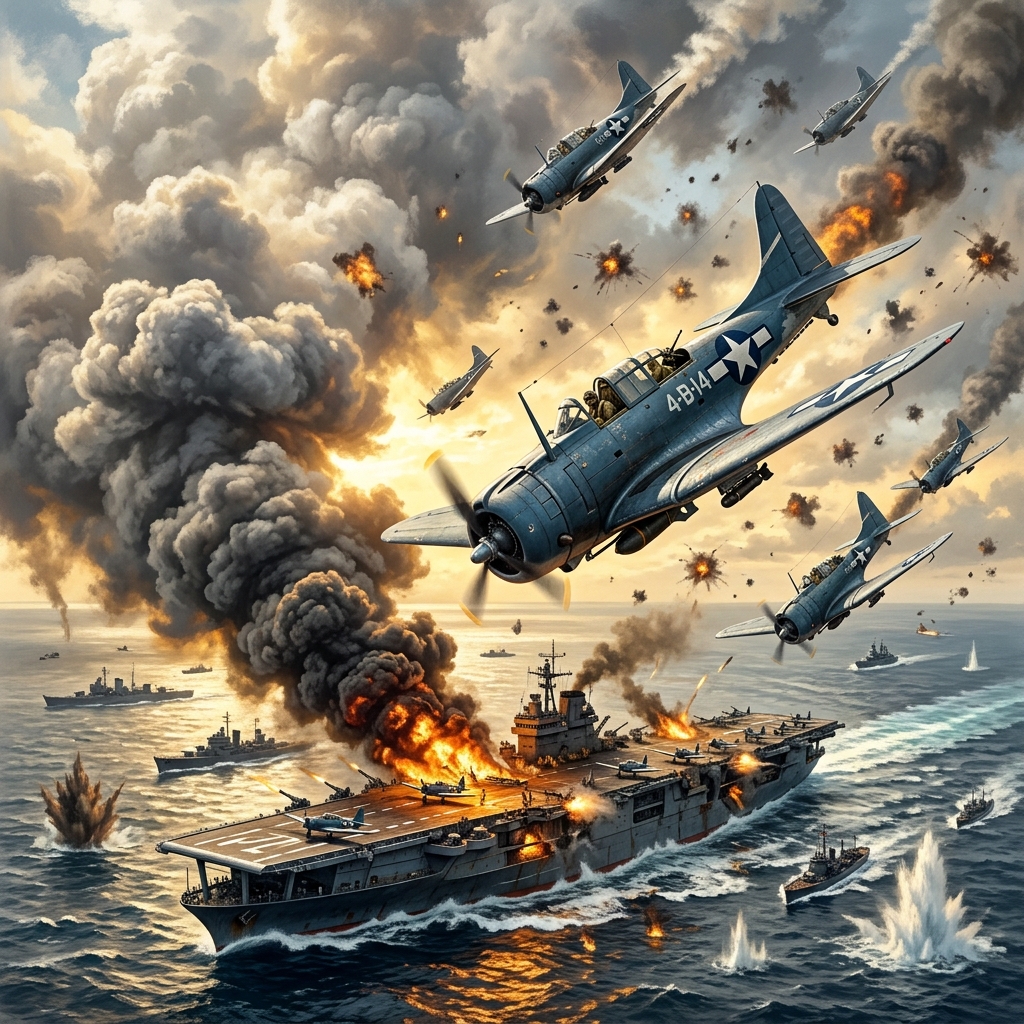
The morning of June 4, 1942, began with a massive Japanese air strike on Midway Atoll. D7Y “Kate” torpedo bombers and A6M “Zero” fighters pounded the island’s facilities, but Midway’s airfields remained operational. The commander of the Japanese strike force, Lieutenant Joichi Tomonaga, radioed Nagumo: “There is need for a second strike.”
This message triggered a series of fateful decisions aboard the Japanese flagship Akagi.
The Re-Arming Dilemma
Vice Admiral Nagumo faced a complex tactical dilemma. He had kept half of his aircraft reserved, armed with torpedoes, in case American ships were suddenly sighted. Now, believing no American ships were in the area, he ordered these aircraft down to the hangar decks to replace their torpedoes with land-contact bombs for a second strike on Midway.
Midway through this 30-minute process, a Japanese scout plane from the cruiser Tone spotted American ships to the northeast. Shortly after, the scout confirmed the presence of at least one American carrier.
Nagumo was caught in a tactical vice:
- If he launched immediately, his bombers would attack with a mix of inappropriate weapons and without fighter escort.
- If he waited, he had to land the returning planes from the first Midway strike, clear his decks, and reload the torpedoes.
Nagumo chose to wait. For the next hour, the hangar decks of the Akagi, Kaga, and Soryu were scenes of chaotic activity. Crewmen frantically swapped bombs for torpedoes, stacking the removed high-explosive land bombs along the hangar walls rather than returning them to the secure magazines to save time. Aviation fuel hoses snaked across the decks.
The Sacrificial Attack of the Torpedo Bombers
Meanwhile, Admiral Fletcher had ordered the American carriers to launch everything they had. The initial waves of American aircraft, however, were uncoordinated.
Between 7:00 AM and 9:30 AM, US torpedo squadrons (VT-8 from Hornet, VT-6 from Enterprise, and VT-3 from Yorktown) found the Japanese fleet. Flying low-performance TBD Devastator torpedo bombers, they attacked without fighter escort.
The result was a tragedy. The Japanese combat air patrol (CAP) of Zero fighters swept down from the skies, while anti-aircraft fire from the screening warships tore the slow-flying bombers to pieces. Out of the 15 Devastators of VT-8, not a single plane returned; only one pilot, Ensign George Gay, survived. In total, the three US torpedo squadrons lost 35 of their 41 aircraft without scoring a single hit on the Japanese carriers.
Yet, their sacrifice was not in vain. The low-level attacks:
- Drew the Japanese Zero fighters down to the water’s surface, leaving the upper altitudes unguarded.
- Prevented the Japanese carriers from launching their own counter-strike.
- Exhausted the Zero pilots’ ammunition and fuel.
The Divine Tempest: Wade McClusky’s Flight
At 10:00 AM, the Japanese fleet seemed to have triumphed. Every American attack had been bloodily repulsed. On the flight decks of the Kido Butai, the strike planes were aligned, fueled, and armed, ready to launch the counter-attack that would destroy the American fleet.
At that exact moment, high above the clouds, two squadrons of SBD Dauntless dive bombers from the Enterprise, led by Lieutenant Commander Wade McClusky, were running out of fuel. Having searched the coordinates where they expected the enemy to be and finding empty ocean, McClusky made a critical decision to fly past his point of safe return.
At 10:05 AM, he spotted the wake of the Japanese destroyer Arashi, which was racing to rejoin the main fleet after unsuccessfully depth-charging an American submarine, the Nautilus. McClusky turned his squadron to follow the Arashi.
At 10:20 AM, McClusky looked down through a break in the clouds. Spread out below him, like toys on a blue carpet, lay the three fleet carriers of the Kido Butai: Akagi, Kaga, and Soryu. The sky above them was empty. The Zeros were still at sea level.
Five Minutes of Devastation
At 10:22 AM, the Dauntlesses plunged.
- The Attack on Kaga: McClusky led the majority of the bombers down onto the giant carrier. They scored four direct hits. One bomb struck near the bridge, killing the captain and senior officers; others tore through the flight deck into the hangar, detonating the stacked bombs and fueled aircraft.
- The Attack on Akagi: Lieutenant Richard “Dick” Best led a small group of three bombers to strike the flagship. Best scored a near-miss and a devastating direct hit that penetrated the flight deck, exploding in the upper hangar. The blast ignited the fully fueled “Kate” torpedo bombers, triggering a series of secondary explosions that gutted the ship.
- The Attack on Soryu: Simultaneously, dive bombers from the Yorktown under Lieutenant Commander Max Leslie struck the Soryu. Three direct hits set the hangar deck ablaze, turning the ship into an inferno within minutes.
By 10:27 AM, just five minutes after the first dive began three of the four pride of the Imperial Japanese Navy were burning hulks. The stacked bombs, exposed aviation fuel lines, and parked aircraft had acted as accelerants, turning the carriers into self-destroying furnaces.
V. The Last Stand: The Sinking of the Hiryu and the Yorktown
The sole surviving Japanese carrier, the Hiryu, positioned north of the other three, quickly launched a counter-strike under the command of Rear Admiral Tamon Yamaguchi.
Following the American planes back to their source, Hiryu‘s dive bombers and torpedo planes found the Yorktown. Despite desperate defense by American Wildcat fighters, the Japanese scored three bomb hits and two torpedo hits, disabling the carrier’s engines and causing a severe list.
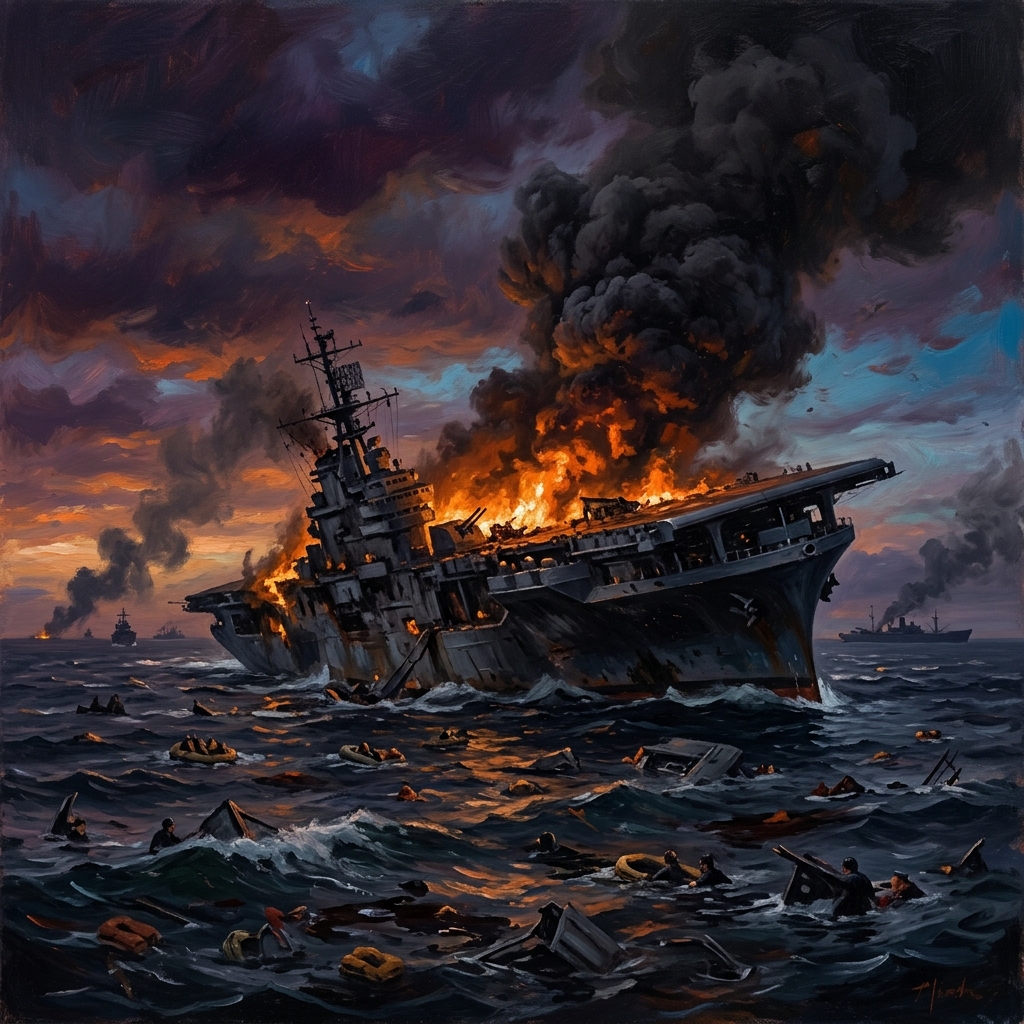
The Yorktown‘s crew, however, performed wonders of damage control, patching the boiler uptakes and extinguishing fires so quickly that when a second wave of Japanese planes arrived, they mistook the repaired ship for an undamaged carrier. They struck the Yorktown again, forcing her abandonment.
But Hiryu‘s triumph was short-lived. At 5:00 PM, a scout plane from the Yorktown spotted her. Dive bombers from the Enterprise and Yorktown (flying from Enterprise‘s deck) descended on the Hiryu, scoring four direct hits on her bow. The explosions blew the forward elevator deck clean into the hangar, setting the ship on fire.
By the morning of June 5, all four of Japan’s frontline carriers had sunk. The Yorktown, listing heavily and under tow, was torpedoed and finally sunk on June 6 by the Japanese submarine I-168, along with the destroyer Hammann.
VI. The Pivot: Strategic Implications and the Collapse of Japanese Expansion
The Battle of Midway was the classic Kantai Kessen that Yamamoto had sought, but it ended in the destruction of his own navy. The strategic pivot it caused altered the trajectory of the global war in several ways:
| Strategic Category | Japanese Status Pre-Midway | Post-Midway Impact |
|---|---|---|
| Carrier Fleet | Dominant (6 fleet carriers, unchallenged air wings) | Devastated (Lost 4 fleet carriers, air groups destroyed) |
| Strategic Posture | Offensive (Expanding toward Hawaii, Australia) | Defensive (Forced into reactive operations in Solomons) |
| Industrial Replacement | Slow (Limited drydock capacity, low training output) | Outpaced (US fleet construction beginning to scale rapidly) |
| Strategic Initiative | Held (Chose when and where to strike) | Lost (Transferred permanently to the Allies) |
The Loss of the Elite Aviators
While the loss of the four carriers was catastrophic, the loss of the aircrews and mechanics was even more damaging. Japan lost approximately 3,000 personnel, including 110 experienced pilots and hundreds of highly trained aircraft maintenance technicians.
Unlike the United States, which had robust pilot training pipelines and rotated experienced aviators back to training commands to pass on their skills, the Japanese navy kept its best pilots on the front line until they were killed. The loss of these veterans at Midway broke the spine of Japanese naval aviation, a deficit from which they never recovered.
Conclusion: The Legacy of a Silent Triumph
The Battle of Midway represents a watershed moment in military history, demonstrating the decisive nature of intelligence over physical force.
When the Japanese fleet sailed for Midway, they possessed superior numbers, better aircraft, and more experienced crews. Yet, they were defeated by a combination of cryptographic persistence, military deception, and tactical flexibility. Wade McClusky’s decision to search beyond his coordinates, Dick Best’s cool-headed targeting of the flagship, and Joseph Rochefort’s sleepless weeks in “The Dungeon” combined to dismantle an empire’s ambition.
Two months after the battle, the United States launched its first offensive of the Pacific War at Guadalcanal. The defensive phase of the conflict was over. The Pacific pivot was complete, proving that the silent battles fought in code rooms can be just as decisive as those fought on the high seas.
The views expressed in this article are those of the editorial team and are intended to foster informed discussion on matters of naval history, intelligence operations, and the strategic pivots of the Second World War.
Related Reading:
- The Cold War’s Forgotten Proxies: Lessons for Managing Modern Conflict — How the division of the post-WWII world shaped the proxy wars of the late 20th century.
- Urban Warfare Doctrine: Lessons from Stalingrad to Mariupol — The evolution of land warfare from the industrial siege to the modern megacity.
- Decentralized Command in High-Intensity Conflict — Analyzing how local initiative at Point Luck altered the course of naval history.