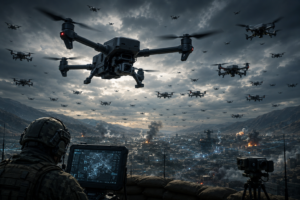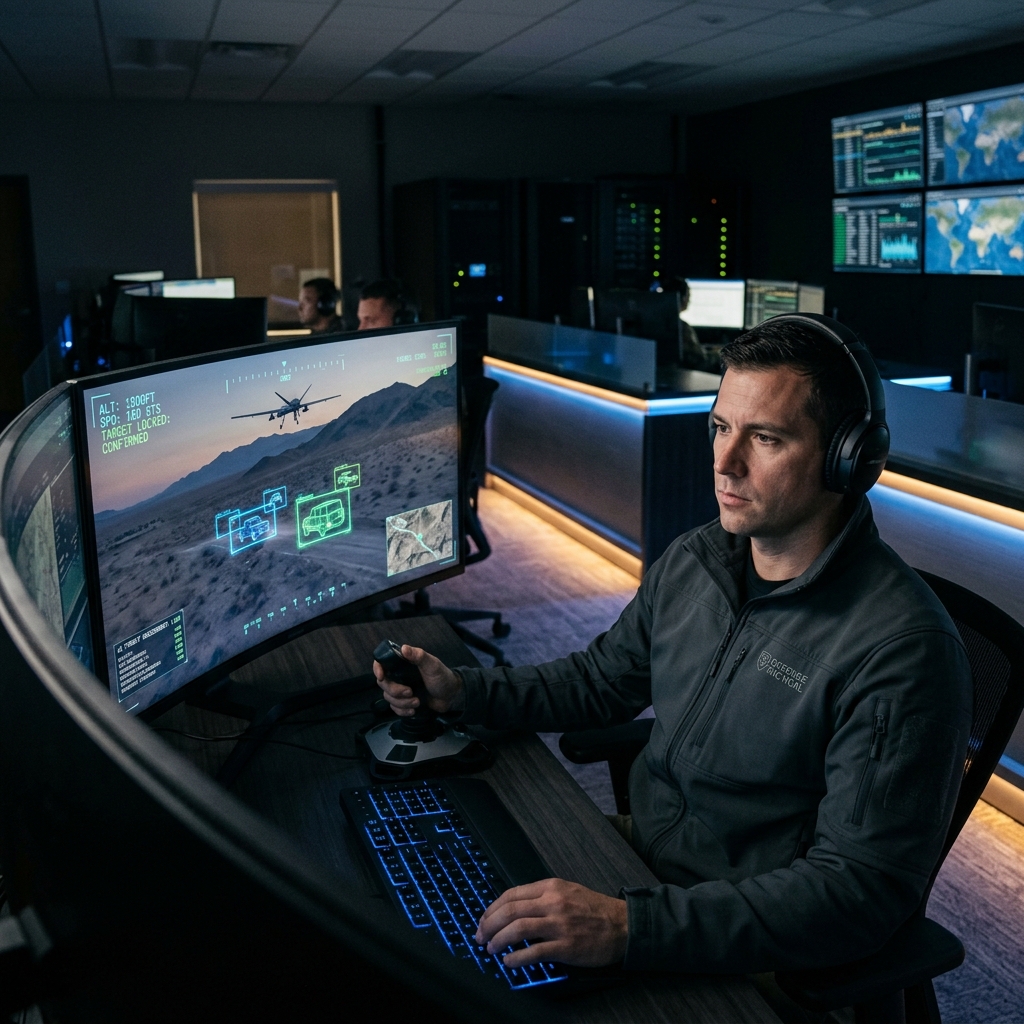
The integration of artificial intelligence into military operations is no longer a theoretical concept confined to the pages of science fiction or the distant future. It is an active, rapidly evolving reality playing out on modern battlefields right now. From the contested skies over Eastern Europe to the vast deserts of the Middle East, global military powers are locked in a quiet but aggressive arms race to integrate algorithmic decision-making directly into their combat systems. At the very center of this technological revolution is a concept known as the “kill chain,” and AI is threatening to completely rewrite the rules of how it operates.
Shrinking the Targeting Cycle
To understand the profound shift taking place, one must first understand what the military kill chain actually is. In tactical terms, it is the sequential process required to execute a successful attack. Military strategists often summarize this using the acronym F2T2EA: Find, Fix, Track, Target, Engage, and Assess. First, an intelligence asset must find a potential target. Then, sensors must fix its location and track its movement. A commander must select the appropriate weapon system to target the asset, execute the engagement, and finally assess the resulting battle damage.
For decades, the defining bottleneck in this entire sequence has been human cognition. A human intelligence analyst had to sit in a darkened room, squinting at hours of grainy drone footage to identify a camouflaged missile launcher. Once found, that analyst had to relay coordinates through a complex chain of command, wait for human commanders to weigh the legal and tactical implications, and finally order a strike. By the time the weapon was fired, the target might have already moved. Artificial intelligence is aggressively stripping away this friction, replacing the slow, deliberate pace of human analysis with the terrifying speed of algorithmic processing.
The Power of Sensor Fusion
The primary tactical advantage that artificial intelligence brings to the modern battlefield is sheer velocity. Today’s combat environments generate an overwhelming, almost incomprehensible amount of data. Drones, satellites, intercepted radio communications, and ground sensors produce terabytes of information every single hour. Human analysts are simply drowning in it.
This is where initiatives like the United States Department of Defense’s Project Maven come into play. By utilizing advanced computer vision and machine learning algorithms, systems can now automatically scan thousands of hours of full-motion video to identify enemy vehicles, personnel, and infrastructure. An algorithm does not experience fatigue; it does not blink. What used to take an entire team of human analysts an exhausting twelve-hour shift to accomplish can now be flagged by an AI targeting system in a matter of seconds.
But the application of AI goes far beyond simply acting as a digital spotting scope. Modern systems excel at “sensor fusion.” They can take a radar blip, a thermal heat signature, and a snippet of intercepted audio, and instantly fuse them into a single, cohesive tactical picture. Even more critically, predictive algorithms can instantly calculate the optimal weapon system required to destroy a target, factor in the trajectory, and analyze the probability of civilian collateral damage. The AI can then present a fully formed, mathematically optimized firing solution to a human commander, reducing the human role from an active analyst to a mere supervisor who simply presses “approve.” By automating the early stages of the kill chain, AI has the potential to reduce the time between finding a target and destroying it from hours down to milliseconds.
Loitering Munitions and Autonomous Hunting
The most visible and immediate manifestation of this algorithmic warfare is the rapid proliferation of loitering munitions, colloquially referred to as “kamikaze drones.” These weapons represent a total blurring of the line between a traditional guided missile and an unmanned aerial vehicle. Unlike a conventional missile that is fired at a specific, known set of coordinates, a modern loitering munition can be launched into a general area without a predetermined target.
Once in the air, the weapon loiters, sometimes for hours, using its onboard optical sensors and AI-driven computer vision to actively hunt. It compares the shapes and thermal signatures of objects on the ground against a vast, pre-loaded database of enemy profiles. It might be programmed to look exclusively for the silhouette of a specific surface-to-air missile radar dish or a particular model of armored personnel carrier. Once the algorithm confirms a match with a high degree of mathematical certainty, it can execute a devastating dive attack. While Western militaries currently insist on keeping a “human in the loop” to authorize the final, lethal plunge, the underlying technology for the weapon to hunt, decide, and kill entirely on its own already exists and has arguably already been deployed in combat zones.
The Ethical Dilemma of Lethal Autonomy
This brings us to the profound and unsettling ethical dilemma at the heart of this technological leap: the reality of Lethal Autonomous Weapons Systems (LAWS). As algorithms take on increasingly greater responsibility within the kill chain, the international community faces deep legal and moral questions about delegating the decision of life and death to a string of code.
Military theorists generally categorize the autonomy of weapon systems into three distinct tiers. The first is “human-in-the-loop,” where the AI acts purely as an advisor, suggesting a target but requiring a human operator to explicitly pull the trigger. The second is “human-on-the-loop,” where the weapon system is capable of selecting and engaging targets automatically, but a human supervisor monitors the process and retains the ability to abort the strike if something goes wrong. The third, and most controversial, is “human-out-of-the-loop.” In this scenario, the artificial intelligence operates completely independently. Once activated, it selects, targets, and destroys without any human oversight or intervention whatsoever.
Critics and human rights advocates argue passionately that “human-out-of-the-loop” systems are inherently unethical. A machine, no matter how advanced its neural network, cannot comprehend the inherent value of human life. It cannot understand context, compassion, or the subtle nuances of human behavior that might indicate surrender. Furthermore, algorithms struggle to reliably apply the complex laws of armed conflict, such as the principles of proportionality and distinction—the ability to tell the difference between an enemy combatant and a civilian holding a similar object.
Beyond the philosophical concerns, there are severe technical vulnerabilities. AI systems are susceptible to “data poisoning,” adversarial hacking, and unpredictable cascading errors when introduced to the chaotic, unstructured environment of a real battlefield. If a fully autonomous weapon system makes a mistake and strikes a civilian center, tracing accountability through a labyrinth of code and sub-contractors becomes a legal nightmare.
The Inevitable Future of Warfare
Despite these profound ethical concerns, the tactical advantages of an accelerated kill chain are simply too immense for global superpowers to ignore. In a high-intensity, peer-to-peer conflict, the victor will inevitably be the side that can process battlefield data, identify threats, and execute strikes faster than the enemy can react. Delaying an engagement to wait for human authorization could mean the difference between winning and losing a war.
While many nations publicly emphasize their commitment to keeping a human hand on the trigger, the relentless pressures of modern combat where survival is measured in fractions of a second will continually push the boundaries of automation. As we move deeper into the 21st century, artificial intelligence in the kill chain will no longer be viewed merely as an advanced tool used by human soldiers. Instead, the algorithm itself will become the defining combatant, forever altering the landscape of human conflict.
Related Reading: