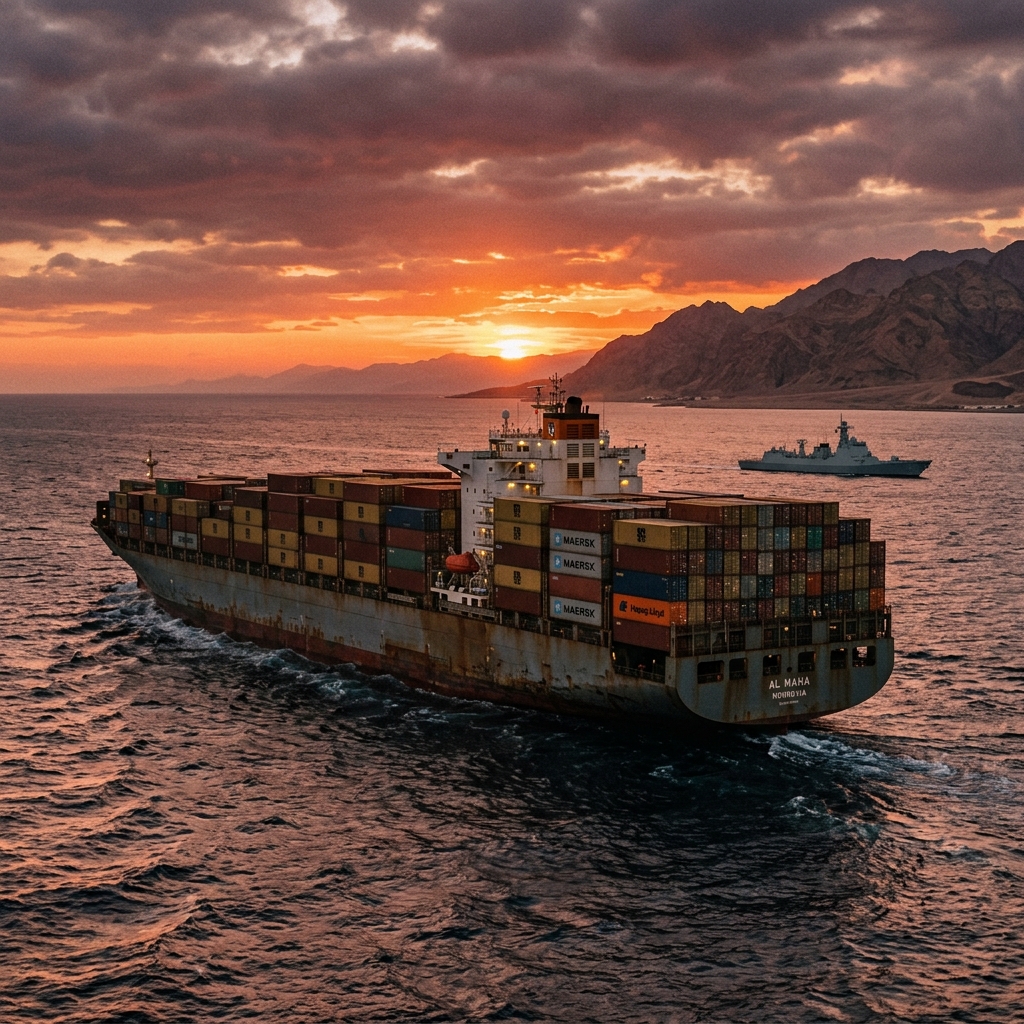
The Red Sea crisis has rapidly escalated from a regional conflict into a major threat to international trade. Since late 2023, frequent and sophisticated Houthis attacks on commercial vessels have severely disrupted one of the world’s most essential maritime trade routes.
What started as a spillover from Middle Eastern conflicts has now forced massive changes in global shipping, causing widespread supply chain disruptions, surging freight rates, and international military intervention.
In this comprehensive analysis, we explore why the Red Sea is so strategically important, how the Houthi rebel offensive operates, the deep economic impact of rerouting global trade, and the ongoing military response to secure these waters.
The Strategic Importance of the Bab el-Mandeb Strait
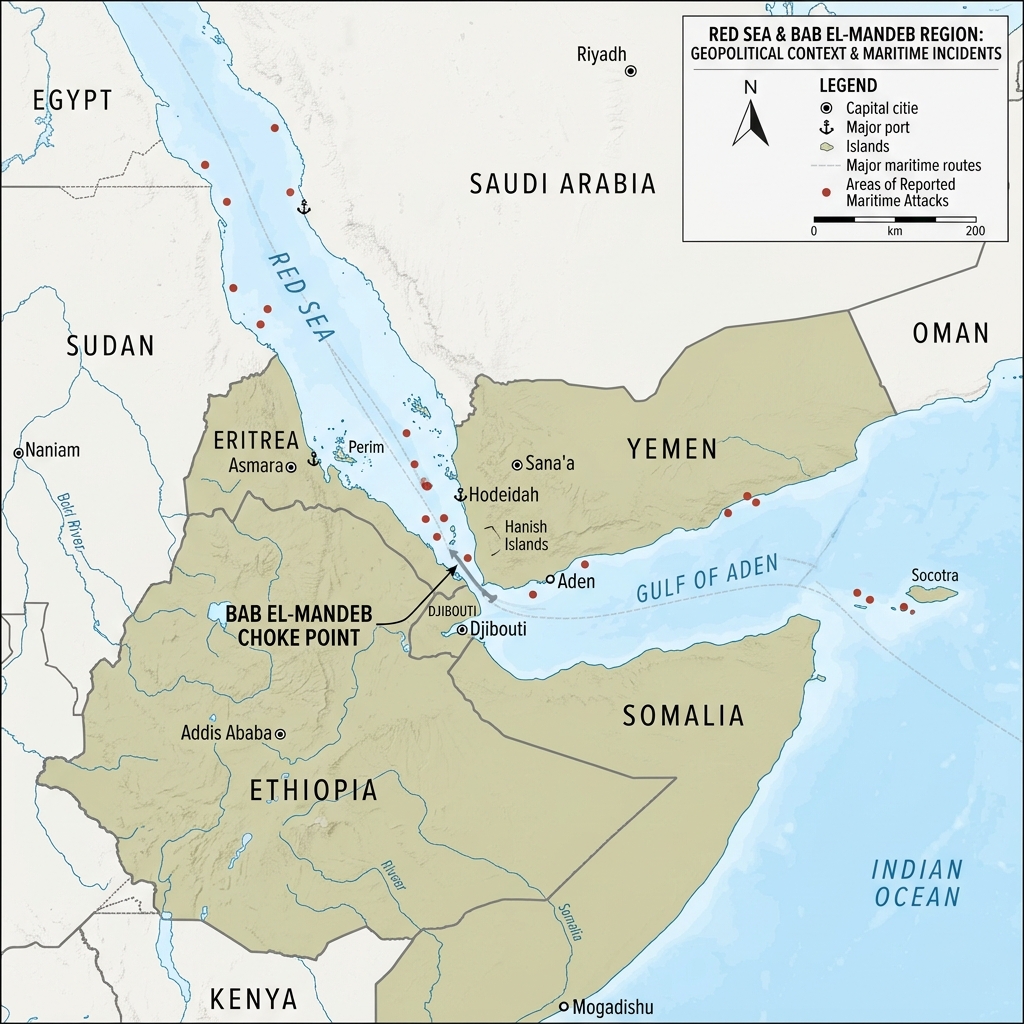
To grasp the full scale of the Red Sea crisis, one must understand the geography of the region. At the southern tip of the Red Sea lies the Bab el-Mandeb Strait (often called the “Gate of Tears”). This narrow, 20-mile-wide waterway separates Yemen on the Arabian Peninsula from Djibouti and Eritrea in the Horn of Africa.
As the gateway to the Suez Canal, the Bab el-Mandeb is a critical global choke point:
- Massive Trade Volume: Historically, 12% to 15% of all global trade passes through this strait.
- Container Traffic: It accounts for nearly 30% of global container shipping.
- Energy Supply: Millions of barrels of oil and liquefied natural gas (LNG) transit this route daily to reach European markets.
When the Bab el-Mandeb Strait is threatened, the fastest maritime route between Europe and Asia is effectively severed.
The Houthi Offensive: Asymmetrical Warfare in the Red Sea
The Houthi movement (Ansar Allah), an Iran-backed rebel group controlling much of western Yemen, launched their maritime campaign in November 2023. While initially targeting ships with alleged ties to Israel, the scope of the Houthi attacks rapidly widened to include vessels connected to the US, the UK, and international shipping lines with no direct involvement in the conflict.
The Houthis have deployed an unprecedented level of military technology for a non-state actor, employing asymmetrical warfare tactics to threaten global shipping:
- Anti-Ship Ballistic Missiles (ASBMs): The Houthis are the first rebel group to successfully use ASBMs in live combat, directly challenging modern naval defense systems.
- Kamikaze Attack Drones (UAVs): Swarms of inexpensive, explosive-laden drones are launched to overwhelm commercial ship defenses.
- Unmanned Surface Vessels (USVs): Remote-controlled explosive boats target the waterlines of massive cargo ships.
- Helicopter Hijackings: In a highly publicized event, Houthi commandos fast-roped onto the Galaxy Leader cargo ship, taking the vessel and crew hostage.
This strategy forces Western navies to use multi-million-dollar interceptor missiles to shoot down relatively cheap drones, creating an unsustainable cost-exchange ratio.
Economic Impact: Rerouting Ships and Supply Chain Disruption
The constant threat of Houthi attacks has forced major ocean carriers—including Maersk, Hapag-Lloyd, and MSC—as well as energy giants like BP, to indefinitely suspend transit through the Red Sea. The only viable alternative is to bypass the Suez Canal entirely and reroute ships around the Cape of Good Hope at the southern tip of Africa.
This monumental shift in global shipping routes has severe economic consequences:
- Extended Transit Times: Sailing around Africa adds 10 to 14 days to a standard voyage between Asian manufacturing hubs and European markets.
- Surging Freight Rates: Longer journeys require vastly more fuel and tie up shipping capacity. Consequently, container freight rates have spiked, reminiscent of pandemic-era supply chain bottlenecks.
- Skyrocketing Insurance Premiums: For the few shipping companies still braving the Red Sea, war risk insurance premiums have surged astronomically, adding hundreds of thousands of dollars to voyage costs.
- Manufacturing Delays: European automotive and tech factories have faced temporary production halts due to delayed component deliveries, highlighting the fragility of “just-in-time” supply chains.
If the disruption in the Red Sea is prolonged, it threatens to reignite global inflation just as central banks attempt to stabilize economies.
Operation Prosperity Guardian: The International Military Response
In response to the escalating crisis, the United States launched Operation Prosperity Guardian in December 2023. This multinational naval coalition operates under the Combined Maritime Forces (CMF) to protect commercial shipping in the Red Sea and Gulf of Aden. The coalition includes naval assets from the UK, France, Italy, Bahrain, and several other nations.
Western naval destroyers and frigates are engaged in daily, high-intensity combat, intercepting incoming Houthi drones and anti-ship missiles using advanced surface-to-air defense systems.
In addition to defensive escorts, US and UK forces have conducted targeted airstrikes against Houthi radar installations, missile launch pads, and weapons depots inside Yemen. However, completely neutralizing the Houthi threat is challenging. Their highly mobile launchers and deep underground bunker networks make them an incredibly resilient adversary.
Long-Term Geopolitical Consequences of the Crisis
The Red Sea crisis is not just a temporary shipping delay; it is an event that is reshaping global geopolitics:
- Vulnerability of Maritime Choke Points: The crisis proves that a well-armed non-state actor can hold a vital artery of the global economy hostage.
- The Limits of Sea Power: Maintaining a permanent, high-intensity naval shield is financially and logistically draining for Western powers.
- Supply Chain “Near-Shoring”: The constant threat of supply chain disruption is accelerating efforts by Western nations to bring manufacturing closer to home (near-shoring or friend-shoring) to reduce reliance on vulnerable sea routes.
- Regional Instability: The attacks complicate diplomatic efforts to end Yemen’s civil war and heighten the risk of a broader regional conflict involving Iran.
Conclusion: A New Era for Global Shipping
The Houthi attacks in the Red Sea have fundamentally altered the risk landscape for global shipping. A route that was once routine is now an active combat zone. While international naval coalitions like Operation Prosperity Guardian provide a critical defensive shield, a permanent military solution remains elusive.
Until a durable political settlement is reached or the rebel group’s capabilities are severely degraded the global economy will be forced to adapt to a divided and far more expensive maritime map. The era of unquestioned freedom of navigation through the world’s most critical maritime choke points has officially ended.
Related Reading:
- The Cold War’s Forgotten Proxies: Lessons for Managing Modern Conflict
- Mission Command: Why Decentralized Leadership Wins Battles
- Asymmetric Warfare: How Small Forces Defeat Larger Armies